
TL;DR:
- Citrus County pool water management requires regular testing and adjustments due to naturally hard groundwater. Maintaining proper chemical levels prevents scaling, corrosion, and chlorine lock, ensuring safe and clear pools. Consistent, proactive maintenance tailored to local water conditions extends pool equipment life and water quality.
Pool water quality in Citrus County is defined by the chemical balance between calcium hardness, chlorine levels, pH, and cyanuric acid. Citrus County homeowners face a specific challenge: local groundwater drawn from limestone aquifers delivers naturally hard water, which pushes calcium hardness toward the upper limits of safe ranges before you add a single chemical. Florida pool water quality standards set clear targets for each parameter, and meeting those targets in this region requires more than a weekly shock treatment. This guide covers the exact numbers, the local water conditions that complicate them, and the maintenance steps that actually keep your pool safe and clear year-round.
What are the ideal chemical levels for Citrus County pools?
Florida pool care standards set specific targets for every major parameter, and Citrus County pools need to stay within those targets consistently. Recommended pool water parameters for Florida include free chlorine at 2–4 ppm for traditional pools and 3–5 ppm for salt systems, pH at 7.2–7.6, and cyanuric acid at 30–50 ppm for standard pools and 60–80 ppm for salt pools. These are not suggestions. Drifting outside these ranges creates real problems, from skin irritation to surface damage to equipment failure.
Calcium hardness carries its own target: 200–400 ppm is the safe range for Florida residential pools. That range matters because Citrus County tap water already arrives with calcium hardness that can approach the upper boundary. You are often starting close to the limit before you account for evaporation, which concentrates minerals further.
Here are the core parameters and their targets for Citrus County homeowners:
- Free chlorine: 2–4 ppm (traditional pools), 3–5 ppm (salt pools)
- pH: 7.2–7.6
- Total alkalinity: 80–120 ppm
- Cyanuric acid (CYA): 30–50 ppm (traditional), 60–80 ppm (salt)
- Calcium hardness: 200–400 ppm
Pro Tip: Test your pool water in the morning before the sun peaks. UV exposure burns off free chlorine quickly, so a midday reading will look lower than your actual overnight baseline.
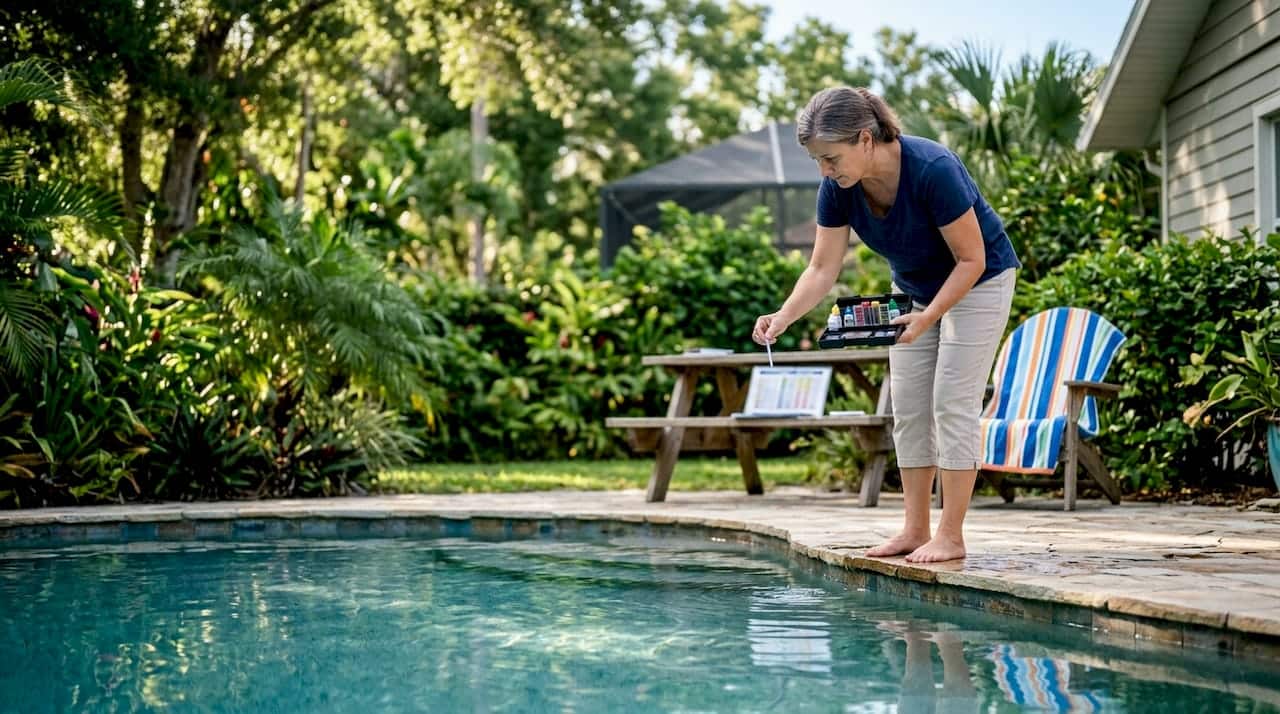
Weekly testing is not optional in Florida’s climate. UV degradation of chlorine happens fast under Central Florida’s sun, which means levels that looked fine on Monday can be dangerously low by Thursday. Build testing into your weekly routine the same way you schedule lawn care.
How does Citrus County’s water hardness affect pool maintenance?
Citrus County’s water comes from limestone aquifers, and limestone is calcium carbonate. That geology is the reason Florida tap water often carries 200–450 ppm calcium hardness straight from the tap. You are not dealing with a water treatment failure. You are dealing with the natural chemistry of the ground beneath your home.
High calcium hardness and low calcium hardness cause opposite problems, and both are damaging. The table below shows what happens at each extreme and what action to take.
| Calcium hardness level | Typical effects | Recommended action |
|---|---|---|
| Below 200 ppm | Corrosion, surface etching, plaster pitting | Add calcium chloride to raise levels |
| 200–400 ppm | Balanced, no scaling or corrosion | Maintain with regular testing |
| 400–600 ppm | Early scale formation on tiles and heaters | Add sequestering agent monthly |
| Above 600 ppm | Scale on salt cells, clogged plumbing, reduced heater efficiency | Partial drain and refill (25–30%) |
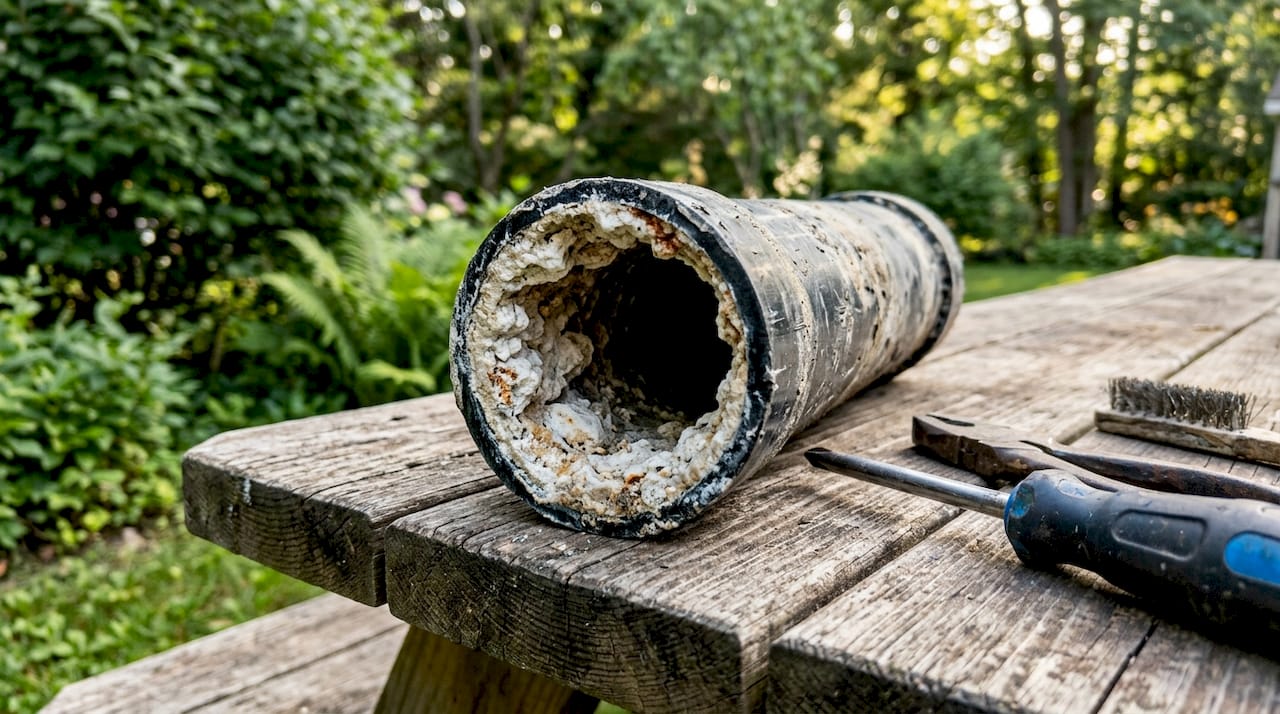
Scale buildup from high calcium is not just cosmetic. It clogs plumbing, coats salt cells, and forces your heater to work harder to push water through narrowed passages. Left unchecked, it shortens the life of every piece of equipment in your system.
The Langelier Saturation Index, or LSI, is the standard tool for measuring whether your water is scaling or corrosive. Keeping pH at the lower end of the acceptable range (7.2–7.4) helps hold the LSI in balance when calcium hardness is elevated. Monthly sequestering agents keep dissolved calcium suspended in the water rather than depositing on surfaces.
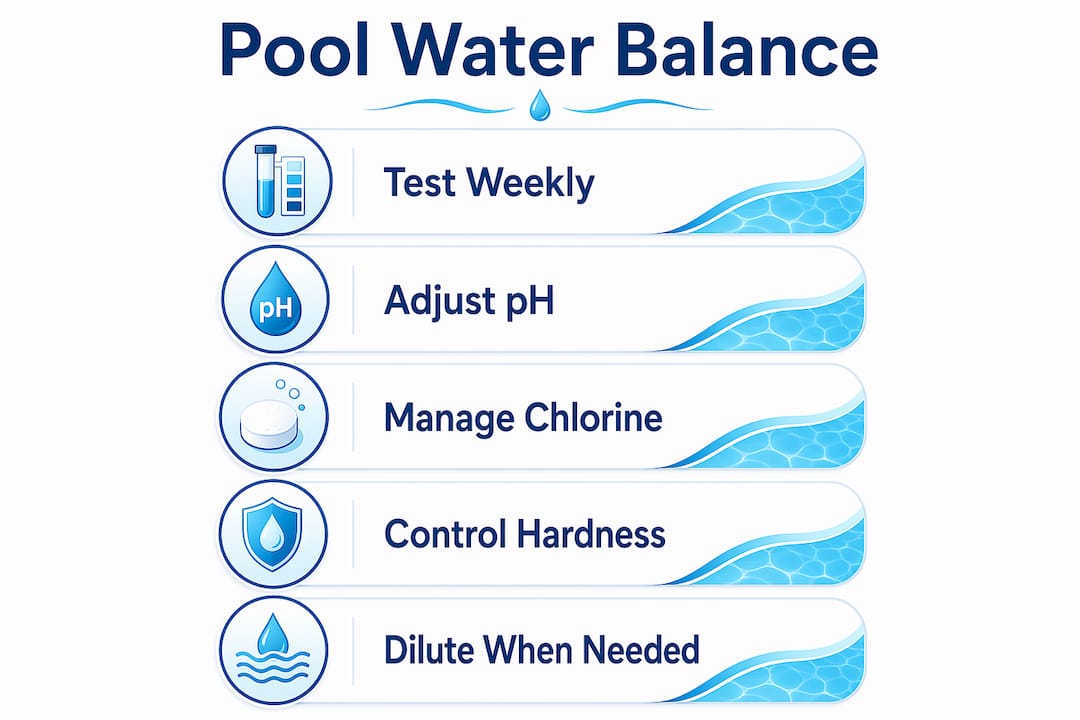
Pro Tip: Calcium hardness can only be reduced by dilution. No chemical addition lowers total hardness. When levels exceed 600 ppm, a 25–30% partial drain and refill with fresh water is the only effective reset.
When a partial drain is necessary, do it in stages and never fully drain your pool without professional guidance. Florida’s high groundwater table creates hydrostatic pressure that can literally push an empty pool shell out of the ground. This is a structural risk that catches many homeowners off guard.
How should Citrus County homeowners monitor and test their pool water?
Consistent testing is the foundation of good Citrus County pool maintenance. Without accurate, regular readings, you are reacting to problems instead of preventing them. A structured testing schedule removes the guesswork and protects both your swimmers and your equipment.
Follow this testing routine:
- Weekly: Test free chlorine, pH, and total alkalinity. These three parameters shift fastest under Florida’s sun and heat. A basic drop-test kit or digital photometer works well for weekly checks.
- Monthly: Test cyanuric acid and calcium hardness. CYA accumulates slowly, and calcium hardness changes with evaporation and refilling. Monthly readings catch drift before it becomes a problem.
- Seasonally: Test total dissolved solids (TDS). When TDS climbs more than 1,500 ppm above your baseline, water quality degrades and a partial drain is warranted.
- Annually (well water users): Test for bacteria and nitrates. Well water users in Florida bear full responsibility for their source water quality, and annual testing is the minimum standard, especially for homes near septic systems.
- As needed: Pull a full water panel at a pool supply store. Professional lab testing catches trace metals and other issues that home kits miss.
Citrus County homeowners can also access the 2025 Consumer Confidence Report for source water data through the county’s official website or by calling the Utilities Compliance Manager at 352-527-5427. That report tells you what is in your tap water before it enters your pool, which is the starting point for accurate chemical management.
For home testing, reagent-based drop kits give reliable readings for chlorine and pH. Digital photometers add accuracy for CYA and alkalinity. Whichever tool you use, calibrate it regularly and replace reagents before their expiration date. Expired reagents produce false readings that lead to wrong chemical additions.
What practical steps keep Citrus County pool water safe and balanced?
Maintaining safe pool water in Citrus County comes down to a consistent schedule, not heroic interventions. The climate here is aggressive. Heat accelerates chemical reactions, UV burns off chlorine, and summer rain dilutes your carefully balanced water. Your maintenance routine needs to account for all of it.
Here are the core maintenance steps for Citrus County homeowners:
- Adjust chemicals after rain. Heavy Florida downpours dilute chlorine and shift pH. Test within 24 hours of any significant rainfall and rebalance before the pool gets heavy use.
- Manage CYA before it accumulates. CYA above 100 ppm causes chlorine lock, meaning your chlorine is present but chemically unable to sanitize. The only fix is dilution through a partial drain and refill.
- Use stabilized chlorine carefully. Trichlor tablets and dichlor granules both add CYA with every dose. In Citrus County’s year-round pool season, CYA can climb to problem levels within months if you rely solely on stabilized products.
- Consider a salt chlorine generator. Salt systems produce chlorine on demand without adding CYA. They work well in Citrus County, though the hard water and salt cell scaling issue means you need to clean cells regularly and keep calcium hardness in check.
- Schedule a partial drain in late fall. After a full summer of evaporation and chemical additions, TDS and CYA levels are typically at their peak. A 25–30% drain and refill in october or november resets your water chemistry heading into the cooler months.
- Inspect equipment monthly. Scale buildup on heater elements and salt cells reduces efficiency before it causes failure. Monthly visual checks catch early deposits that a sequestering agent can still address.
Pro Tip: Run your pool pump during off-peak hours (10 PM to 6 AM) to reduce energy costs and maintain circulation when evaporation rates are lower. Consistent circulation prevents chemical stratification in the water.
The pool filtration system is your first line of defense against water quality problems. A filter running at reduced capacity because of scale or debris cannot remove contaminants effectively, no matter how well-balanced your chemistry is. Clean or backwash your filter on schedule, and replace filter media according to the manufacturer’s timeline.
Key Takeaways
Citrus County pool water quality requires consistent chemical management, regular testing, and proactive dilution strategies to counter the region’s naturally hard groundwater.
| Point | Details |
|---|---|
| Target chemical ranges | Maintain free chlorine at 2–4 ppm, pH at 7.2–7.6, and calcium hardness at 200–400 ppm. |
| Hard water is the local challenge | Citrus County’s limestone aquifer delivers high-calcium water that requires monthly sequestering agents and periodic partial drains. |
| CYA buildup is a silent threat | Cyanuric acid above 100 ppm causes chlorine lock; dilution through partial drain and refill is the only fix. |
| Test on a fixed schedule | Test chlorine, pH, and alkalinity weekly; test CYA and calcium hardness monthly. |
| Never fully drain without help | Florida’s groundwater table creates hydrostatic pressure that can damage an empty pool shell. |
What I’ve learned from decades of Florida pool chemistry
The biggest mistake Citrus County homeowners make is treating water chemistry as a problem to solve once. It is not. Florida’s groundwater is relentlessly hard, the sun is relentlessly strong, and the pool season never really ends. You are not fixing your water. You are managing it continuously.
The homeowners who have the fewest problems are the ones who test on a fixed schedule and act on small deviations before they compound. A pH that drifts to 7.8 is a minor adjustment. A pH that sits at 7.8 for three weeks while CYA climbs past 80 ppm is a much harder situation to unwind. Randrswimmingpools has worked with Central Florida pool owners since 1985, and the pattern is consistent: the pools that stay clean and clear belong to homeowners who test weekly, not monthly.
One thing that surprises people is how much the source water matters. Pulling the Citrus County Consumer Confidence Report before you set up a new pool or change your water source gives you a real baseline. You know exactly what calcium hardness and TDS you are starting with, which means your first chemical additions are calculated, not guessed. That single step saves money and prevents the overcorrection cycle that plagues a lot of first-year pool owners.
If your calcium hardness is consistently pushing above 500 ppm despite partial drains, that is the point to call a professional. Reverse osmosis water treatment is effective but not cheap, and it makes sense only when dilution alone cannot keep pace with your local water conditions. Know when the situation has moved past DIY territory.
— Results
Randrswimmingpools: pool expertise built for Central Florida conditions
Citrus County’s water chemistry is specific, and the pool that handles it best is one designed with local conditions in mind from the start.
R and R Swimming Pools has been building custom inground pools across Central Florida since 1985. Every pool the team designs accounts for the region’s hard water, high UV exposure, and year-round use demands. Whether you are planning a new inground pool installation or looking for expert guidance on managing your existing pool’s water chemistry, Randrswimmingpools brings four decades of local experience to the conversation. The custom pool planning process starts with a free consultation, so you get a pool built to perform in Citrus County’s conditions, not just look good in a catalog.
FAQ
What is the ideal calcium hardness for a Citrus County pool?
The ideal calcium hardness range for Florida residential pools is 200–400 ppm. Citrus County’s groundwater often delivers water near the upper end of this range, so regular monitoring is critical.
How often should I test my pool water in Citrus County?
Test chlorine, pH, and total alkalinity weekly. Test cyanuric acid and calcium hardness monthly. Florida’s heat and UV exposure shift chemical levels faster than in cooler climates.
What causes chlorine lock in a Florida pool?
Chlorine lock occurs when cyanuric acid exceeds 100 ppm. At that level, CYA chemically binds chlorine and prevents it from sanitizing the water. The fix is a partial drain and refill to dilute CYA back into the 30–50 ppm range.
Is it safe to fully drain a pool in Citrus County?
Full drainage is not recommended without professional guidance. Florida’s high groundwater table creates hydrostatic pressure that can push an empty pool shell out of the ground, causing structural damage.
Where can Citrus County homeowners get water quality data?
The Citrus County 2025 Consumer Confidence Report is available through the county’s official website. Homeowners can also request a paper copy or call the Utilities Compliance Manager at 352-527-5427 for source water information.
