
TL;DR:
- Proper pool filtration in Central Florida requires correctly sizing the system, choosing the right filter type, and running multiple daily turnovers to maintain clear water. Seasonal adjustments, proactive maintenance, and understanding flow dynamics are essential for optimal results and cost efficiency. Oversized equipment and neglecting season-specific needs lead to dirty water and wasted energy, so tuning settings based on environmental conditions is key.
Most Central Florida homeowners assume that bigger pumps and more powerful filtration systems automatically equal cleaner water. That’s a costly and surprisingly common mistake. Real pool clarity depends on choosing the right filter type, sizing your system correctly, and running it on smart cycles tuned to Florida’s unique climate. Whether you’re planning a new inground pool or trying to get more out of your existing setup, understanding how filtration actually works will save you money, reduce chemical use, and keep your pool inviting 365 days a year.
Table of Contents
- What is pool filtration and why does it matter?
- How pool filtration works: The basics explained
- Types of pool filters: Sand, cartridge, and DE compared
- Sizing, cycles, and common filtration mistakes
- The uncomfortable truth about pool filtration most homeowners miss
- Ready for smarter pool filtration? Get expert help or start planning
- Frequently asked questions
Key Takeaways
| Point | Details |
|---|---|
| Filter cycles matter most | One turnover only partially cleans your pool—multiple daily cycles ensure clarity. |
| Choose the right filter type | Sand, cartridge, and DE filters each have unique strengths for Central Florida’s environment. |
| Proper sizing is crucial | Undersized or oversized systems both reduce filtration effectiveness and raise costs. |
| Seasonal adjustments are essential | Storms and pollen in Florida require more frequent cleaning and tuned filter routines. |
| Expert guidance saves effort | A knowledgeable local pro can help you design, maintain, and upgrade for optimal performance. |
What is pool filtration and why does it matter?
Pool filtration is the continuous process of pulling water out of your pool, running it through a filter to remove contaminants, and returning clean water back in. It sounds simple, but what’s being removed is surprisingly complex. We’re talking about sunscreen residues, body oils, dead skin cells, algae spores, pollen, bacteria, and microscopic debris that look like clean water to the naked eye. None of those things disappear on their own, and none of your sanitizing chemicals work efficiently when the water is cloudy or loaded with organic material.
Central Florida makes this challenge harder than most places. The year-round heat accelerates algae growth. Afternoon thunderstorms dump organic debris, runoff, and fresh contaminants into your pool on a weekly basis during summer. Oak pollen seasons in spring send fine yellow particles into pool water that cloud it faster than most homeowners expect. And because Central Florida pools get used 12 months a year, the cumulative load on your filtration system is genuinely higher than in northern climates.
Here’s what proper filtration delivers for you:
- Cleaner water with fewer chemicals needed to maintain balance
- Reduced risk of eye and skin irritation for swimmers
- Lower likelihood of algae blooms, which are expensive to treat
- Longer equipment life because clean water is gentler on pumps and surfaces
- A pool that actually looks inviting instead of dull or cloudy
“The residential pool turnover benchmark is 8-12 hours for one full cycle, meaning the entire pool volume passes through the filter once. Aiming for 1-2 turnovers daily is the standard, with more during summer or heavy use periods.”
Knowing this, you can see why how filtration keeps pools clean involves more than just turning on a pump and walking away. It requires a system matched to your pool’s specific size, usage, and the local environment.
How pool filtration works: The basics explained
Understanding the flow of your pool’s water system takes about two minutes, and it makes every future maintenance decision easier. Here’s the basic sequence of events every time your pump runs:
- Water enters through skimmers and main drains. Skimmers pull surface water, catching leaves and floating debris. The main drain at the pool’s bottom handles deeper circulation.
- The pump creates suction and pressure. This is the heart of the system. The pump pulls water in on one side and pushes it through the filter on the other. Knowing how pumps drive filtration helps you match pump size to your actual needs.
- Water passes through the filter media. Whether it’s sand, cartridge material, or diatomaceous earth (DE), this is where particles get trapped. Clean water continues forward.
- Filtered water returns through return jets. These jets are positioned to create circulation patterns that push water back toward the skimmers, keeping the cycle going.
- The cycle repeats until a full turnover is complete. One turnover means 100% of your pool’s water volume has passed through the filter at least once.
A simple turnover calculation: take your pool’s volume in gallons and divide by your pump’s flow rate in gallons per hour. A 20,000-gallon pool with a pump moving 50 gallons per minute (3,000 gallons per hour) needs about 6.7 hours per turnover. That’s actually good performance.
| Pool volume (gallons) | Pump flow rate (GPM) | Hours per turnover |
|---|---|---|
| 15,000 | 40 | 6.25 |
| 20,000 | 50 | 6.67 |
| 25,000 | 60 | 6.94 |
| 30,000 | 75 | 6.67 |
Pro Tip: Don’t chase the idea that running your pump faster always helps. Water moving too quickly through a filter doesn’t get cleaned as well, because the media needs contact time to trap particles. A correctly sized pump running at a moderate speed often outperforms an oversized pump running flat out.
High summer use, back-to-back swimmers, or a heavy storm event will demand more frequent or longer filtration cycles. The 1-2 daily turnovers benchmark is a starting point, not a ceiling.
Types of pool filters: Sand, cartridge, and DE compared
Choosing a filter type isn’t just a technical decision, it’s a lifestyle decision based on how much time you want to spend maintaining it and what your pool is up against on a typical week in Central Florida.
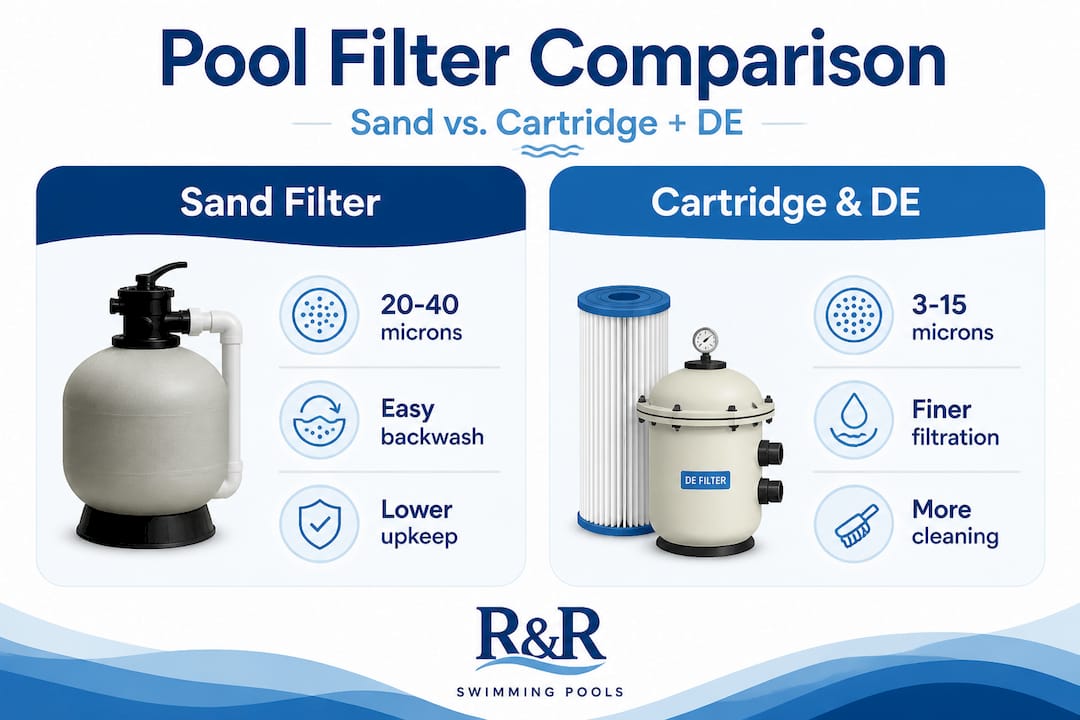
Sand filters use a bed of specially graded silica sand to trap particles as small as 20-40 microns. Water flows in from the top, gets pushed through the sand, and exits clean from the bottom. When the filter gets dirty, you backwash it, which reverses flow and flushes debris down the drain. Sand filters are the easiest to maintain after a storm dumps a pile of leaves and debris into your pool.
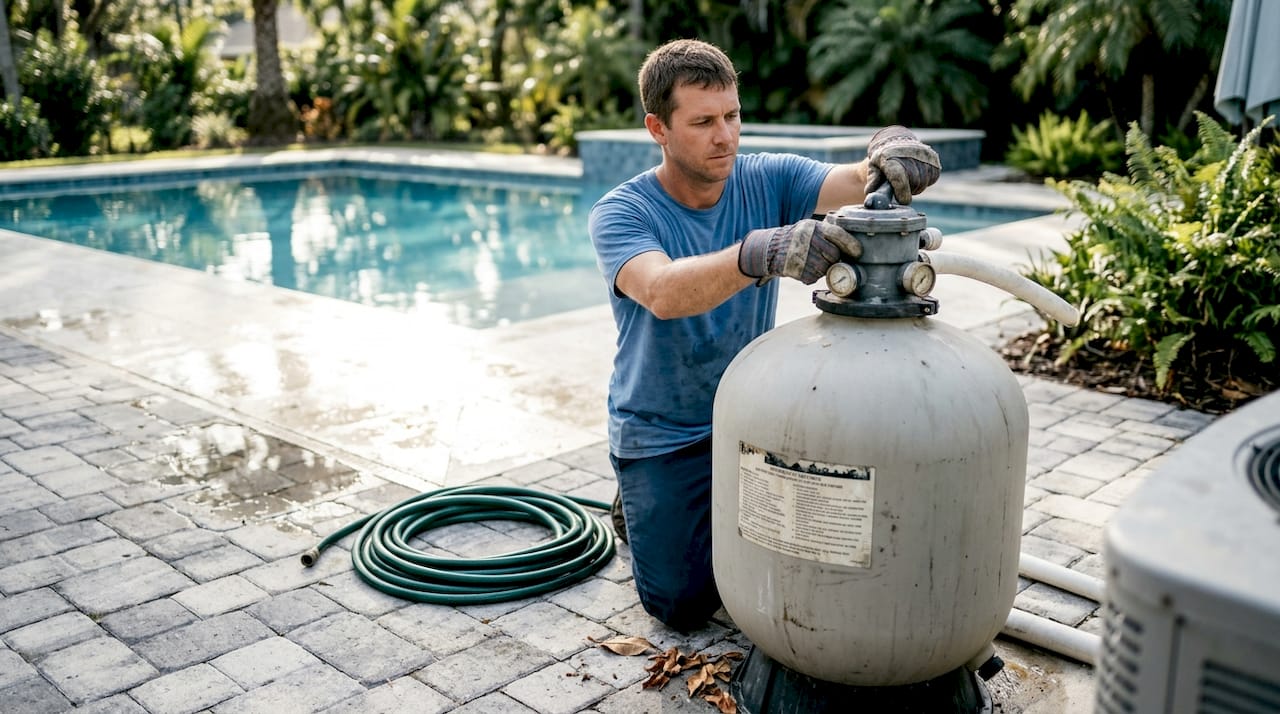
Cartridge filters use a pleated polyester element to trap particles down to 10-15 microns, catching finer debris than sand. Instead of backwashing, you remove the cartridge and rinse it with a hose. They use less water than sand filters and work well for pools with steady, moderate use. The tradeoff is that the cartridge itself wears out over time and needs periodic replacement.
Diatomaceous earth (DE) filters are the finest performers, capturing particles as small as 3-5 microns. DE powder coats a series of internal grids, and water passing through gets screened at an incredibly fine level. This matters enormously during Central Florida’s spring pollen season, when fine particles cloud pool water faster than coarser filters can handle. DE filters require more upkeep, including adding fresh DE powder after backwashing, but the water clarity payoff is real.
| Filter type | Filtration level | Maintenance style | Best for |
|---|---|---|---|
| Sand | 20-40 microns | Backwash (easy, frequent) | Storm debris, heavy use |
| Cartridge | 10-15 microns | Rinse cartridge | Everyday residential use |
| DE | 3-5 microns | Add DE powder after backwash | Pollen, algae, fine particles |
Here’s where detailed filter types really matter for your decision: sizing matters as much as type. As research on pool circulation confirms, high debris events favor sand while fine pollen and algae favor DE or cartridge systems. Oversizing your filter creates a different problem, because water moves through too quickly for effective particle trapping. Undersizing means the system can’t complete turnovers fast enough to keep up.
A few things to keep in mind when comparing your options:
- Sand filters cost less upfront and are the most forgiving for new pool owners
- Cartridge filters save water, which matters in Florida’s drought-sensitive summers
- DE filters deliver the clearest water but require more hands-on attention
- All three can work beautifully when properly sized and regularly maintained
Pro Tip: Talk to your pool installer about the actual micron rating of whatever filter you’re considering, not just the brand name or tank size. A larger tank doesn’t always mean better filtration if the media is coarser than your environment demands.
Sizing, cycles, and common filtration mistakes
Most filtration problems in Central Florida pools aren’t hardware failures. They’re sizing mistakes and cycle management issues that slowly add up to cloudy water, chemical bills that climb, and algae that seems to appear out of nowhere.
The first common mistake is relying on a single daily turnover. Research makes this clear: one turnover filters only 60-65% of your pool water effectively. You need two or more turnovers to reach 85-98% water filtration. One cycle sounds like enough on paper, but in practice, water mixing in the pool means some water passes through multiple times while some barely circulates at all during a single cycle.
“Achieving real water clarity means running multiple turnovers, not just one. Two turnovers bring effectiveness up to 85-98%, compared to just 60-65% for a single cycle.”
The second common mistake is sizing equipment by pool volume alone without accounting for bather load, shade coverage, or local debris conditions. A pool with consistent afternoon shade in a low-traffic yard needs far less aggressive filtration than an identical pool that gets afternoon sun, sees daily swim parties, and sits under an oak tree.
Here’s a practical list of filtration factors specific to Central Florida:
- Summer heat drives algae growth faster; add a half-cycle in the early morning to get ahead of it
- Storm season (June through November) regularly introduces debris, bacteria, and organic load; check and possibly increase cycle times after every major storm
- Pollen season in spring can overwhelm cartridge and sand filters quickly; check filter pressure gauges more frequently
- Year-round use means no off-season recovery period for your equipment; schedule maintenance accordingly
Considering pool pump upgrades is a smart move if your current pump can’t handle two daily turnovers within a reasonable time window. Variable speed pumps, in particular, let you run longer cycles at lower speeds, which actually improves filtration quality while cutting energy costs significantly.
For homeowners building from scratch or redesigning, incorporating these principles into custom pool planning from day one avoids the expensive retrofitting problem entirely.
Pro Tip: Frequent light filter cleaning beats rare deep cleanings every time. A cartridge rinsed every two weeks stays efficient far longer than one that goes three months between cleanings. The same applies to backwashing sand filters. Small regular actions protect your investment better than occasional intensive maintenance.
The uncomfortable truth about pool filtration most homeowners miss
After decades of building pools across Central Florida, here’s what we’ve seen repeatedly: homeowners who struggle with water quality almost never have an underpowered system. They have a correctly sized or even oversized system that nobody ever taught them to tune seasonally.
A $5,000 automation upgrade won’t fix a system running on the same year-round schedule in January as it runs in July. Florida’s climate doesn’t stay the same, and your filtration cycles shouldn’t either. The pools that consistently look amazing belong to owners who check their filter pressure gauge once a week, bump their pump timer an extra hour or two when storm season hits, and rinse or backwash proactively rather than reactively.
The “more horsepower fixes everything” mindset costs homeowners real money. Oversized pumps cavitate, meaning they pull in air because the system can’t feed them enough water, which damages equipment and reduces filtration quality. High velocity water in an oversized system blows right past filter media instead of filtering through it slowly enough to do its job.
The smarter approach is tuning, not upgrading. Adjust your run times based on the season. Increase cycles during the pollen surge in March and April. Add a short morning filtration cycle during July and August when the sun hits the pool hardest and algae pressure is at its peak. Following energy-efficient pool practices built specifically for Central Florida’s conditions gives you cleaner water at lower operating costs.
The homeowners with the most beautiful pools in our region aren’t necessarily the ones with the most expensive equipment. They’re the ones who understand their system, watch for warning signs early, and make small smart adjustments before small problems become expensive ones.
Ready for smarter pool filtration? Get expert help or start planning
You now have a real working knowledge of what proper pool filtration looks like in Central Florida, and why it goes so much deeper than just running your pump for a few hours a day.
R & R Swimming Pools has been helping Central Florida homeowners make smart, informed pool decisions since 1985. Whether you want to build a new pool with the right filtration system designed in from the start, or you need to understand your current setup better, we have the resources to help. Explore Pool School for homeowners for practical guides on all things pool care. Walk through our step-by-step installation guide if you’re thinking about building. Or check out the top pool types in 2026 to see what options best match your lifestyle and yard. Your next great swim is closer than you think.
Frequently asked questions
How often should I run my pool filter during Florida summers?
Aim for at least 1-2 turnovers daily during summer and heavy swim periods, with additional cycles after storms or high-debris events to maintain water clarity and safety.
What type of filter is easiest to maintain after Florida storms?
Sand filters are generally the most durable and easiest to maintain after storms because backwashing handles large debris loads quickly. High debris events are exactly the scenario where sand filtration performs best.
Do I need to clean my pool filter more often in pollen season?
Yes, particularly if you have a cartridge or DE filter, because fine pollen and algae clog filter media faster than coarser debris and demand more frequent cleaning intervals.
Does one turnover cycle clean all the pool water?
No. One turnover only cleans about 60-65% of pool water due to natural mixing patterns; two or more daily cycles push effectiveness up to 85-98% for genuinely clean, clear water.
Recommended
- Top pool maintenance tips for Central Florida homeowners
- Pool pump guide: What Central Florida homeowners need
- Pool Prep Work Explained: Essential Steps for Central Florida
- Pool maintenance importance for Central Florida: 2026 guide
- Top pool fence safety features every homeowner needs – The Glass Railing Store
