
TL;DR:
- Proper pool elevation planning is vital for effective drainage, structural integrity, and aesthetic appeal in Central Florida. Incorrect elevation decisions can lead to costly repairs, drainage failures, and safety hazards, emphasizing the importance of early, detailed site assessment. Thoughtful elevation design transforms challenging slopes into unique, functional, and visually stunning outdoor spaces.
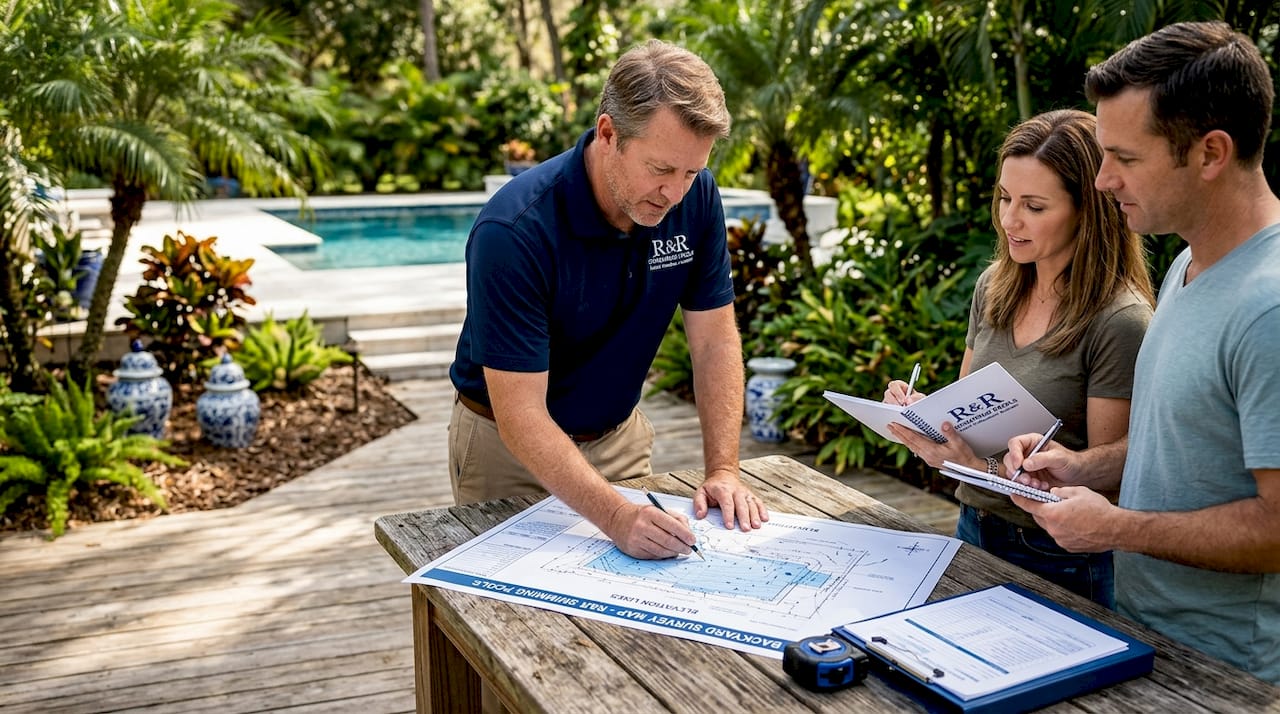
Most homeowners spend hours picking tile colors and waterfall styles but give almost no thought to elevation until a contractor brings it up on-site. That’s a costly mistake. The role of pool elevations in custom pool design touches everything from how well your backyard drains during a Florida afternoon thunderstorm to whether your pool shell cracks three years after installation. Get it right from the start and elevation becomes one of your most powerful design tools. Get it wrong and you’re looking at drainage failures, structural repairs, and code violations that no amount of beautiful tile can fix.
Table of Contents
- How elevation shapes drainage and water management
- Understanding pool floor and deck slope requirements
- Structural impacts of elevation in pool construction
- Enhancing aesthetic and functional zones through elevation
- Practical tips for homeowners: working with pool elevation
- Why elevation is the secret to truly custom pool success in Central Florida
- Discover expert custom pool design and installation in Central Florida
- Frequently asked questions
Key Takeaways
| Point | Details |
|---|---|
| Elevation drives drainage | Proper pool elevation directs water runoff away to protect the pool and yard from erosion and debris. |
| Slope meets safety codes | Deck and pool floor slopes must comply with Florida regulations to ensure safety and prevent standing water. |
| Structural integrity depends on elevation | Correct elevation placement of drains and structural features prevents costly concrete and cracking issues. |
| Elevation enhances design | Using elevation changes creates natural zones and luxury features that improve pool aesthetics and functionality. |
| Plan elevation early | Discuss elevation details with builders from the start to avoid surprises and create a durable custom pool. |
How elevation shapes drainage and water management
Central Florida’s rainfall is no joke. Many communities see 50 to 60 inches of rain per year, and a significant portion of that falls in heavy, concentrated bursts. When you’re planning a pool, where that water goes matters enormously. On sloped Central Florida properties, elevation changes directly drive drainage and runoff control, so builders plan grading and drainage systems early to move rainwater away from the pool deck instead of letting it pool around the structure.
The importance of pool elevations in drainage planning cannot be overstated. A poorly graded yard funnels water into your pool, bringing with it sediment, debris, mulch, and chemicals from surrounding landscaping. That’s not just a cleaning headache. It accelerates chemical imbalances, clogs filtration systems, and degrades the pool surface over time.
Common drainage techniques used in elevation-aware pool design include:
- Channel drains installed along the pool deck perimeter to intercept sheet flow before it enters the pool
- Underground French drains that redirect subsurface water away from the shell
- Deck slope grading that pitches the surface away from the pool edge at a code-compliant angle
- Catch basins positioned at low points in the yard to collect and redirect runoff
- Swales (shallow, graded channels) integrated into landscaping to guide water naturally
Improper elevation planning leads to mud infiltration, soil erosion around the pool’s bond beam (the concrete ring that connects the shell to the deck), and chronic water-pooling problems that are expensive to correct after construction. Builders who invest time in proper pool planning steps during site assessment can turn a challenging sloped lot into a well-functioning outdoor retreat.
“The pool deck is your first line of defense against water intrusion. If the elevation and grading aren’t addressed before a single shovel hits the ground, no amount of drainage hardware will fully compensate.”
Pro Tip: During your initial site visit with a builder, ask specifically how rainwater currently moves across your yard. Walk the property during or right after rain if possible. Knowing your yard’s natural drainage patterns before design begins saves significant rework later.
Designers who understand the pool elevation impact on landscape work with those natural patterns rather than against them. That means a sloped lot isn’t a problem. It’s an opportunity to create layered, intentional outdoor spaces where water moves exactly where you want it.
Understanding pool floor and deck slope requirements
With drainage and water flow basics set, it’s essential to understand how slopes on the pool floor and deck meet safety and code standards. Florida doesn’t leave this to guesswork. Pool deck slopes are regulated at a minimum of 1/4 inch per foot away from the pool edge, a standard designed to prevent standing water, reduce slip hazards, and protect the pool structure from water intrusion at the coping line.
For the pool floor itself, slope is calculated using a simple formula: the depth change (rise or drop) divided by the horizontal length of the sloped area. Pool floor slope is quantified as a rise-over-run ratio, and calculating it accurately is critical for swimmer safety, debris management, and meeting building codes on maximum floor steepness.
Here’s a step-by-step approach to understanding your pool slope requirements:
- Identify the pool’s shallowest and deepest points. The difference in depth is your “rise.”
- Measure the horizontal distance between those two points. This is your “run.”
- Divide rise by run to get the slope ratio. A 3-foot depth change over 15 feet of horizontal distance equals a 1:5 slope.
- Check that transition slopes don’t exceed code limits. Steep transitions create tripping and diving hazards.
- Exclude flat sections from slope calculations to avoid artificially skewing the ratio.
- Confirm deck slope meets the 1/4 inch per foot minimum across all paved surfaces.
| Area | Minimum slope | Maximum slope | Purpose |
|---|---|---|---|
| Pool deck | 1/4 inch per foot | Varies by material | Drainage and slip prevention |
| Shallow end floor | None specified | 1:7 ratio recommended | Swimmer comfort and safety |
| Transition zone floor | Gradual | 1:3 maximum | Safe depth change |
| Deep end floor | Flat or slight pitch | No steep edges | Structural stability |
Proper pool design in Central Florida accounts for all of these slope variables from the earliest design phase. Failing a slope inspection mid-construction is far more expensive than getting it right on paper first. The fix usually involves demolishing and repourring concrete, which adds weeks to your timeline and thousands to your budget.
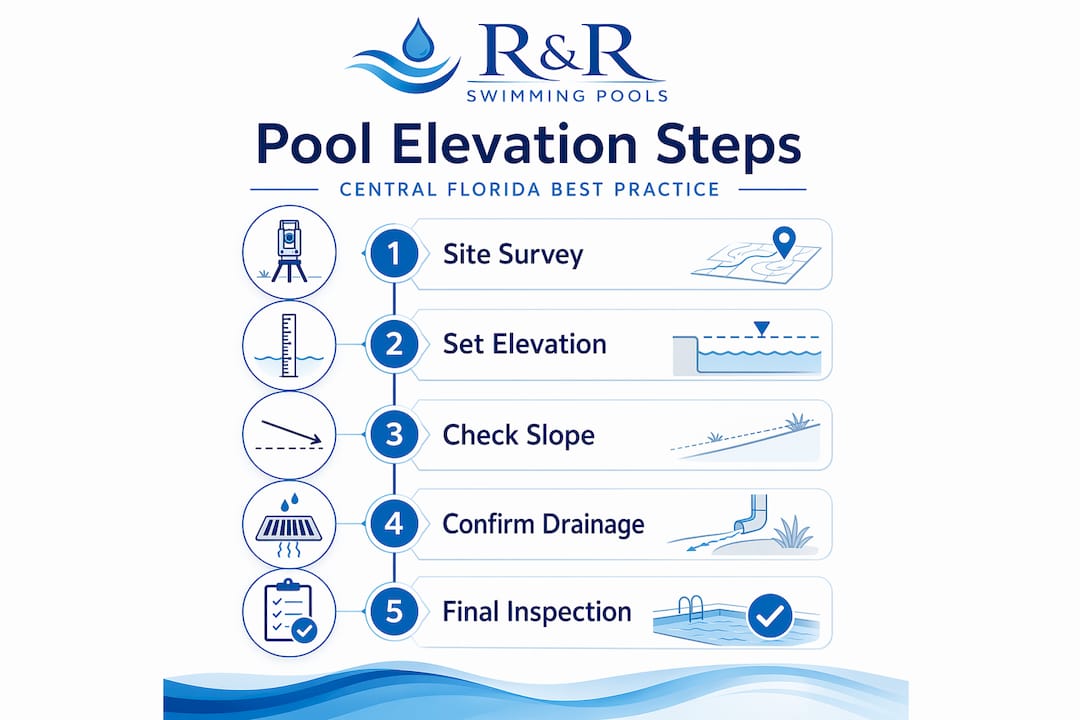
Pro Tip: Ask your contractor for a written slope compliance report before deck concrete is poured. A reputable builder will have this ready as part of standard quality control. If they don’t, that’s a red flag worth addressing before work continues.
Thinking carefully about your pool decking materials also matters here. Textured surfaces like exposed aggregate and brushed concrete provide better slip resistance on slopes compared to smooth finishes, giving you both code compliance and practical safety.
Structural impacts of elevation in pool construction
Beyond slope calculations, elevation has major implications on the pool’s structural integrity and installation details. When you build a pool into a sloped yard, the surrounding soil doesn’t push equally from all sides. Uphill soil exerts significantly more lateral pressure on the pool shell than downhill soil. Without proper structural engineering, that uneven pressure causes cracking, shifting, and long-term settlement.
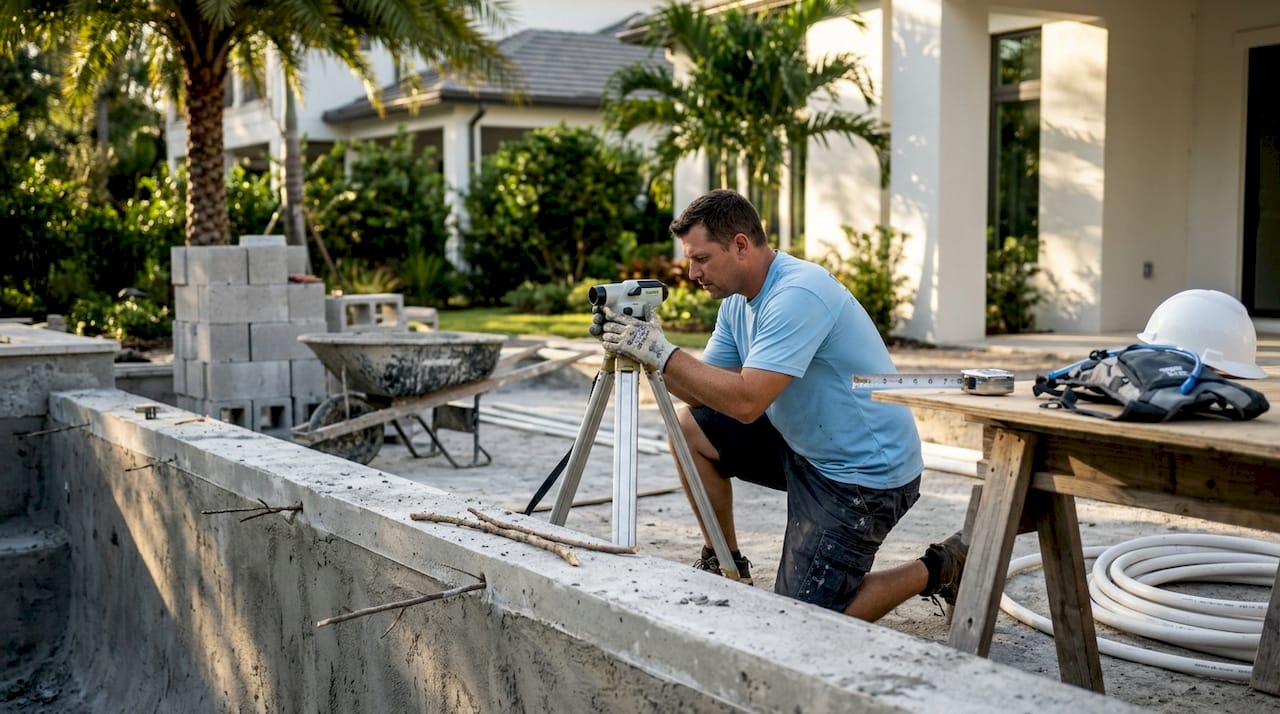
Elevation changes often require more complex structural solutions, including retaining walls and stepped designs, to handle the soil pressure that builds up on the uphill side of a pool installation. Retaining walls accomplish two things: they hold back the earth and they create a defined, attractive edge that can double as seating or a planting bed.
Critical structural considerations when elevation varies across your lot:
- Retaining wall depth and material must be specified by an engineer for slopes steeper than 3:1
- Pool shell wall thickness may need to increase on the high-side of a sloped installation
- Backfill compaction must be performed in controlled lifts (layers) to prevent future settlement
- Drain fixtures including sumps and channel drains must be set at precise elevations before any concrete is placed
That last point deserves its own emphasis. Being off by roughly three inches in sump or channel drain elevation can cause excess concrete thickness buildup and creates unintended mounding that leads to cracking risk downstream. Three inches sounds trivial. In concrete pool construction, it’s the difference between a sound shell and an expensive repair.
“Most structural failures in residential pools trace back to decisions made during excavation and rough plumbing, not to the materials chosen for the finish. Elevation precision at those early stages is everything.”
Your custom pool planning guide should include a detailed fixture elevation drawing showing where every drain, light niche, and return fitting sits relative to finished grade. If your builder can’t produce that document, the precision you need isn’t built into their process.
Enhancing aesthetic and functional zones through elevation
After covering technical and structural aspects, let’s explore how elevation enhances the pool’s look and livability. This is where understanding the benefits of raised pool levels shifts from engineering into art.
Elevation changes create natural zones for lounging, swimming, and entertaining, improving the overall functionality of the space without requiring fences or walls to separate areas. A raised patio sits 18 inches above the pool deck, giving guests a view of the water while keeping their space clearly defined. A sunken seating area drops you to water level, creating an immersive experience that feels completely different from sitting in a standard chair beside the pool.
Features that elevation makes possible:
- Infinity edges that appear to blend with the horizon, requiring precise elevation alignment between the pool water level and the catch basin below
- Raised spa spillovers where water cascades from a spa set above the pool into the main vessel
- Sunken fire pit areas recessed below the pool deck level for an intimate, sheltered feel
- Integrated planters built into retaining walls that add height contrast and natural color
- Elevated sun shelves that change the perceived scale and dimension of the pool area
Incorporating elevation changes, connected seating areas, and layered lighting is what separates a resort-style backyard from a standard rectangular pool surrounded by concrete. The difference is almost entirely in the vertical dimension, not the square footage.
| Design feature | Elevation required | Visual impact | Functional benefit |
|---|---|---|---|
| Infinity edge | Precise water level control | Very high | Dramatic view integration |
| Raised spa | 12 to 18 inches above pool | High | Spillover water feature |
| Sunken seating | 12 to 24 inches below deck | High | Intimate social zone |
| Elevated patio | 18 to 36 inches above pool | Medium | View and separation |
| Integrated planters | Variable, tied to wall height | Medium | Layered greenery |
Explore what’s possible with custom pool features before you lock in your design. Many homeowners don’t realize these elevation-driven features cost less than they assume, especially when the site’s natural topography already provides some of the height differential needed.
Pro Tip: If your lot is relatively flat, don’t assume elevation-based design is out of reach. Strategic berms (built-up earthen mounds) and raised bond beam walls can create the elevation differences needed for dramatic features without requiring a naturally sloped lot. Talk through pool features planning options with your designer early.
Practical tips for homeowners: working with pool elevation
Having explored elevation’s design benefits, here are concrete steps for working with your builder to get elevation right from day one.
- Raise elevation in your very first builder meeting. Don’t wait for a contractor to bring it up. Ask specifically how they handle grading, drainage, and slope compliance on your type of lot.
- Request a site drainage assessment before any design is finalized. This tells you how water currently moves across your property and identifies problem areas.
- Ask for a slope compliance plan in writing that covers both the pool floor and the surrounding deck. This document protects you at inspection time.
- Discuss structural supports early. If your yard has any slope at all, ask whether retaining walls are needed and what materials would work best for your landscape style.
- Request fixture elevation drawings showing precise placement of sumps, drains, and return inlets relative to finished grade.
- Ask for elevation-specific inspections at the rough plumbing stage, before concrete is placed around fixtures.
Understanding elevation early helps avoid surprises and allows designers to turn site challenges into genuine design advantages. A builder who views your sloped lot as a problem is thinking in two dimensions. One who sees elevation opportunity is thinking in three.
Working through essential pool planning steps with a builder experienced in Central Florida terrain ensures that the role of pool elevations is addressed before any dirt moves, not after problems appear.
Pro Tip: Prioritize builders who have direct experience with sloped lots and can show you examples from their portfolio. Ask to see a completed pool on a property similar to yours. If they’ve done it well before, you can see exactly how elevation decisions played out in the finished product.
Why elevation is the secret to truly custom pool success in Central Florida
Here’s an opinion that doesn’t get said enough: elevation is not a technical checkbox. It’s the foundation of a genuinely custom pool, and most homeowners don’t realize that until something goes wrong.
The conventional approach treats elevation as a logistics problem to solve rather than a creative asset to use. Builders grade the yard, meet code minimums, set the drains, and move on. That works. It’s safe. But it produces a pool that sits in your yard rather than one that belongs there.
Elevation changes require complex structural solutions and directly influence final look and durability. That’s not a burden. That’s an invitation to design something that could not exist anywhere else, on any other lot. A retaining wall becomes a seating wall. A slope becomes a tiered entertainment zone. A drainage challenge becomes the justification for a beautiful raised spa spillover.
What separates experienced Central Florida pool builders from the rest is how they handle the moments when elevation makes construction harder. The drain sump placement is one of those moments. Three inches, properly measured, is the difference between a sound shell and a cracked one. That precision doesn’t happen without systems, experience, and a builder who understands what’s actually at stake in those early excavation and plumbing stages.
Homeowners who prioritize elevation planning from day one also tend to spend less overall. Structural fixes after installation are dramatically more expensive than designing correctly upfront. You’re not paying more for a builder who takes elevation seriously. You’re avoiding a bill you don’t want to see three years from now.
Start with the right question: not “what features do I want?” but “what does this site make possible?” Elevation, honestly assessed and thoughtfully designed, often answers that question better than any features catalog can. Learn more about what makes custom pool design in Florida genuinely site-specific rather than formula-based.
Discover expert custom pool design and installation in Central Florida
If reading through the role of pool elevations has you thinking more carefully about your backyard project, that’s exactly the right instinct to follow. Elevation planning requires a builder who treats your specific lot as the starting point, not a template.
R & R Swimming Pools has been designing and building custom inground pools across Central Florida since 1985. That means decades of working with sloped lots, heavy Florida rains, local code requirements, and homeowners who want something that looks and functions beautifully for the long term. Their team approaches every project with site-specific custom pool planning that addresses elevation, drainage, and structural integrity before a single design element is finalized. Whether you’re starting from scratch or rethinking an existing space, explore the full inground pool installation process or walk through the custom pool design steps to see how a project like yours takes shape.
Frequently asked questions
Why is pool elevation important in Central Florida?
Pool elevation directs water drainage and affects structural stability, both critical in Florida where heavy rain and sloped properties mean elevation changes drive runoff control and determine how well your pool holds up over time.
What is the required slope for pool decks in Florida?
Florida regulations require a minimum of 1/4 inch per foot away from the pool edge on deck and patio surfaces, ensuring proper drainage and reducing slip hazards after rain.
How can elevation errors affect pool structure?
Even minor miscalculations matter. Being off by roughly three inches in drain sump elevation causes excessive concrete buildup around fixtures, which creates stress points that crack over time.
Can elevation changes improve pool aesthetics?
Absolutely. Thoughtful elevation enables features like sunken seating and infinity edges that transform a standard backyard pool into a resort-quality outdoor living space with distinct functional zones.
What should homeowners discuss with builders about pool elevation?
Cover drainage plans, slope compliance, retaining wall needs, and fixture placement early. Understanding elevation before design is locked in allows your builder to turn site challenges into design advantages rather than expensive surprises.
