
TL;DR:
- Adding fire features enhances pools into outdoor living spaces but requires careful planning to ensure safety and design harmony. Proper placement, fuel choice, and compliance with local codes are essential to prevent hazards and achieve visual impact. Layering multiple fire elements creates a dynamic backyard ambiance that combines practicality with aesthetic appeal.
Adding fire features for pools transforms a backyard from a simple swim area into an outdoor living destination. But with so many styles, fuel types, and installation requirements out there, choosing the right one is genuinely tricky. The wrong placement can create a safety hazard. The wrong style can clash with your pool’s design. This guide ranks the top 10 fire feature options by practicality, visual impact, and fit for residential pool settings — so you can choose with confidence instead of guessing.
Table of Contents
- Key takeaways
- What to consider before choosing fire features for pools
- 1. Fire bowls for pools
- 2. Pool fire pits
- 3. Fireplace by the pool
- 4. Linear fire features
- 5. Fire tables
- 6. Tiki torches as poolside fire features
- 7. Fire pillars and sculptures
- 8. Fire ribbon features in water walls
- 9. Comparison of fire feature types
- 10. Layering multiple fire features for maximum impact
- What I’ve learned from years of watching homeowners choose fire features
- Ready to bring fire and water together in your backyard?
- FAQ
Key takeaways
| Point | Details |
|---|---|
| Safety clearances matter most | Local codes often require 6–10 ft of horizontal clearance and 15–20 ft vertical clearance near combustibles. |
| Fuel type shapes your experience | Gas and propane offer cleaner, more controllable flames than wood, making them better for poolside settings. |
| Design harmony is non-negotiable | Fire features should complement your pool’s materials, shape, and style — not compete with them. |
| Wind planning is often overlooked | The direction and exposure of your fire feature should be determined at the layout stage, not after installation. |
| Professional installation pays off | Permit compliance, gas line routing, and structural integration require expertise that protects your investment. |
What to consider before choosing fire features for pools
Not all fire features are created equal, and the pool environment adds layers of complexity that most homeowners don’t anticipate. Before you fall in love with a specific look, run through this checklist.
- Safety clearances and code compliance. Local codes often mandate 6–10 ft of horizontal and 15–20 ft of vertical clearance from combustible structures. What the manufacturer says and what your local building department requires are often two different numbers.
- Fuel type. Natural gas is convenient and connects directly to your home’s line. Propane offers flexibility without running a gas line, but requires tank management. Many codes prohibit wood-burning fire pits near decks entirely due to emission and ember risks.
- Placement and orientation. Wind exposure shapes flame behavior more than most homeowners realize. Think about your prevailing wind direction during the design phase, not after concrete is poured.
- Design cohesion. Match materials — travertine with travertine, concrete with concrete. A sleek linear burner looks out of place next to a rustic stone pool edge.
- Water and fire integration. Features that combine both elements require careful plumbing and gas routing. Placement affects both aesthetics and performance.
- Maintenance demands. Gas features require periodic burner cleaning and gas line inspection. Lava rock or fire glass media needs occasional replacement.
- Budget and installation complexity. Portable fire tables sit at one end of the scale. Built-in fire walls and integrated scupper systems sit at the other.
Pro Tip: Get your local fire marshal’s requirements before you finalize any design. A permit issue discovered after installation can mean expensive removal or rework.
1. Fire bowls for pools
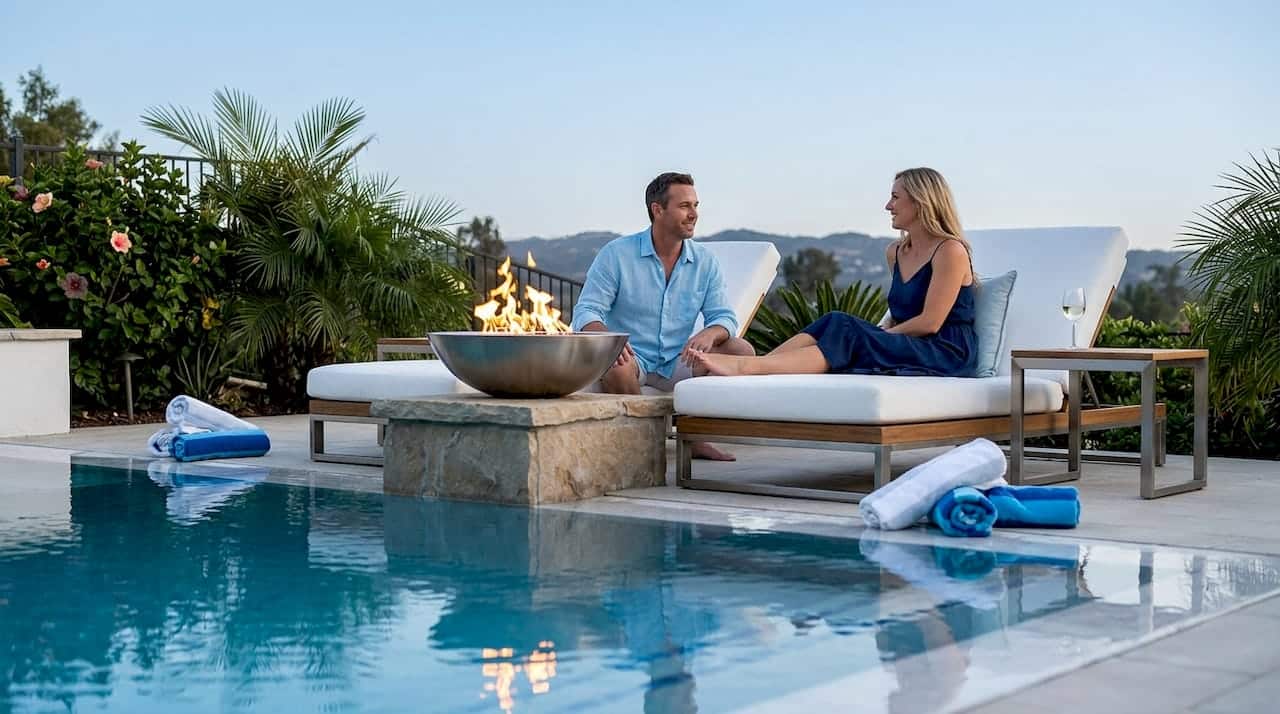
Fire bowls are the most popular fire feature for pool settings, and for good reason. They deliver dramatic visual impact without requiring permanent structural integration, and they pair naturally with the rounded geometry of most residential pools.
A well-designed fire bowl creates a focal point that draws the eye and creates warmth without overpowering the space. The Ibiza Fire & Water Bowl, for example, uses a 65,000 BTU burner paired with an 11-inch water scupper and 27 lbs. of lava rock media. It runs on natural gas or propane, making it adaptable to most residential setups.
Common options in this category include:
- Single-element fire bowls. Cast stone, concrete, or stainless steel bowls on pedestals. Clean and versatile.
- Fire and water combo bowls. Water flows from the bowl into the pool or a catch basin while the flame burns above. The visual contrast is striking.
- Elevated pedestal bowls. Positioned at pool edge or on a raised platform for maximum visibility.
- Recessed deck bowls. Flush-mounted in the pool deck for a low-profile, modern look.
Pro Tip: For combo fire and water bowls, scupper placement between 6 and 18 inches above the waterline produces the cleanest waterfall effect while improving pool aeration.
2. Pool fire pits
Pool fire pits are a social staple. They anchor a seating zone and create an instinctive gathering point near the water. The key decision you’ll face is portable versus built-in, and gas versus wood.
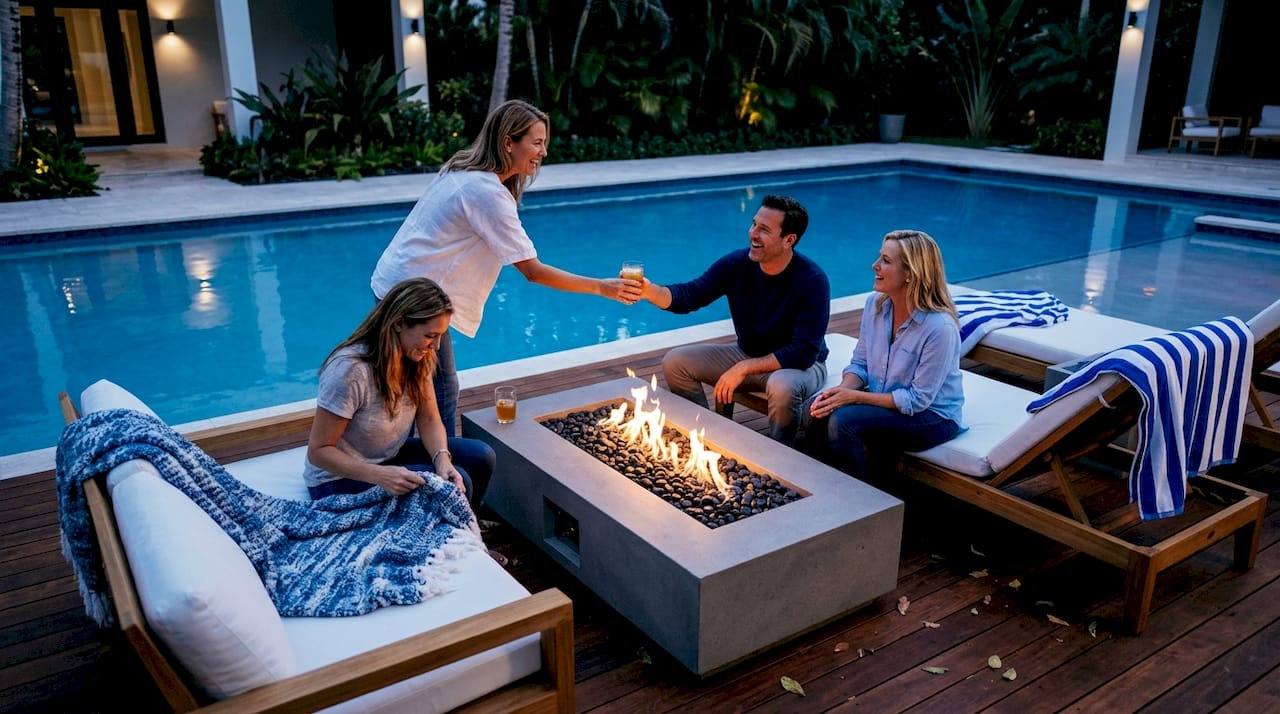
Built-in pool fire pits are constructed with the pool deck and offer a permanent, polished look. Portable gas fire pits give you flexibility to rearrange your layout. Gas fire pits allow closer seating than wood-burning options because there are no flying embers. Comfortable seating distance is 15–24 inches from the fire pit edge, with at least 36 inches of walkway clearance around the perimeter.
Style choices break down like this:
- Modern gas fire pits. Square or rectangular, concrete or steel, with clean lines for contemporary pools.
- Round gas fire pits. Classic shape that works in traditional and transitional backyard settings.
- Wood-burning fire pits. Better suited to open grass areas well away from the pool deck. Decks may need fire-resistant barriers to safely host any open flame.
- Sunken fire pits. Built into a lowered seating area for a sunken lounge feel that pairs beautifully with infinity-edge pools.
3. Fireplace by the pool
A freestanding or built-in fireplace creates a completely different energy than a fire pit. It offers a more formal, architectural presence that works best with larger outdoor spaces and pools that have a clear entertainment zone separate from the swim area.
Built-in fireplaces are typically constructed from concrete block and finished with stucco, stone, or tile to match your pool’s aesthetic. They provide directed heat toward seating areas rather than 360-degree warmth, which makes them better for cooler Florida evenings. You can explore how a fireplace by pool works as a luxury feature within a broader backyard design. Most built-in fireplaces require a dedicated gas line and structural footing, so plan for them during the pool design phase to avoid costly add-on work.
4. Linear fire features
Linear burners are the signature fire element of contemporary pool design. They run along walls, ledges, water features, or raised planters in a continuous line of flame, giving pools a resort-style quality that is hard to achieve with any other element.
Linear features work especially well with rectangular pools, negative edge designs, and pools that use clean geometric shapes throughout. They can be mounted horizontally along a raised bond beam or vertically in a fire wall that doubles as a privacy screen. The gas line routing for linear features needs professional planning since long runs require proper sizing to maintain consistent flame height across the entire length.
5. Fire tables
Fire tables function as both a heat source and a conversation surface around your pool. They replace a standard outdoor dining or lounge table with one that has a gas burner recessed into the center, often filled with fire glass or lava rock.
The social function here is the main draw. People sit around them naturally, just like a campfire. They work best as an accent feature 10–15 feet from the pool edge, within a clearly defined patio zone. Gas fire tables in the 40,000–60,000 BTU range provide enough warmth for a group of six without overwhelming the space.
Pro Tip: Choose a fire table with a cover for the burner insert so the table remains functional as a surface when the fire is not in use.
6. Tiki torches as poolside fire features
Tiki torches are underrated for their design versatility. When used strategically, they define pathways, mark transitions, and create a layered lighting effect around a pool that no electric fixture fully replicates. Modern versions have moved far beyond the basic bamboo post. You can find stainless steel, black powder-coated iron, and copper styles that hold up well to Florida weather.
Fuel torches burn citronella or torch fuel and require manual refilling, but their low cost and no-installation requirement make them an easy add-on for homeowners who want immediate ambiance. For a more permanent version, gas-fed torch posts installed in fixed positions along a pool deck create a consistent look without weekly maintenance.
7. Fire pillars and sculptures
Poolside fire sculptures and pillars are the boldest option on this list. They function as art pieces that happen to produce flame. Think concrete or metal columns with a gas burner embedded in the top, positioned as standalone focal points or flanking a pool entry.
These features command attention and work best when your pool already has a strong visual identity. A luxury pool design that incorporates architectural details like raised spa walls or water grottos absorbs fire sculptures naturally. In a simpler backyard, a fire sculpture can easily look out of place. Let the scale of your space guide the decision.
8. Fire ribbon features in water walls
A fire ribbon is a long, narrow burner installed in a water wall so that fire appears to float above or emerge from a cascade of water. It is one of the most visually dramatic fire and water installations available for residential pools.
The technical execution requires precise coordination between the water pump system and the gas line to maintain the right visual balance. Scupper height and flow rate directly affect whether the water enhances or smothers the flame effect. These features are built-in by nature and require professional design from day one.
9. Comparison of fire feature types
| Feature type | Fuel options | Clearance needed | Maintenance level | Best style fit | Typical cost range |
|---|---|---|---|---|---|
| Fire bowl | Gas, propane | 6–10 ft horizontal | Low to medium | Any | $500–$3,000 |
| Fire pit (built-in) | Gas, propane, wood | 10 ft minimum | Medium | Traditional, rustic | $2,000–$8,000 |
| Fireplace (built-in) | Gas | 10 ft+ | Low | Formal, transitional | $5,000–$15,000+ |
| Linear burner | Gas | 6 ft minimum | Low | Modern, contemporary | $1,500–$6,000 |
| Fire table | Gas, propane | 5–8 ft | Low | Casual, modern | $400–$2,500 |
| Tiki torches | Liquid fuel, gas | 3–5 ft | Medium | Tropical, casual | $50–$800 each |
| Fire sculpture/pillar | Gas | 10 ft+ | Low | High-end, architectural | $3,000–$10,000+ |
| Fire ribbon/water wall | Gas | 6–10 ft | Medium | Resort, contemporary | $8,000–$20,000+ |
10. Layering multiple fire features for maximum impact
The most memorable backyard pool settings rarely rely on a single fire feature. They layer. A fire bowl at the pool’s far end creates a focal point. Tiki torches along a pathway define the arrival experience. A fire table in the lounge zone anchors social activity. Each feature serves a specific spatial and functional role.
When layering, keep materials consistent and limit yourself to two fuel types at most. Mixing propane tables with natural gas wall features is fine. Mixing three different stone finishes across your fire elements creates visual noise. Think of backyard pool upgrades as a system, not a collection of individual purchases.
What I’ve learned from years of watching homeowners choose fire features
I’ve seen homeowners spend serious money on beautiful fire features that never get used. Nine times out of ten, it comes down to two problems: placement that fights the wind, and a feature that was chosen for looks alone without thinking about how it fits into actual evenings outside.
Wind impact on flame behavior is the detail that catches almost everyone off guard. A fire bowl positioned on the wrong side of a pool becomes a smoke-and-flicker problem the minute any breeze picks up. By the time you notice it, the concrete is already in the ground.
The other thing I’ve watched homeowners get wrong is assuming the manufacturer’s clearance specs cover them legally. Checking local codes independently before finalizing a design is not optional. Central Florida jurisdictions each have their own rules, and a permit pulled after the fact is always more painful than one planned from the start.
My honest advice: pick your fire feature after you’ve walked your yard at dusk on a typical evening, paid attention to where the wind comes from, and thought about where you actually sit. The feature that fits your real outdoor habits will always outperform the one that looked best in a showroom photo.
— Randrswimmingpools
Ready to bring fire and water together in your backyard?
At R and R Swimming Pools, we have been designing and building custom inground pools in Central Florida since 1985. Fire features are not an afterthought in our designs. They are planned into the pool layout from day one, with gas line routing, code compliance, and visual cohesion handled as part of the full project.
Whether you want a dramatic fire and water bowl flanking your pool entry or a sleek linear burner along a raised spa wall, our team can make it work safely and beautifully. Our custom pool installation guide walks you through the full process, and our inground pool planning resource covers how features like fire elements are integrated from the planning stage forward. Contact us for a free design consultation and see what’s possible for your backyard.
FAQ
What are the safest fire features for pools?
Gas and propane fire features are the safest choice for pool settings because they produce no flying embers and allow for controlled shut-off. Always verify local clearance requirements, which typically range from 6–10 ft horizontally from combustible surfaces.
Can I add a fire feature to an existing pool?
Yes, most fire features can be retrofitted to an existing pool deck. Portable fire tables and fire bowls require no structural work, while built-in features like linear burners or fire walls require professional installation and possibly a permit.
What is a fire and water bowl for a pool?
A fire and water bowl is a pedestal-mounted feature that combines a gas flame burner on top with a water scupper that flows into the pool. The Ibiza Fire & Water Bowl is a well-known example, running at 65,000 BTUs with natural gas or propane.
Do fire features require a permit near a pool?
In most Central Florida jurisdictions, yes. Built-in gas fire features, fireplaces, and any feature connected to a permanent gas line require a permit and inspection. Portable propane units often do not, but local rules vary.
How far should a fire feature be from the pool edge?
Most codes and safety guidelines recommend at least 6–10 ft of horizontal clearance between a fire feature and combustible surfaces, with seating positioned 15–24 inches from the fire pit edge and clear walkway access of at least 36 inches around the feature.
