

TL;DR:
- Maintaining proper pool water balance involves keeping parameters like pH, alkalinity, calcium hardness, cyanuric acid, and chlorine within recommended ranges. An imbalanced system leads to issues such as algae, cloudiness, corrosion, and increased chemical costs, while a balanced pool ensures safety, equipment longevity, and clear water. Adjusting water chemistry in the proper sequence and testing regularly helps prevent problems and preserves the pool’s condition year-round.
Pool water balance is the state where pH, total alkalinity, calcium hardness, cyanuric acid, and free chlorine are held within recommended ranges to protect swimmers and pool equipment. When any one of these parameters drifts out of range, the entire system shifts. Sanitizer loses effectiveness, surfaces corrode or scale, and swimmers notice it fast. Understanding why maintain pool water balance matters is the first step toward a pool that stays clear, safe, and cost-effective year after year.
Why maintain pool water balance: the core chemistry
Pool water balance is not a single number. It is a system of interacting chemical, physical, and environmental factors that must stay in proportion with each other. The industry term for measuring this system is the Langelier Saturation Index (LSI), which factors pH, alkalinity, calcium hardness, and water temperature to predict whether water will corrode pool surfaces or deposit scale.
Each parameter has a target range that pool professionals follow:
- Total Alkalinity: 80–120 ppm. Acts as a pH buffer. Low alkalinity below 60 ppm causes pH to bounce unpredictably with every rain shower or bather load.
- pH: 7.4–7.6. Controls how active chlorine is in the water. At pH 8.0, only 20% of free chlorine remains active as a sanitizer.
- Calcium Hardness: 200–400 ppm. Prevents water from pulling minerals out of plaster and metal fittings, which causes pitting and corrosion.
- Cyanuric Acid: 30–50 ppm for standard pools, 60–80 ppm for salt pools. Shields chlorine from UV degradation in outdoor sunlight.
- Free Chlorine: 2–4 ppm. The active sanitizer that kills bacteria and algae when pH and alkalinity are correctly set.
The LSI ties all of these together. A balanced LSI prevents etching, scaling, and metal corrosion by keeping calcium, pH, and alkalinity in proportion with water temperature. Pool owners who track only chlorine and ignore the LSI often spend more money fixing damage than they would have spent on routine chemistry.
Pro Tip: Test your LSI monthly, especially in summer when Florida heat raises water temperature and shifts the index toward scaling.
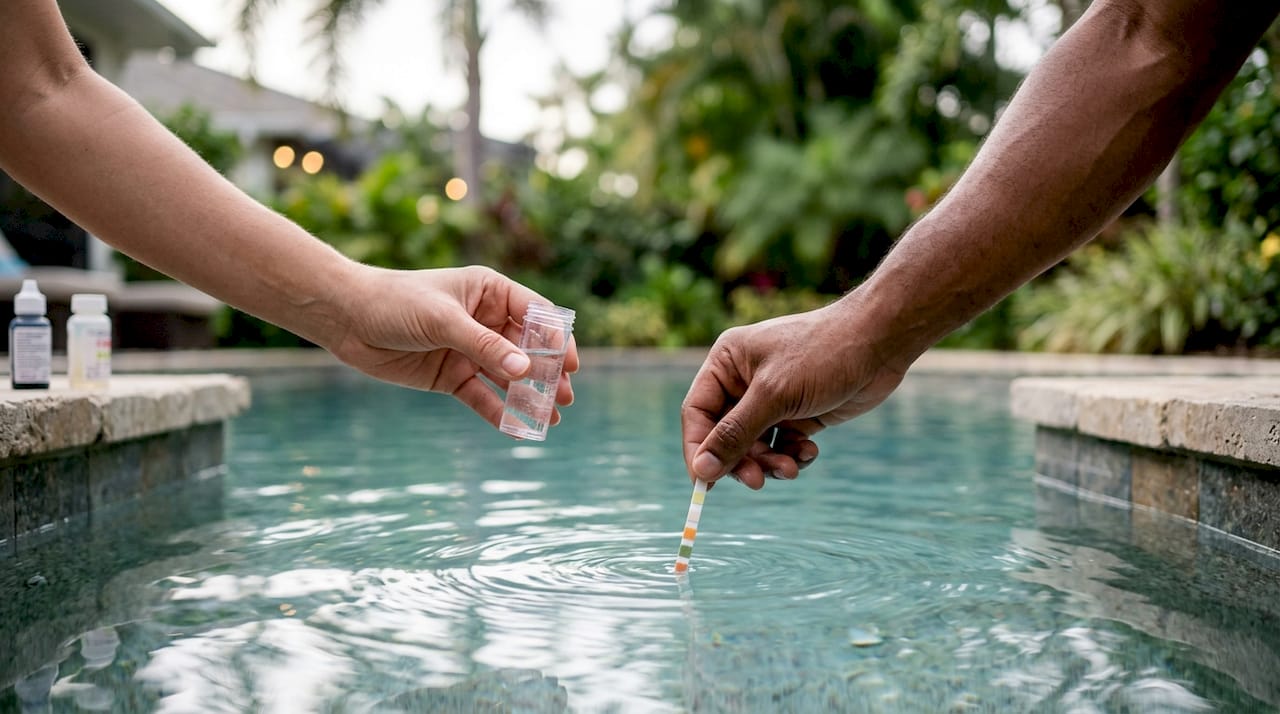
What happens when pool chemistry goes wrong?
Unbalanced water chemistry leads to algae, cloudy water, surface staining, scale buildup, red eyes, and dry skin. Each of those outcomes has a direct cause in the chemistry.
The benefits of keeping water balanced are concrete and measurable:
- Sanitizer works as intended. Chlorine kills bacteria and algae efficiently only when pH sits between 7.4 and 7.6. Outside that window, you add more chemical and get less result.
- Swimmer comfort improves. Balanced water does not irritate eyes or dry out skin. Red eyes after swimming are almost always a pH or combined chlorine problem, not a chlorine excess.
- Equipment lasts longer. Corrosive water attacks pump seals, heater elements, and metal fittings. Scaling water clogs filters and reduces flow. Both shorten equipment life significantly.
- Surfaces stay intact. Concrete and plaster pools are especially vulnerable to low calcium hardness. Water that lacks calcium pulls it directly from the plaster, leaving pits and rough patches.
- Chemical costs drop. Correcting imbalanced water requires large doses of multiple chemicals. Maintaining balance with small, routine adjustments costs far less over a season.
The importance of pool water balance also shows up in home value. A pool with stained walls, cloudy water, or corroded fittings signals neglect to buyers and appraisers alike.
How do chemical parameters interact and in what order should you adjust them?
Chemical parameters do not behave independently. Adjusting one changes the behavior of others, which is why the order of adjustments matters as much as the adjustments themselves.
The recommended balancing sequence is:
- Total Alkalinity first. Alkalinity stabilizes pH. Without it in range, every pH adjustment you make will drift back within hours. Bring alkalinity to 80–120 ppm before touching anything else.
- pH second. Once alkalinity is stable, pH adjustments hold. Target 7.4–7.6 using muriatic acid to lower or sodium carbonate to raise.
- Calcium Hardness third. Adjust calcium after pH is stable, since calcium additions can slightly affect pH readings.
- Cyanuric Acid fourth. Add stabilizer only after the primary parameters are set. Cyanuric acid dissolves slowly and should be added through the skimmer with the pump running.
- Free Chlorine last. Chlorine is the final step because its effectiveness depends entirely on the pH and alkalinity being correct first.
The relationship between alkalinity and pH is the most misunderstood part of pool chemistry. Without adequate total alkalinity, even small changes like rain or a heavy swim session cause pH to swing unpredictably. That makes every subsequent chemical adjustment unreliable.
Environmental factors also shift the balance continuously. Sunlight degrades chlorine. Aeration from waterfalls and fountains raises pH. Bather load adds organic matter that consumes chlorine and drops pH. A pool is a dynamic system, not a static one.
Pro Tip: Wait 15–30 minutes between each chemical addition and retest before adding the next one. Rushing this process causes overcorrection and wastes money.
Common mistakes pool owners make with water chemistry
Most pool problems trace back to a small set of repeated errors. Recognizing them saves time, money, and frustration.
- Adding chlorine to a green or cloudy pool without fixing pH first. High pH inactivates chlorine, so the pool stays green despite heavy chlorine doses. The fix is to correct pH and alkalinity before shocking.
- Treating chemistry as fixed targets instead of a system. pH at 7.5 means nothing if alkalinity is at 40 ppm. The numbers only work when the whole system is in proportion.
- Ignoring the effect of pool features on pH. Aeration from water features and salt chlorine generators raises pH continuously. Pool owners with these features need to plan regular muriatic acid additions, not just react when pH climbs.
- Overcorrecting with large chemical doses. Adding a full recommended dose when the parameter is only slightly off almost always overshoots the target. Add half, wait, retest, then decide.
- Skipping tests during stable-looking periods. Clear water does not mean balanced water. Cyanuric acid can climb to unsafe levels over a season without any visible sign until chlorine stops working.
Many beginners underestimate the importance of correcting pH and alkalinity before adjusting sanitizer levels. That single mistake accounts for a large share of persistent pool problems.
Practical routine for testing and maintaining pool water quality
A consistent testing schedule is the most effective tool a pool owner has. Here is a practical routine that covers all parameters without becoming a full-time job:
- Test chlorine and pH two to three times per week. These shift fastest and have the most direct impact on swimmer safety. Use a reliable test kit or digital tester, not just test strips.
- Test total alkalinity and calcium hardness weekly. These move more slowly but set the foundation for everything else. A weekly check catches drift before it becomes a problem.
- Test cyanuric acid monthly. Stabilizer accumulates over the season and rarely drops on its own. High cyanuric acid above 80 ppm reduces chlorine effectiveness even when chlorine reads correctly.
- Add chemicals one at a time. Wait 15–30 minutes between additions for proper mixing, and wait several hours after a shock treatment before adding anything else.
- Keep a log. Recording test results and chemical additions over time reveals patterns. You will learn when your pool tends to drift and can adjust proactively.
- Call a professional when results are consistently out of range. Persistent imbalance despite correct adjustments often signals a deeper issue: a failing filter, a leak diluting chemistry, or cyanuric acid that has built up too high to correct without a partial drain.
Routine pool maintenance tips for Central Florida owners also account for the region’s heat and heavy rain, both of which accelerate chemical consumption and dilution. Florida pools need more frequent attention than pools in cooler climates.
Pro Tip: Use a dedicated pool maintenance app to log test results. Seeing a week of pH readings in a chart is far more useful than remembering yesterday’s number.
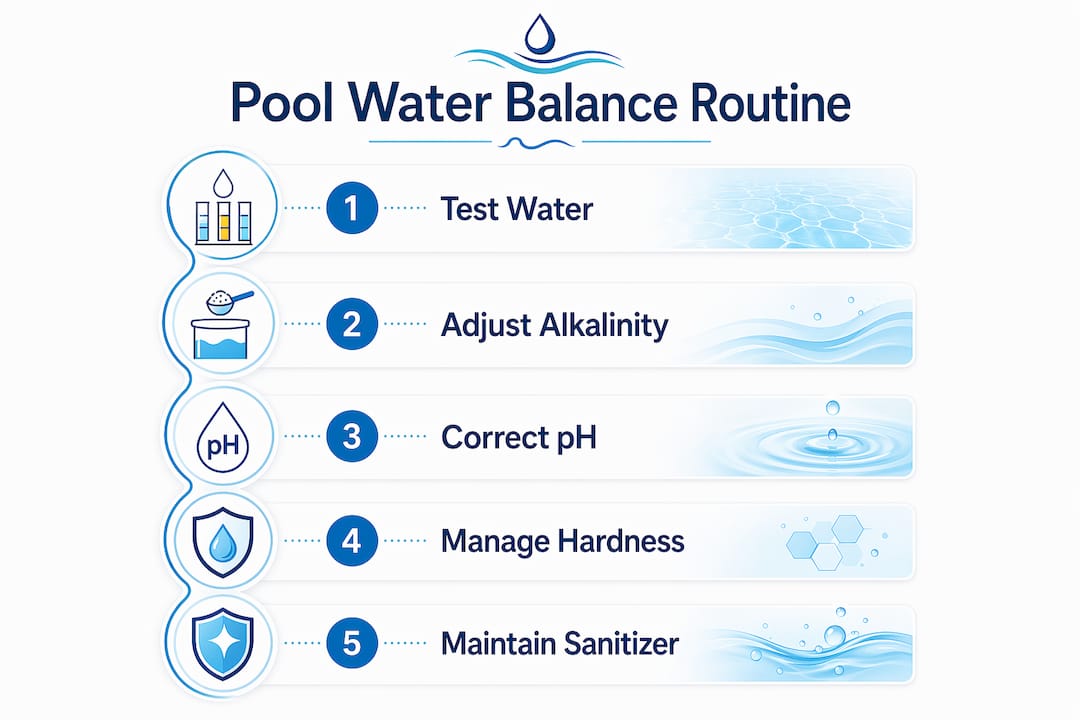
For a full walkthrough of the adjustment sequence, the step-by-step maintenance workflow from Randrswimmingpools covers each parameter in order with timing guidance.
Key Takeaways
Balanced pool water protects swimmers, preserves equipment, and keeps sanitizer working at full strength across every season.
| Point | Details |
|---|---|
| Follow the balancing sequence | Adjust alkalinity first, then pH, calcium hardness, cyanuric acid, and chlorine last. |
| pH controls chlorine power | At pH 8.0, only 20% of free chlorine is active. Keep pH at 7.4–7.6 for full sanitizer effect. |
| Test on a schedule | Check chlorine and pH two to three times weekly; test alkalinity and calcium hardness weekly. |
| Pool features shift pH | Waterfalls, fountains, and salt generators raise pH continuously. Plan regular acid additions. |
| Fix alkalinity before chlorine | Adding chlorine to water with low alkalinity or high pH wastes chemical and leaves the pool unsafe. |
Pool chemistry is a system, not a checklist
After years of working with pool owners across Central Florida, the pattern I see most often is this: people treat water chemistry like a checklist of numbers to hit, then wonder why the pool still looks off. The numbers are not the goal. The system is.
What I have learned is that the most successful pool owners think about their water the way a good cook thinks about seasoning. You do not dump in salt and call it done. You taste, adjust, wait, and taste again. Pool chemistry works the same way. Patience and steady routine testing beat emergency chemical fixes every time.
The other thing I would push back on is the idea that clear water means safe water. I have seen pools that looked crystal clear with cyanuric acid above 100 ppm, which means the chlorine was essentially locked up and doing nothing. Visual clarity is not a chemistry report.
My honest advice: invest in a quality digital tester, keep a log, and learn how your specific pool behaves across the seasons. Every pool is different. Yours will develop patterns you can predict and manage. That knowledge is worth more than any single chemical product.
— Results
Randrswimmingpools: expert support for your pool
R and R Swimming Pools has been building and supporting custom inground pools across Central Florida since 1985. Whether you are managing water chemistry in a new concrete pool or planning a fiberglass installation, the team brings decades of hands-on knowledge to every project. The Pool School resource covers chemistry basics, maintenance schedules, and troubleshooting for pool owners at every experience level. For owners ready to build or upgrade, the inground pool installation guide walks through every stage of the process with expert guidance from a team that has done it thousands of times.
FAQ
What is pool water balance?
Pool water balance is the condition where pH, total alkalinity, calcium hardness, cyanuric acid, and free chlorine are all within recommended ranges at the same time. The Langelier Saturation Index (LSI) is the standard tool professionals use to measure overall balance.
How often should I test my pool water?
Test chlorine and pH two to three times per week, alkalinity and calcium hardness weekly, and cyanuric acid monthly. More frequent testing is needed after heavy rain, high bather load, or chemical additions.
Why does my pool stay green even after I add chlorine?
High pH inactivates chlorine, so adding more chlorine to water with pH above 7.8 has little effect. Correct pH and alkalinity first, then shock the pool for the treatment to work.
What does total alkalinity do for pool water?
Total alkalinity acts as a buffer that stabilizes pH. When alkalinity falls below 60 ppm, pH swings unpredictably with every environmental change, making all other chemical adjustments unreliable.
Can pool water features affect water chemistry?
Yes. Waterfalls, fountains, and salt chlorine generators aerate the water, which raises pH continuously. Pool owners with these features should plan regular muriatic acid additions to keep pH in the correct range.
