
TL;DR:
- Proper equipment, routine schedule, and water chemistry knowledge keep pools clean and trouble-free.
- Regular testing, cleaning filters, and maintaining balanced water chemistry prevent common issues like algae and cloudiness.
- Consistent daily checks of the filter pressure gauge and proactive maintenance reduce costly repairs and stress.
Owning a custom inground pool in Central Florida is one of the best investments you can make for your home and lifestyle. But here’s the reality: even the most beautifully designed pool can turn into a source of stress when water turns green overnight, equipment starts making strange noises, or your chemical costs spiral out of control. The good news is that none of those problems are inevitable. With the right tools, a consistent schedule, and a solid understanding of water chemistry, you can keep your pool sparkling, efficient, and enjoyable every single month of the year. This guide gives you exactly that.
Table of Contents
- Essential tools and supplies for custom pool care
- Step-by-step custom pool maintenance schedule
- How to manage water chemistry for a custom pool
- Filter and equipment maintenance: What every owner needs to know
- Troubleshooting common pool issues and mistakes
- Our perspective: The secrets to effortless, stress-free custom pool care
- Take the next step to a custom pool you’ll love
- Frequently asked questions
Key Takeaways
| Point | Details |
|---|---|
| Consistency Matters | Sticking to a simple, regular routine prevents most pool issues. |
| Know Your Equipment | Understanding your filter type and pump helps you spot problems early. |
| Balance Is Key | Test and adjust water chemistry weekly for sparkling, safe swimming. |
| DIY and Delegate | Do simple tasks yourself and call professionals for complex repairs. |
| Central Florida Factors | Watch for rain, sun, and local water hardness to avoid surprises. |
Essential tools and supplies for custom pool care
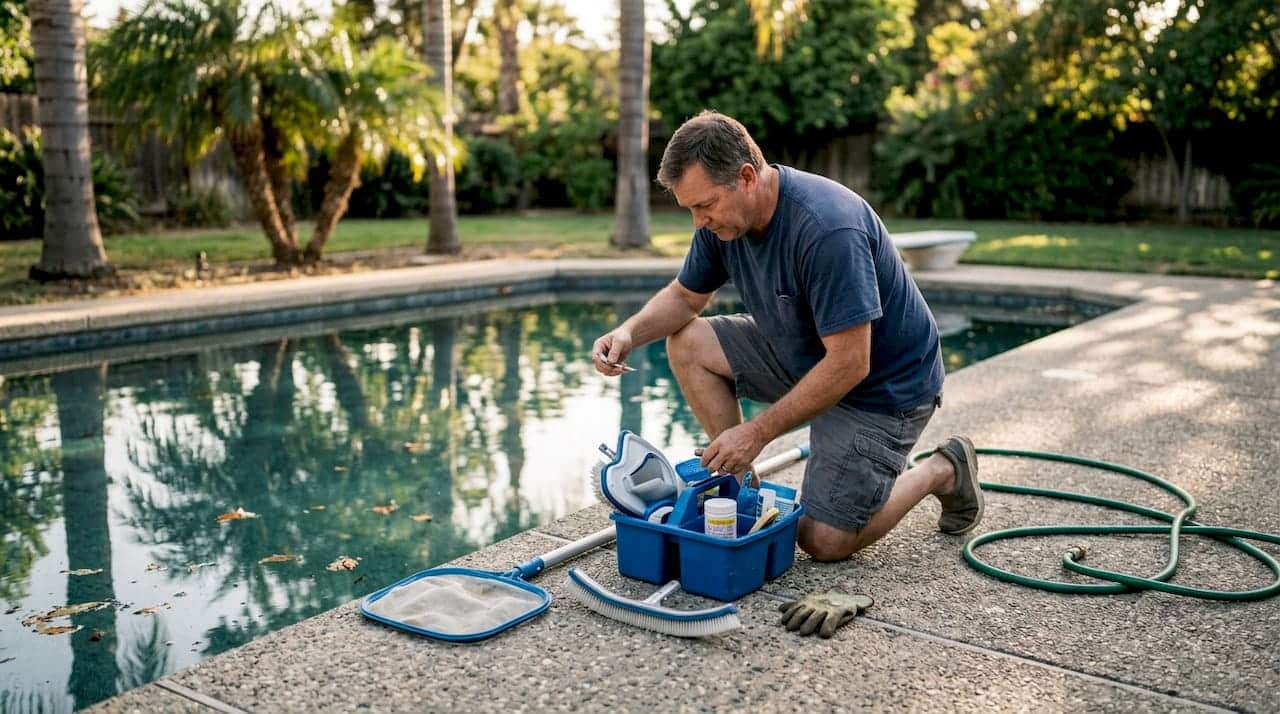
Before you can build a great maintenance routine, you need the right equipment in your hands. Think of your pool care supplies the way a chef thinks about a well-stocked kitchen. Without the right tools, even the best intentions fall short.
Here are the must-have items every Central Florida pool owner should keep on hand:
- Skimmer net: Removes leaves, insects, and surface debris before they sink and decompose.
- Pool brush: Scrubs walls, steps, and floor to prevent algae buildup. Use a stainless steel brush for concrete pools and a nylon brush for fiberglass.
- Manual or automatic vacuum: Clears settled debris from the pool floor. Robotic vacuums save significant time.
- Water test kit or digital tester: Measures pH, chlorine, alkalinity, and calcium hardness accurately.
- Chemical supplies: Chlorine tablets or liquid, pH increaser and decreaser, alkalinity increaser, and algaecide for backup.
- Filter-specific tools: Backwash hose for sand or DE filters, cartridge cleaning wand for cartridge filters.
Essential tools and supplies streamline regular pool care and prevent preventable issues, which means skipping even one item on this list can cost you more in repairs than the tool itself would have.
For quick access during your weekly routine, organize everything in a dedicated pool care caddy. Keep it near the equipment pad so nothing gets misplaced between sessions. You’ll also find more pool care tips useful once you have your supplies dialed in.
| Tool | Purpose |
|---|---|
| Skimmer net | Surface debris removal |
| Pool brush | Algae prevention on surfaces |
| Vacuum | Floor debris removal |
| Water test kit | Chemical balance monitoring |
| Backwash hose | Sand or DE filter maintenance |
| Cartridge cleaning wand | Cartridge filter rinsing |
Always store chemicals in a cool, dry place away from direct sunlight and never mix different chemicals together. If you’re just getting started, reviewing a guide on preparing for pool ownership will help you plan your supply setup before your first swim season.
Safety note: Wear gloves and eye protection when handling pool chemicals, and always add chemicals to water, never the reverse.
Step-by-step custom pool maintenance schedule
With your tools ready, it’s time to build a routine that makes expert maintenance feel effortless. Central Florida’s warm climate means your pool sees heavy use and heavy sun almost year-round, so a structured schedule isn’t optional. It’s essential.
Consistent pool care outperforms reactive fixes for preventing issues, which means the homeowners who spend 15 minutes a day on their pool spend far less on emergency repairs than those who only act when something goes wrong.
Here’s a practical breakdown:
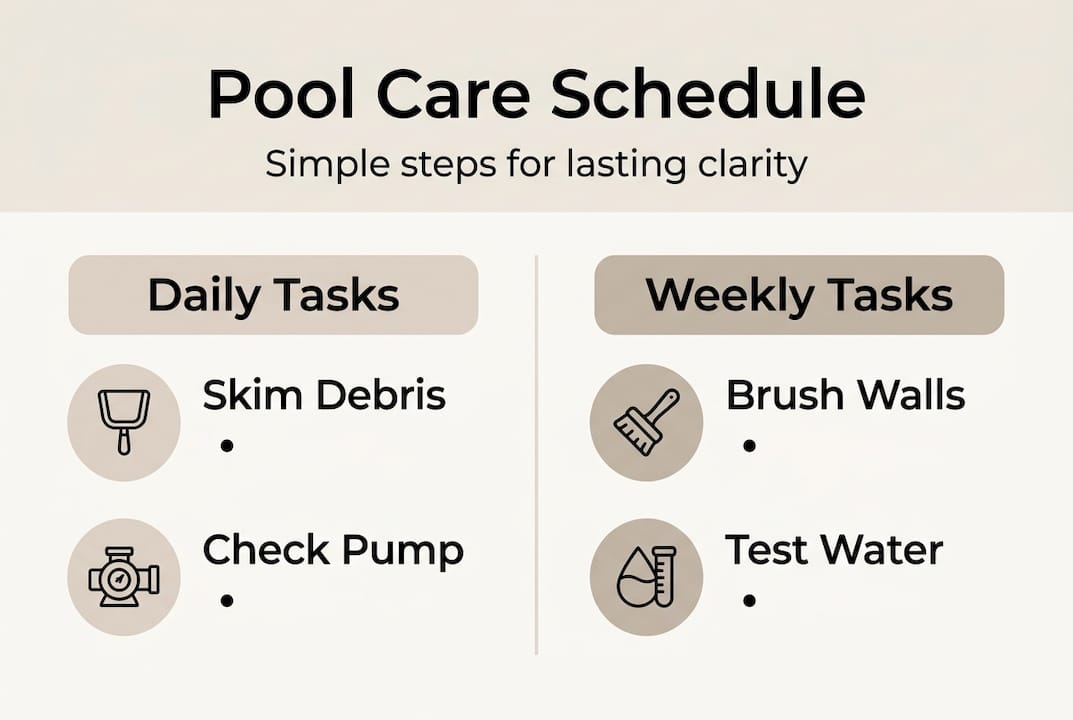
- Daily: Skim the surface, check the water level, and glance at the pump to confirm it’s running.
- Weekly: Brush walls and steps, vacuum the floor, test water chemistry, and add chemicals as needed.
- Monthly: Clean or backwash the filter, inspect pump baskets, check for leaks, and review equipment pressure gauges.
- Quarterly: Deep clean the filter, inspect heater and automation systems, and assess coping and tile for cracks or buildup.
| Frequency | Task |
|---|---|
| Daily | Skim surface, check pump operation |
| Weekly | Brush, vacuum, test and balance water |
| Monthly | Filter cleaning, equipment inspection |
| Quarterly | Deep filter clean, heater and tile check |
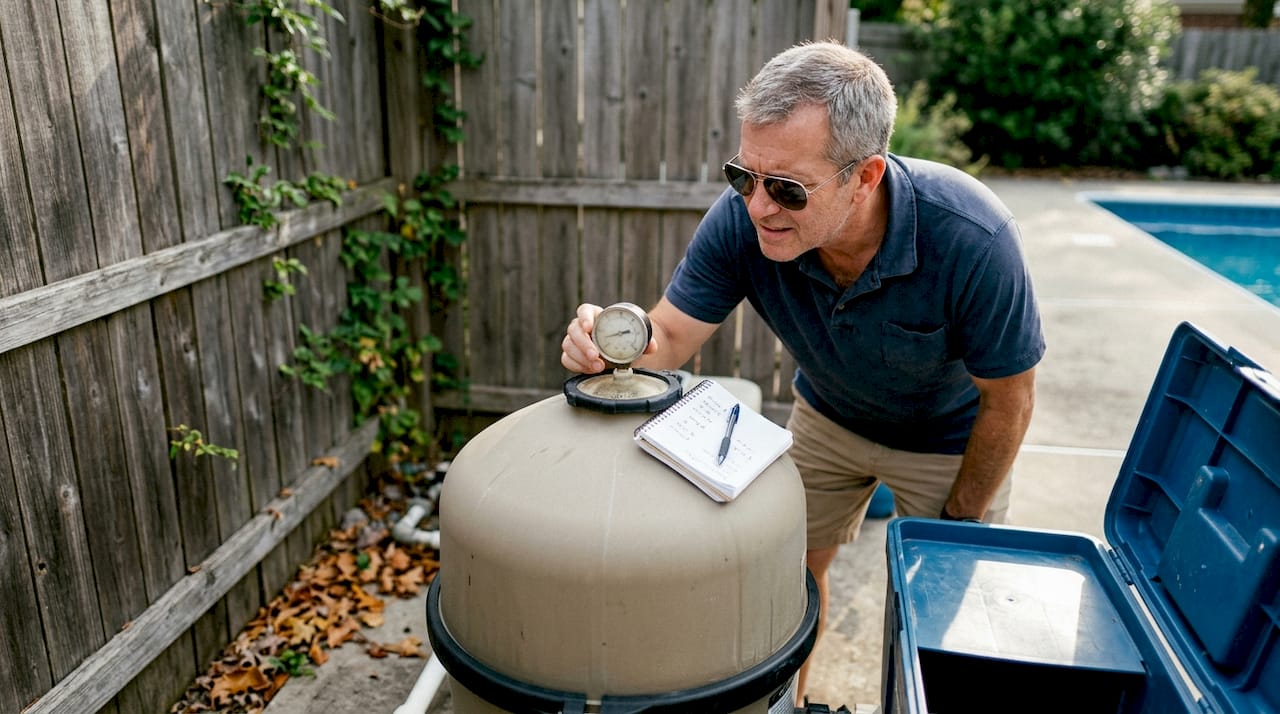
Pro Tip: Watch your filter pressure gauge every week. If the reading climbs 8 to 10 PSI above your normal starting pressure, that’s your earliest warning sign that the filter needs attention before flow restriction causes bigger problems.
During Florida’s rainy season, increase your water testing to twice a week. Heavy rainfall dilutes chlorine fast and can shift your pH significantly. If your pool gets heavy use during summer, bump up your brushing and vacuuming frequency too. Your installation guide may also include manufacturer-specific recommendations worth following alongside these pool maintenance schedules.
How to manage water chemistry for a custom pool
Maintenance routines alone won’t protect your pool unless your water stays balanced. This is where most homeowners either get it right and enjoy crystal-clear water, or get it wrong and spend weekends fighting green, cloudy, or irritating water.
Test your water weekly for these key parameters:
- pH: Target 7.2 to 7.8. Below 7.2 causes eye irritation and equipment corrosion. Above 7.8 makes chlorine ineffective.
- Free chlorine: Target 1.0 to 3.0 ppm for traditional pools.
- Total alkalinity: Target 80 to 120 ppm. This acts as a buffer for pH stability.
- Calcium hardness: Target 200 to 400 ppm. Low calcium etches plaster; high calcium causes scaling.
Saltwater pools have become popular in Central Florida because they feel gentler on skin and eyes. However, salt pools automate chlorination but need pH adjustment and cell care, meaning you still need to test regularly and clean the salt cell every few months to prevent calcium buildup.
For maintaining water quality in a saltwater pool, pH tends to drift upward over time, so you’ll use pH decreaser more often than chlorine pool owners expect.
Raising pH in a saltwater pool is rarely the issue. Lowering it is the constant task. Keep pH decreaser stocked and test after every heavy rain.
Pro Tip: After a Florida storm turns your pool green, shock the water immediately with a double dose of chlorine, brush every surface thoroughly, run the filter continuously for 24 hours, and test again before swimming. Acting within the first 12 hours prevents algae from rooting into plaster or fiberglass surfaces.
Filter and equipment maintenance: What every owner needs to know
Now that your water is dialed in, let’s look at essential routines for hardware and filter upkeep. Your filter is the kidney of your pool. If it stops working properly, everything else suffers quickly.
| Filter type | Routine maintenance | Deep cleaning |
|---|---|---|
| Sand | Backwash at 8-10 PSI over baseline | Every 6-12 months |
| Cartridge | Rinse weekly or biweekly | Every 6-12 months |
| DE (diatomaceous earth) | Backwash and recharge as needed | Every 6-12 months |
Sand, cartridge, and DE filters each require backwashing or rinsing on schedule and a deep clean every 6 to 12 months to maintain peak performance.
Beyond the filter, inspect these components monthly:
- Pump basket: Empty it weekly. A clogged basket starves the pump of water flow.
- Pump motor: Listen for grinding, humming, or vibration. These are early signs of bearing failure.
- Heater: Check for error codes and verify the thermostat is responding correctly.
- Automation system: Test all valves and timers to confirm they’re operating on schedule.
A rising pressure gauge is your pool’s way of asking for help. Ignoring it doesn’t make the problem smaller. It makes the repair bill larger.
For most filter cleaning and chemical adjustments, confident DIY is fine. But for anything involving electrical connections, plumbing leaks, or heater repairs, call a licensed professional. Knowing when to call a pro protects both your safety and your equipment warranty.
Troubleshooting common pool issues and mistakes
Even with the best routine, Central Florida’s climate throws surprises. Here’s how to handle the most common setbacks quickly and confidently.
Fast fixes for common problems:
- Green water: Shock immediately, brush all surfaces, run filter 24 hours, retest.
- Cloudy water: Check filter pressure, test and balance chemistry, add clarifier if needed.
- Noisy pump: Check for debris in the basket, air leaks at the lid, or low water level.
- Staining on surfaces: Identify the stain type (organic vs. metal) before treating. Wrong treatment makes it worse.
- Foam on the surface: Usually caused by body oils, lotions, or low calcium. Shower before swimming and check calcium levels.
Consistent checks and proactive intervention are key to long-term durability, which means the homeowners who avoid expensive repairs are almost always the ones who never skipped their weekly routine.
Pro Tip: Recurring algae blooms almost always trace back to one of three root causes. Poor circulation in dead zones like steps or corners, chronically low chlorine, or a filter that isn’t cleaning thoroughly. Fix the root cause, not just the symptom.
The most common mistakes we see Central Florida pool owners make include skipping filter checks for months at a time, using the same chemical dose year-round regardless of season, and ignoring early warning sounds from the pump. For more targeted pool troubleshooting tips, review our dedicated guide before your next maintenance session.
Our perspective: The secrets to effortless, stress-free custom pool care
After nearly four decades of building and supporting custom pools across Central Florida, we’ve noticed something consistent. The homeowners who enjoy their pools the most are not the ones with the fanciest equipment. They’re the ones with the simplest, most consistent habits.
Here’s the mindset shift that changes everything: stop thinking of pool maintenance as a chore you react to and start treating it as a five-minute daily check-in. Most pool problems don’t appear overnight. They build slowly over days of neglect. Catch them early, and the fix is a small chemical adjustment. Catch them late, and you’re draining the pool and calling a contractor.
Conventional wisdom says saltwater pools are “low maintenance.” That’s only half true. They reduce chlorine work but introduce new chemistry demands. No pool in Florida is truly set-and-forget.
The real secret is treating your filter pressure gauge like a vital sign. It tells you more about your pool’s health than any single chemical test. If you only check one thing daily, make it that gauge. Homeowners who follow this approach, along with planning a low-maintenance pool from the design stage, consistently spend less time and money over the life of their pool than those who don’t.
Take the next step to a custom pool you’ll love
Ready to put this knowledge to work for you?
At R&R Swimming Pools, we’ve spent over 40 years helping Central Florida homeowners get more out of their pools with less stress. Whether you’re still in the planning phase or looking to upgrade an existing pool, our Pool School gives you hands-on guidance from professionals who know Florida pools inside and out. If you’re ready to explore design options or need expert support, our custom pool installation guide is a great place to start. Reach out today to schedule a free consultation and discover how the right pool, built and maintained the right way, delivers enjoyment for decades.
Frequently asked questions
How often should a custom pool filter be cleaned?
Clean a sand filter every 6-12 months and backwash when pressure rises 8 to 10 PSI over baseline; rinse a cartridge filter weekly or biweekly, and backwash and recharge DE filters as needed.
What is the best way to keep custom pool water balanced?
Test weekly, target a pH of 7.2 to 7.8, and adjust chlorine or salt levels after rain or heavy sun exposure to maintain consistent water quality.
Can I do my own pool maintenance or should I hire a pro?
You can handle most basic care yourself, but complex electrical or plumbing repairs should always be handled by a licensed professional to protect your safety and equipment.
How can I prevent algae and cloudy water in my custom pool?
A consistent maintenance schedule, regular brushing, and keeping chlorine or salt levels in range are the most effective ways to prevent algae and cloudy water year-round.