
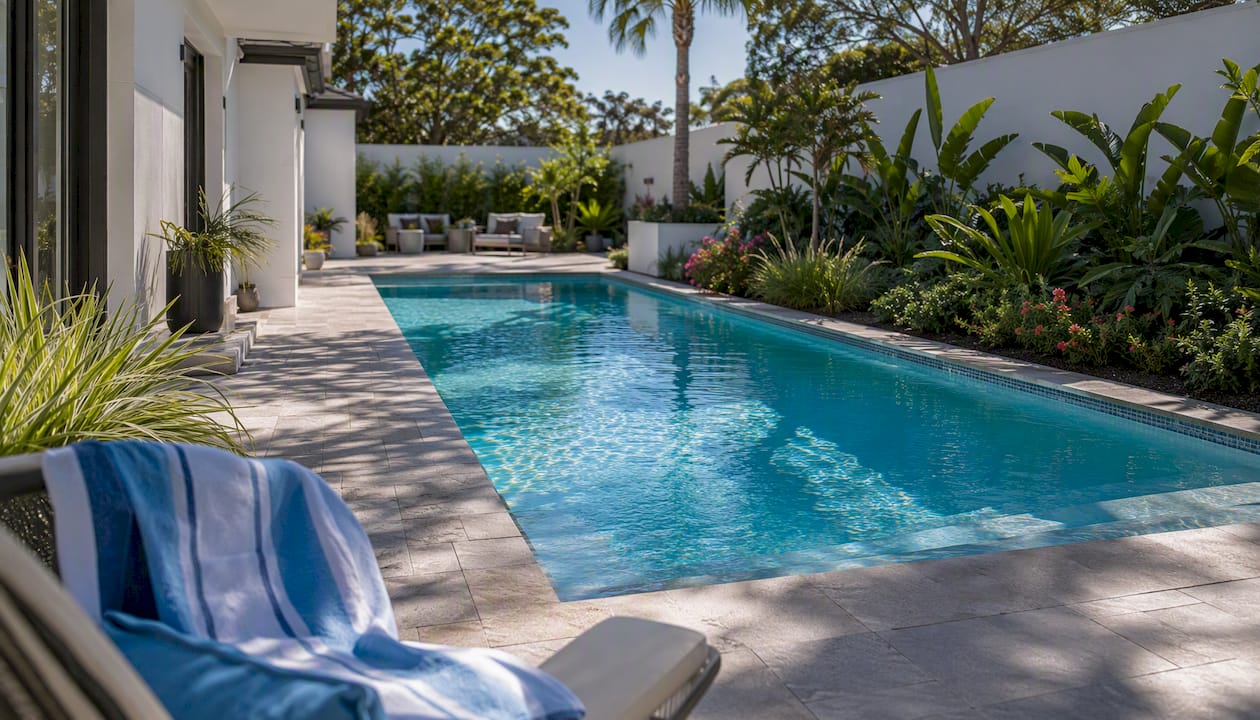
For a narrow yard, a purpose-built long, slim pool paired with multi-use features delivers the best balance of swimability and usable deck space. Think an elongated rectangle or narrow oval, not a shrunken version of your neighbor’s freeform lagoon.
- Small pools commonly fall under about 600 square feet, and a lap lane as narrow as 7 to 8 feet still supports real exercise.
- The best add-ons earn their footprint: a tanning ledge, built-in bench seating, or a swim-jet system that turns a short pool into a real workout lane.
- R&R Swimming Pools has designed and built custom inground pools for Central Florida yards of every shape since 1985, including plenty of tight, oddly-proportioned lots.
Pro Tip: Design for your actual footprint from day one. Trying to squeeze a full-size layout into a narrow lot almost always produces a cramped pool with no deck left over.
Key Takeaways
Narrow yard pools succeed when the shape, features, and materials are chosen specifically for the footprint rather than scaled down from a standard pool plan.
| Point | Details |
|---|---|
| Design for the footprint | Choose an elongated rectangle, narrow oval, or spool sized to your actual yard, not a shrunken standard pool. |
| Use the side setback | That narrow strip between house and property line often fits a lap lane or plunge pool perfectly. |
| Pick one signature feature | A tanning ledge, swim-jet system, or built-in bench earns its space better than several small add-ons. |
| Match materials to timeline | Gunite offers full customization with a longer build; fiberglass installs faster with less upkeep. |
| Work with local expertise | Randrswimmingpools has designed custom concrete and fiberglass pools for Central Florida’s tightest lots since 1985. |
Table of Contents
- How Do You Plan a Narrow Yard Pool Design?
- Which Pool Shapes Fit a Narrow Lot Best?
- What Features Add Function Without Adding Footprint?
- Which Materials and Finishes Work Best in Tight Spaces?
- How Do You Landscape and Light a Narrow Pool Yard?
- What Drives Maintenance, Timeline, and Cost?
- What Should You Ask a Pool Contractor Before Signing?
- What Usually Works Best for Narrow Yard Clients?
- Get a Narrow Yard Pool Design That Actually Fits Your Lot
- Frequently Asked Questions
- Sources
How Do You Plan a Narrow Yard Pool Design?
Before anyone sketches a shape, measure what you’re actually working with. Pull your property survey and walk the yard with a tape measure, not a guess.
Start with this checklist:
- Usable footprint after setbacks, easements, and any HOA restrictions
- Access points for excavation equipment (a narrow side yard often means a smaller excavator or a crane lift)
- Existing obstacles: mature trees, septic lines, utility boxes, drainage swales
- Space you want reserved for decking, landscaping, or a covered lounge area
Once you know the footprint, decide what matters most. Rank these in order:
- Primary use: lap swimming versus lounging and entertaining
- Year-round heating versus seasonal use only
- Seating and shallow-water space versus maximizing swim length
- Budget ceiling for the shell, decking, and features combined
Sketch the yard on graph paper or a free design app, labeling every dimension, gate location, and utility line. That sketch becomes the starting point for your first pool design conversation with a contractor, and it saves everyone a wasted site visit.
Which Pool Shapes Fit a Narrow Lot Best?
Four shapes consistently outperform the rest in tight side yards, and each solves a slightly different problem.
The elongated rectangle is the default for a reason: it maximizes swim distance in a strip of yard and keeps the deck lines simple. A narrow oval softens the corners, which can make a tight space feel less boxed in without sacrificing much length. An L-shaped corner lane works when your side yard turns a corner around the house. It wraps the pool around an existing structure instead of fighting it. A courtyard spool or cocktail pool suits yards where length simply isn’t available. This is often the right call for a side strip under 20 feet long.
One overlooked opportunity: the side setback itself. That narrow buffer between your house and the property line is frequently the exact right proportion for a lap pool or slim plunge pool, turning regulatory dead space into your best feature.
| Design goal | Typical width | Typical length |
|---|---|---|
| True lap swimming | 7–10 ft | 30–40 ft |
| Swim-jet resistance pool | 8–10 ft | 12–20 ft |
| Plunge or cocktail pool | 8–12 ft | 8 ft |
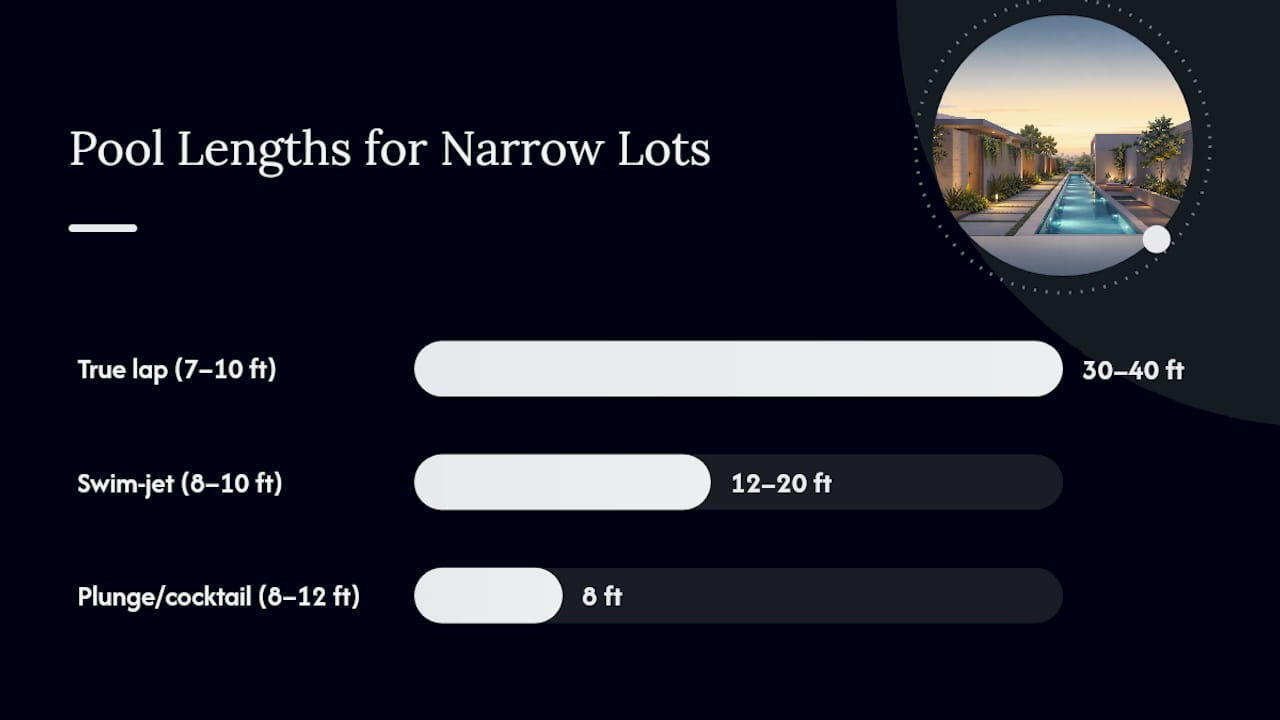
If you swim laps seriously, prioritize length over every other feature. If your yard tops out around 20 feet, a shorter pool with a swim-jet system will serve you better than a cramped attempt at real laps.
What Features Add Function Without Adding Footprint?
The features that matter most in a narrow pool don’t make the pool bigger. They make the pool do more.
A tanning ledge, or Baja shelf, is the single highest-value addition for a small pool. It doubles as a shallow lounging zone for adults and a safe wading spot for kids, all within a few feet of shell depth you’d need anyway. Built-in benches and perimeter seating tuck into the pool wall instead of eating deck space with freestanding furniture. For exercise, a swim-jet system lets you swim in place against adjustable resistance, which means a 15-foot pool can deliver a workout a 40-foot lap lane would otherwise require.
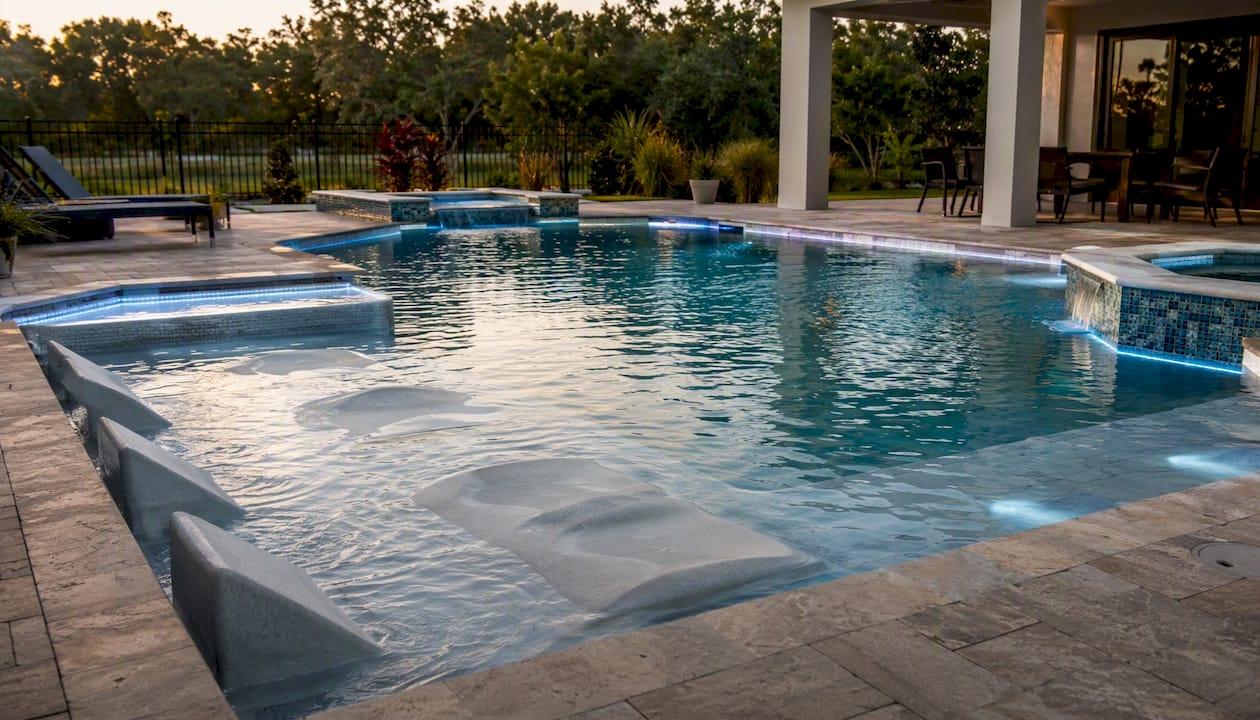
Resist the urge to add everything. Design professionals agree that in a small pool, every feature has to earn its space, and one well-chosen ledge or water feature almost always beats three small add-ons competing for the same 400 square feet.
Pro Tip: Pick one signature feature, a spillover spa, a tanning ledge, or a swim-jet wall, and build the rest of the design around it. A pool trying to do five things at once usually does none of them well.
Which Materials and Finishes Work Best in Tight Spaces?
Your shell material affects both installation logistics and how much deck you keep. Gunite, also called shotcrete concrete, offers near-unlimited shape customization, which matters when you’re fitting a pool around a tree or a utility line. It takes longer to install, several weeks to a few months depending on curing and finish work. Fiberglass ships as a preformed shell and installs much faster, often in days rather than weeks, with generally lower long-term maintenance. The trade-off is a fixed set of shapes and sizes.
| Factor | Gunite/concrete | Fiberglass |
|---|---|---|
| Shape flexibility | Fully custom | Preset shell shapes |
| Install time | Weeks to months | Days |
| Long-term upkeep | More surface care | Generally lower |
Decking matters just as much as the shell in a narrow yard. Composite decking, textured pavers, and stamped concrete all keep the perimeter slim while staying slip-resistant, a real concern around Central Florida pools that see bare feet year-round. Small-format tile on the waterline visually widens a tight space better than large slabs do. For equipment and fencing, slim metal panels or glass barriers preserve sightlines, and a compact pool fence design keeps the yard from feeling boxed in. Push equipment pads to an unused corner or side alley so they never compete with usable deck.
How Do You Landscape and Light a Narrow Pool Yard?
Privacy in a tight yard has to come from height, not width, since you rarely have room to spare on the sides. Slat fences, tall planters, and trellises with climbing vines all add screening without stealing deck inches. Vertical landscaping and continuous decking materials that run the yard’s full length also trick the eye into reading the space as bigger than it is.
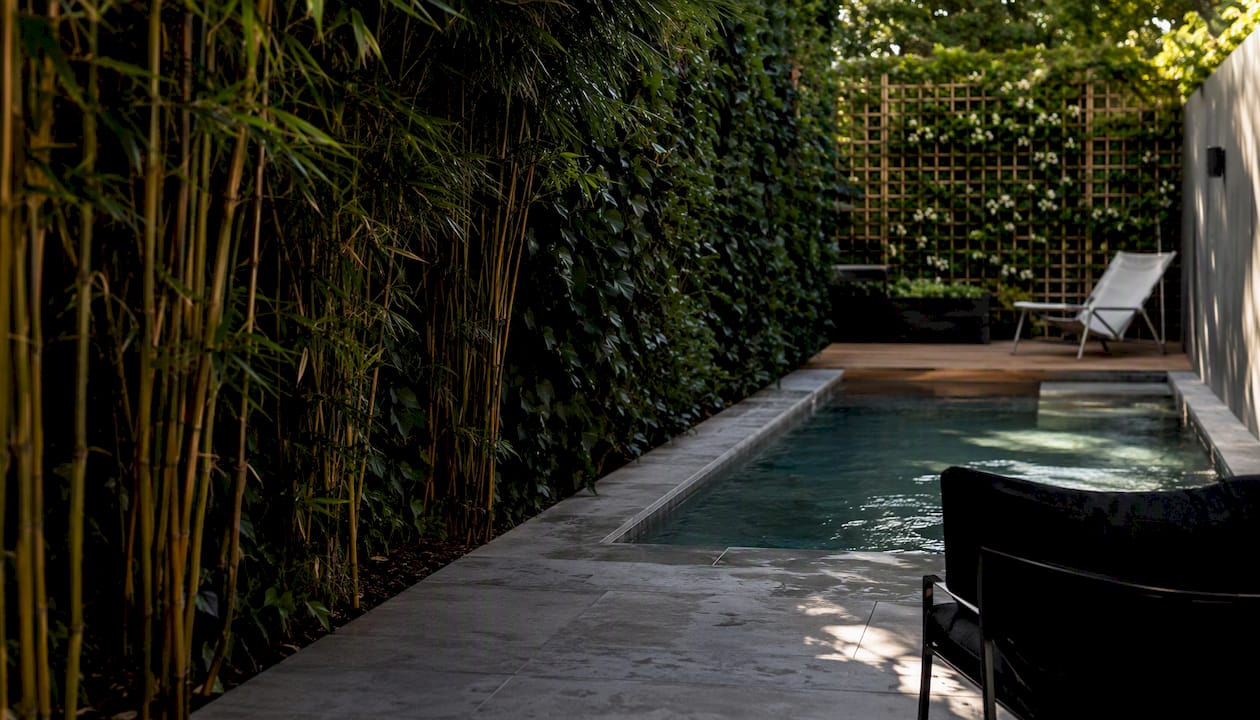
Lighting does similar work after dark. Recessed step lights, narrow LED strips under the coping, and low uplighting on planters all add ambiance without bulky fixtures crowding the walkway.
Orient the pool to catch afternoon sun where possible, and angle it away from neighboring windows rather than relying on fencing alone for privacy. If you’re weighing screening options against sightlines from indoor living spaces, this guide to privacy strategies covers vertical solutions worth considering before you finalize fence height.
Pro Tip: Run your decking material in one continuous line from the house to the far end of the pool. Breaking it up with multiple materials makes a narrow yard look choppier and smaller than it actually is.
What Drives Maintenance, Timeline, and Cost?
Smaller pools use less water and less energy to heat, which typically lowers day-to-day running costs compared to a full-size pool. That said, a smaller water volume also swings chemically faster, so you may find yourself testing and balancing more often, especially through a Florida summer.
Drainage and equipment access deserve attention early, not as an afterthought. Pumps and filters should sit somewhere that doesn’t block a walkway or eat into your deck, and drainage needs to move water away from the shell and any adjacent structures.
What actually drives your timeline and budget:
- Excavation access. A yard reachable only through a narrow side gate may need smaller equipment and more labor hours.
- Shell choice. Fiberglass moves faster; gunite takes longer but allows tighter, more custom shapes.
- Permitting. Local approvals and required inspections add weeks regardless of shell type.
- Feature selection. A tanning ledge or spillover spa adds cost, but usually less than adding pool length would.
What Should You Ask a Pool Contractor Before Signing?
A narrow yard is a specialty job, so treat the first meeting like an interview, not a formality.
Bring your yard sketch and ask directly:
- Have you built pools in yards this narrow, and can I see photos of similar projects?
- What’s your access and rigging plan for equipment given my gate and setback widths?
- Where do you propose putting the equipment pad, and how does that affect my deck space?
- What’s the realistic timeline from permit to first swim?
- Can you provide proof of license, insurance, and warranty terms in writing?
Confirm permits and utility locates get pulled before any digging starts, and ask what setbacks apply to your specific lot. Watch for red flags: a contractor who won’t commit to a timeline, can’t produce license or insurance numbers on request, or has no local references for tight-lot work. Those are signs to keep looking.
What Usually Works Best for Narrow Yard Clients?
The projects that turn out best almost always push the pool toward one property edge and commit to a single standout feature instead of a wish list. Clients who fight that instinct, trying to fit a tanning ledge, a spa, and a full lap lane into 18 feet, usually end up cutting something mid-project anyway.
Local portfolio work across Central Florida’s older, tighter subdivisions has shown this pattern often enough that R&R Swimming Pools leads with a design-first conversation before anyone talks shapes or materials.
Get a Narrow Yard Pool Design That Actually Fits Your Lot
R and R Swimming Pools has built custom concrete and fiberglass pools across Central Florida since 1985, and narrow, oddly-shaped lots are where that decades of experience shows the most. A generic pool company sketches a shape and hopes it fits. Randrswimmingpools starts with your actual property lines, setbacks, and gate access, then designs the shell, decking, and features around what your yard can genuinely hold.
Licensed, insured, and familiar with local permitting across the region, the team walks new clients through financing options and a realistic timeline before any contract gets signed. Bring a yard sketch, your top priority (laps, lounging, or entertaining), and a few photos of features you like. From there, book a free consultation on custom pool installation and get a design built around your lot, not a catalog shape forced into it.
Frequently Asked Questions
What is the minimum yard width for an inground pool?
Most narrow lap pools need at least 10 to 12 feet of usable width to accommodate the pool, coping, and a walkway on at least one side. A plunge pool or spool can work in tighter spans, sometimes as narrow as 8 feet.
Are narrow lap pools good for exercise?
Yes. A lane 7 to 8 feet wide and 30 to 40 feet long supports genuine lap swimming, and a shorter pool paired with a swim-jet system delivers comparable resistance training in far less space.
Does a narrow pool cost less than a standard pool?
Generally yes, since smaller water volume and shorter shells typically reduce excavation, materials, and heating costs, though features like tanning ledges or swim jets add back some of that savings.
Can you add a spa to a narrow pool design?
A spillover spa fits well in many narrow layouts, but it’s usually best as your one signature feature rather than paired with a tanning ledge and extended lap space in the same tight footprint.
