
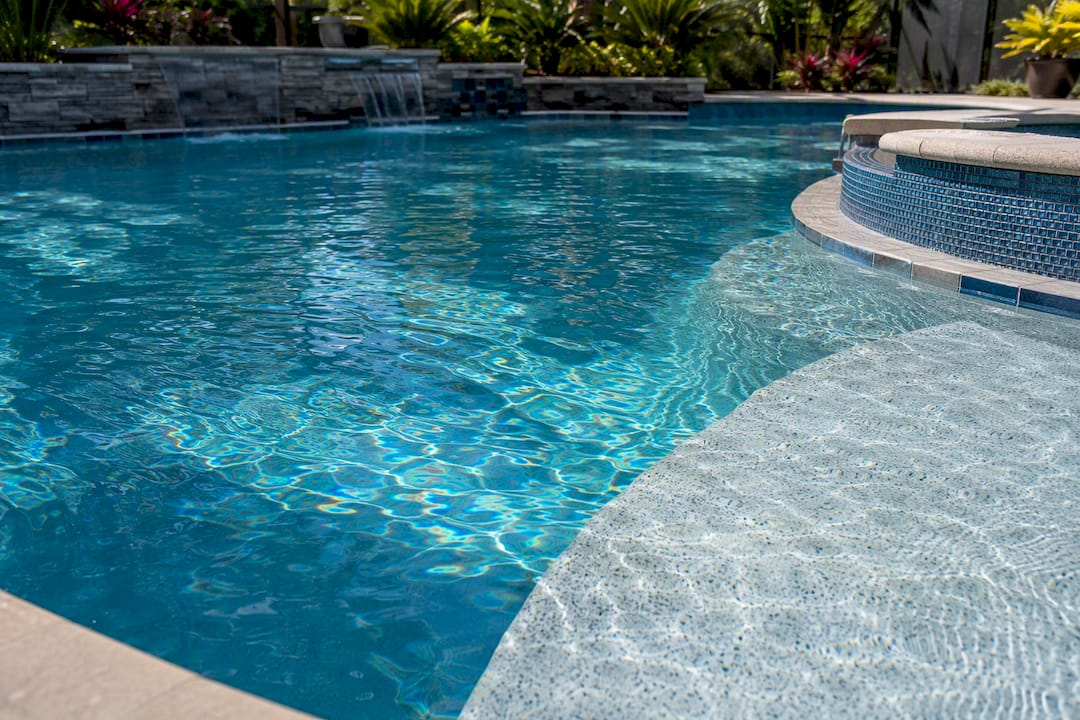
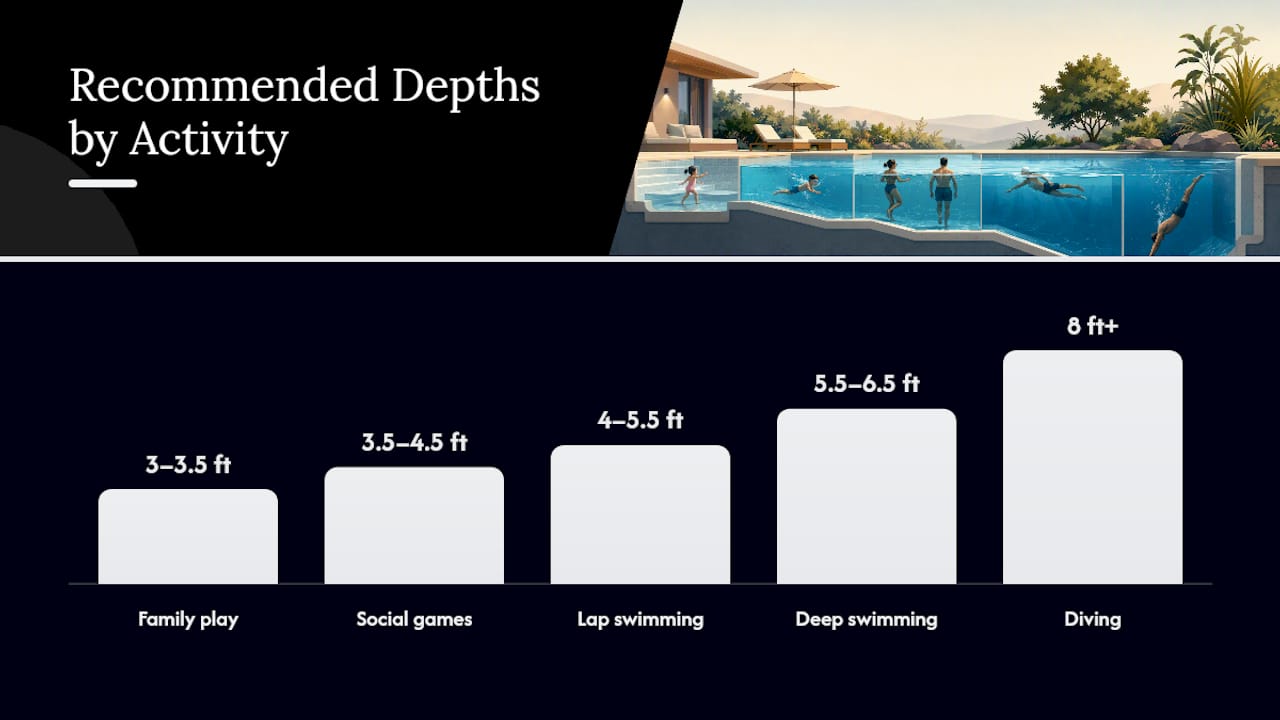
Design your pool depth around what your family actually does in the water, not around a single dramatic deep end. Most residential pools work best with a shallow zone around 3’ to 3.5’ for standing and kids, 3.5’ to 4.5’ for games and social play, 4’ to 5.5’ for lap swimming, and 5.5’ to 6.5’ for a comfortable deep section. Diving is its own category entirely: it demands a deep section starting at around 8 feet and a code-compliant diving envelope under the International Swimming Pool and Spa Code (ISPSC).
Construction adds one more variable. Every builder works within a tolerance of about ±3 inches on overall depth, so a “6-foot” pool might finish at 5’9″ or 6’3″ and still meet spec. Randrswimmingpools has spent decades in Central Florida sorting activity wish lists from actual daily use, and that experience shapes every recommendation below.
- Shallow/standing: 3’ to 3.5’
- Family play and games: 3.5’ to 4.5’
- Lap or sport swimming: 4’ to 5.5’
- Deep/swim section: 5.5’ to 6.5’
- Diving: 8’+ with a full ISPSC diving envelope
Key Takeaways
Pool depth planning works best when depth zones follow real activities and stay inside ISPSC code minimums rather than chasing a single impressive number.
| Point | Details |
|---|---|
| Design by activity first | Match depth zones to standing, play, lap swimming, and deep-water use before finalizing a shape. |
| Respect the code floor | ISPSC requires shallow points between 33 inches and 4 feet, with entry/exit required past 24 inches. |
| Watch the transition point | Shallow-to-deep transitions must sit at least 6 feet from the shallow end at 33+ inches deep. |
| Treat diving separately | Diving needs 8+ feet and a full ISPSC diving envelope, not a deeper corner added later. |
| Confirm tolerances early | Ask whether depth numbers are design targets or within the standard ±3 inch construction tolerance, and rely on a contractor like Randrswimmingpools for site evaluation and code review. |
Table of Contents
- Pool Depth Planning: What It Is and Why It Matters
- Common Mistakes Homeowners Make Choosing Pool Depth
- Recommended Pool Depth Ranges by Activity
- Safety Rules and Code Requirements That Shape Your Depth
- Your Pool Depth Checklist for the Contractor Meeting
- What Builders Know About Depth That Homeowners Rarely Hear
- How Randrswimmingpools Helps You Finalize Depth Decisions
- Frequently Asked Questions
- Sources
Pool Depth Planning: What It Is and Why It Matters
Pool depth planning is the process of matching your depth zones to the way your household will actually use the pool, then building in the safety margins code requires. It sounds simple until you realize how many competing pressures pull on that single decision.
Go deeper than you need and you pay for it twice: more excavated dirt, more water to heat, more chemicals to balance, and less usable standing area for the people who actually swim there. A pool that’s mostly 3.5 feet deep costs less to run and gets used more often than one built around a rarely-used 7-foot section. Cost factors tied to depth compound over the life of the pool, not just at closing.
If diving happens once a summer at a friend’s house, that’s not a reason to reshape your entire pool geometry around a diving envelope.*
Common Mistakes Homeowners Make Choosing Pool Depth
Homeowners tend to chase the wrong number. A deep end sounds impressive on paper, but it rarely earns its cost in actual use.
- Prioritizing a dramatic deep end over a functional shallow zone where most swimming happens
- Requesting a diving board without understanding the code-mandated envelope and liability it triggers
- Skipping gradual transitions or entry points, which makes the pool harder and less safe to use
- Ignoring construction tolerances and site constraints until after the contract is signed
Guiton’s Pool Center notes that effective planning keeps most residential depths in the 3 to 5.5 foot range, reserving anything deeper for pools specifically engineered around diving.
Deeper isn’t better. It’s just more expensive to heat, harder to maintain, and often the least-used part of the pool.
Recommended Pool Depth Ranges by Activity
Depth planning gets much easier once you sort by what actually happens in each zone, rather than trying to pick one number for the whole pool.
Family play and kids. A shallow zone from 3’ to 3.5’ supports standing, splashing, and lounging. Wide, extended shallow areas, sometimes called tanning ledges, get used constantly because they double as a spot to sit with a drink and keep an eye on younger swimmers. Family-focused depth guidance backs this up: extra shallow footage tends to outperform extra deep footage in daily use.
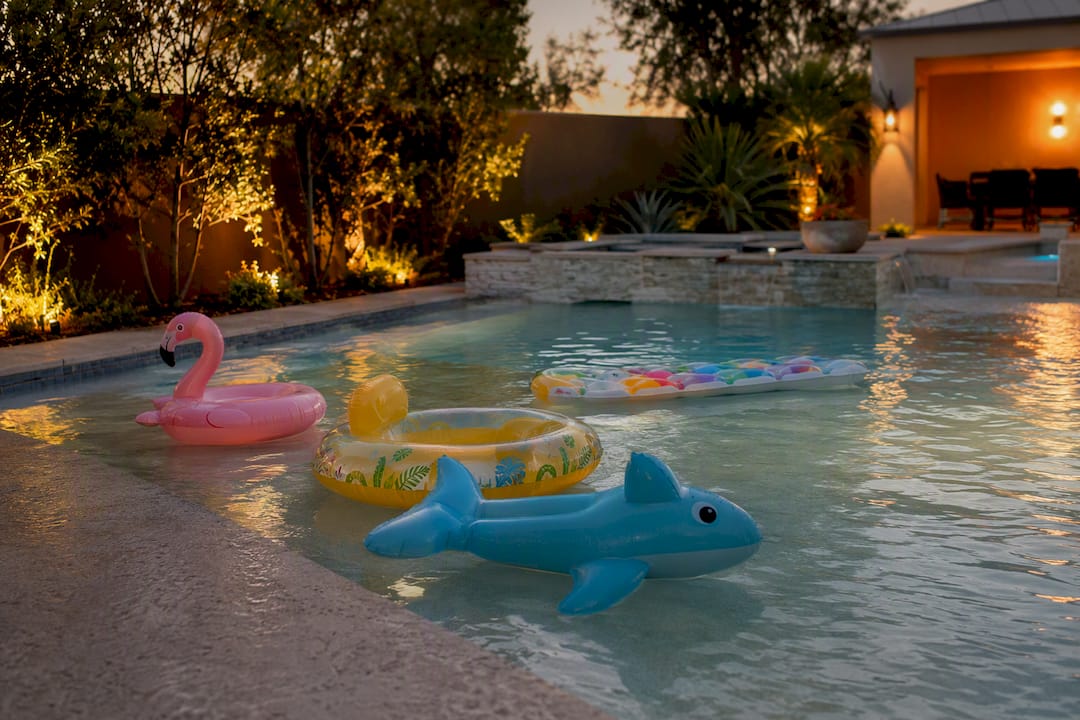
Social play and games. Water basketball or volleyball need enough depth to stand and jump without touching bottom awkwardly, typically 3.5’ to 4.5’.
Lap swimming. A flat or gently sloped run of 4’ to 5.5’ gives adults room to swim laps without scraping the bottom on turns. If lap swimming is a priority, talk to your builder about a straighter, more rectangular footprint to support it.
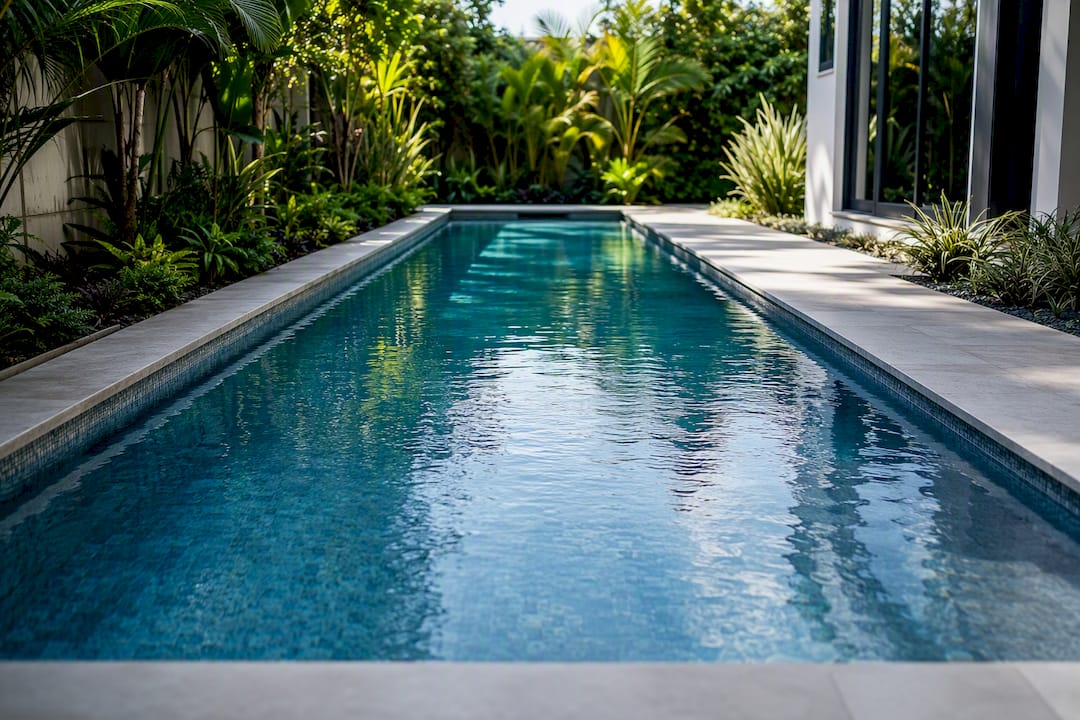
Deep or swim sections. For teens and adults who want water deep enough for comfortable strokes and turns, 5.5’ to 6.5’ is the practical range. Research from pool builders points to this same 5 to 6.5 foot band as the new norm for deep ends, replacing the old 8-foot standard.
Diving. Diving requires a specific ISPSC diving envelope, generally 8 feet or deeper, engineered around board height and distance. Treat this as a specialized, whole-pool design decision, not an add-on.
Benches and swimouts. Shallow shelves at 15 to 18 inches placed near steps or corners add social seating without eating into swimmable depth elsewhere.
Safety Rules and Code Requirements That Shape Your Depth
Code sets the floor, not the ceiling, for depth decisions. Under the ISPSC 2021, the shallowest point of a residential pool must fall between 33 inches and 4 feet. Any shallow area deeper than 24 inches needs a means of entry and exit, such as steps, a bench, or a swimout.
The transition from shallow to deep isn’t arbitrary either. Code requires that transition point to occur at least 6 feet from the start of the shallow end, at a depth no less than 33 inches below the design waterline. Slope matters too: ISPSC 2015 caps the floor slope between the shallow start and the transition point at 1 vertical foot for every 7 horizontal feet, which is why a sudden drop-off isn’t an option.
A pool isn’t just deep or shallow. Every transition, every slope, and every entry point is governed by dimensions someone measured for a reason.
Diving adds another layer: Table 804.1 in the ISPSC spells out minimum water envelopes by board height, meaning the whole pool geometry has to accommodate it. And remember the ±3 inch construction tolerance on overall depth. That’s normal, expected, and worth confirming with your contractor before the crew breaks ground.
Your Pool Depth Checklist for the Contractor Meeting
Bring this list to your estimate meeting so nothing critical slips through:
- List your top 1 to 3 activities and design depth zones around them first.
- Ask about site limits, water table, easements, or retaining costs that could restrict achievable depth.
- Confirm which ISPSC rules apply to your design, particularly shallow depth minimums and transition placement.
- Request drawings that mark exact transition points, and ask whether dimensions are “design” or “within tolerance” (±3 inches).
- Ask where entry and exit points will go for both shallow and deep zones, especially if any depth exceeds 48 inches.
- Get a rough estimate of how depth affects water volume, heating time, and chemical cost.
Pages like the step-by-step pool design guide and the accessibility design guide cover the drawing and entry/exit details in more depth if you want to review them before your appointment.
What Builders Know About Depth That Homeowners Rarely Hear
Every dig has a tolerance built in, generally ±3 inches on overall depth. Ask your builder directly whether a quoted number is the design target or the acceptable range, because those are two different promises.
Slope limits also shape how much usable shallow area you actually get. A gentler slope eats more horizontal footage before reaching the transition point, which matters if your yard is tight. And subsurface conditions, especially a high water table or unstable soil, can force a shallower design or add engineering costs you didn’t plan for. Excavation realities in Central Florida vary block to block.
Pro Tip: Request a site evaluation before locking in your dig depth. It’s far cheaper to adjust a drawing than to issue a change order mid-excavation.
A Contractor’s Take on Getting Depth Right
After decades of builds, the pattern holds: pools with generous shallow zones and one confidently deep section get used more than pools built around maximum depth everywhere. A layout with an extended 3.5-foot shallow shelf paired with a single 6-foot section tends to outperform a uniform 5-foot pool for family satisfaction. Depth choices also follow you at resale, so build for how you live now, not for a feature you’ll use twice.
How Randrswimmingpools Helps You Finalize Depth Decisions
Once you know roughly what you want, the real work is translating it into a code-compliant, buildable design. R and R Swimming Pools has designed and installed custom concrete and fiberglass pools across Central Florida since 1985, and depth planning is where a lot of that experience earns its keep.

Rather than guessing at ranges from a blog post, you get a site evaluation, a code review against ISPSC requirements, and construction drawings that spell out exact transition points before anyone breaks ground. That matters more with concrete, where depth is fully customizable, than with fiberglass shells, which come with preset depth profiles you’ll want to compare against your activity list early. If you’re leaning toward a fully custom shape, the concrete pool building page walks through how depth flexibility factors into that choice. When you’re ready to move from planning to a real quote, start with the inground pool installation guide and schedule a consultation with the local team.
Frequently Asked Questions
How deep should a backyard pool be for a family with young kids?
A shallow zone of 3’ to 3.5’ works well for standing, play, and supervision, paired with a deeper section of 5.5’ to 6.5’ if older kids or adults want to swim.
What is the minimum legal depth for a residential pool?
Under the ISPSC, the shallowest point must fall between 33 inches and 4 feet, and any shallow area deeper than 24 inches requires a means of entry or exit.
Do I need a deep end if I don’t plan to dive?
No. Most families are better served by a moderate deep section around 5.5’ to 6.5’ rather than a full diving envelope, which requires 8+ feet and specific code-mandated dimensions.
How much does depth affect pool cost?
Deeper profiles increase excavation, water volume, heating time, and chemical use, all of which raise both build and ongoing operating costs.
Can I add a diving board later if I build a moderate depth pool now?
Generally no. Diving envelopes affect the entire pool geometry, so retrofitting one into an existing design usually isn’t feasible without significant reconstruction.
Sources
- Pool Depth and Size: What Really Works for Family Use
- Pool Depth Planning: What Most Homeowners Get Wrong – Guiton’s Pool Center
