
TL;DR:
- Pool installation in Ocala begins with obtaining permits, which take 4 to 8 weeks and require detailed documentation. Delays often result from incomplete applications or late design changes, emphasizing the importance of early planning and a licensed contractor. The most critical phase is the permit process, which determines the project’s schedule and final completion timeline.
The Ocala pool installation process is a defined sequence of steps covering site assessment, permit acquisition, construction, and final county inspection before you can legally use your new pool. Marion County requires a building permit for every residential inground pool, and that permit submission date starts your official construction clock. Randrswimmingpools has built custom concrete and fiberglass pools across Central Florida since 1985, and the most common mistake homeowners make is treating excavation as the starting line. The real starting line is the permit application. Understanding each phase before you commit saves money, time, and serious frustration.
What permits and approvals are needed before pool construction in Ocala?
Marion County requires a building permit for every inground pool, and you submit that permit through the Civic Access portal, which launched in november 2025 as the county’s unified digital submission system. Getting your application right the first time is the single most effective way to protect your schedule.
Your permit package must include:
- Sealed architectural drawings prepared and stamped by a licensed engineer
- A site plan showing pool placement, setbacks, and drainage
- Flood zone determination for your specific parcel
- Notice of Commencement (NOC) for any project valued over $5,000
- Proof of contractor licensure for all trades involved
The permitting phase runs 4–8 weeks and is consistently the longest single stage in the entire build. That timeline reflects licensed engineer stamps, municipal plan reviews, and the reality of application backlogs. An incomplete submission resets that clock entirely.
Homeowners who want to act as their own general contractor can do so through an owner-builder affidavit. However, owner-builders assume full legal and financial liability for code compliance, inspections, and safety under the Florida Building Code. That responsibility is significant. Most homeowners find that hiring a licensed contractor with a clean permit record moves the process faster and with far less personal exposure.
Pro Tip: Submit your permit application with every required document in one package. A single missing item, such as a contractor license number or the NOC, can add weeks to your approval timeline.
How do you prepare your property and design your pool for Ocala’s site conditions?
Central Florida’s soil and groundwater conditions directly affect how your pool is built. Ocala sits on sandy, porous soil with a water table that varies significantly by neighborhood and season. Homeowners consistently underestimate how much groundwater levels and soil conditions can complicate excavation and extend the construction schedule.
A proper site assessment before permit submission covers:
- Soil type and bearing capacity to determine excavation method and shell support
- Groundwater depth to assess dewatering needs during excavation
- Setback requirements from property lines, utilities, and structures
- Utility locates to identify underground lines before any digging begins
Your design choices must be locked in before you submit your permit application. Tile, coping, decking material, equipment layout, and any water features like waterfalls or spa spillways all need to appear in the permitted drawings. Changing design details after submission requires an amended permit, which restarts the approval timeline and delays your legal start date. That is a costly mistake that Randrswimmingpools helps clients avoid by walking through every design decision during the pre-permit consultation.
For a detailed look at how to evaluate your yard before breaking ground, the Florida yard preparation guide from Randrswimmingpools covers soil conditions, drainage planning, and site readiness specific to Central Florida properties.

Pro Tip: Treat your design meeting like a final exam. Every finish, fixture, and feature you decide after permit submission costs you time and money in amended drawings and re-review fees.
What happens during each construction phase, from excavation to final inspection?
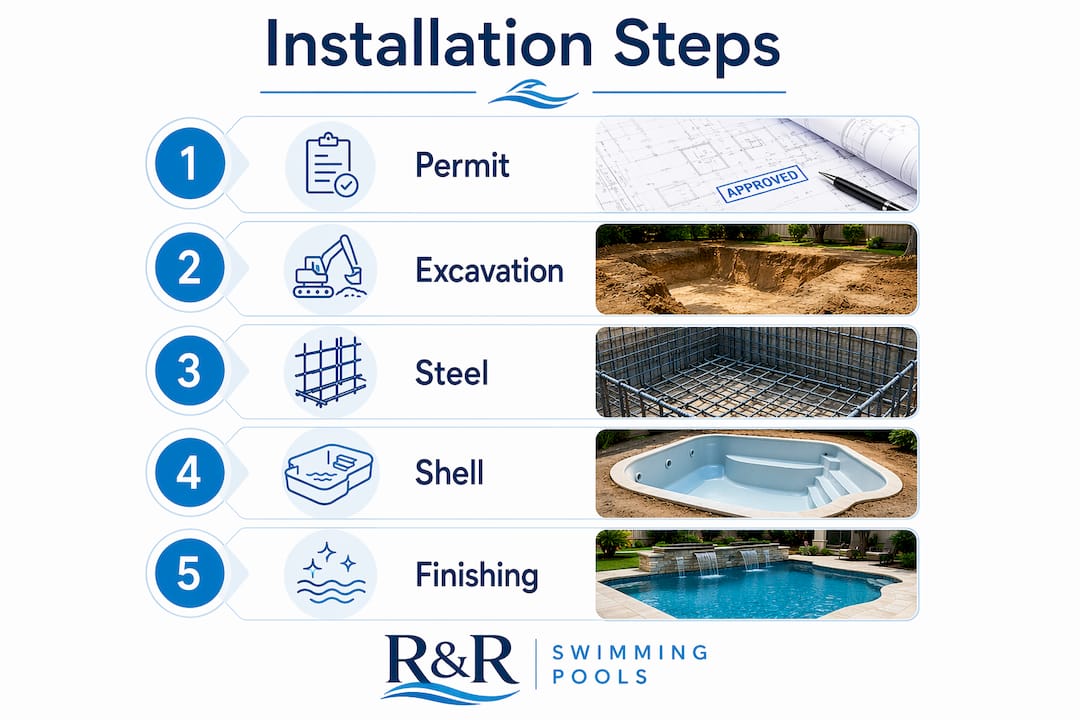
Once your permit is issued, construction moves through a defined sequence. Custom gunite pools in Florida typically run about 13 weeks from permit issuance to final inspection, broken down across the following phases.
Phase-by-phase construction breakdown
- Excavation (1–3 weeks): Heavy equipment digs the pool shell to engineered dimensions. Inspectors verify depth and footprint before steel work begins.
- Steel framework and plumbing rough-in (1–3 weeks): Rebar is tied into the shell shape. Plumbing lines are laid and pressure-tested before any concrete is applied.
- Gunite or fiberglass shell application: For concrete pools, gunite is pneumatically applied over the steel frame. For fiberglass pools, the prefabricated shell is craned into the excavated hole.
- Shell curing (28 days minimum): After gunite application, the shell must cure for at least 28 days while kept moist to prevent cracking. Surface cracks during this period are normal and addressed at the finish stage.
- Tile, coping, and decking (2–4 weeks): Waterline tile is set, coping is installed around the shell perimeter, and decking material is poured or laid.
- Equipment installation: Pump, filter, heater, automation controls, and any solar energy systems are mounted and connected. Homeowners interested in pairing their pool with energy-efficient systems can explore commercial solar options in Ocala that may apply to residential properties as well.
- Interior finish and pool fill (1–2 weeks): Plaster, pebble, or quartz finish is applied to the shell interior. The pool is filled immediately after application begins to prevent the finish from drying unevenly.
- Startup and water chemistry balance: Equipment is commissioned, water chemistry is balanced, and the pool enters a startup brushing and chemical program.
- Final inspections and certificate of completion: Building, plumbing, and electrical inspections are completed. The certificate of completion must be issued before the pool is handed over to you.
| Phase | Typical Duration |
|---|---|
| Permit issuance | 4–8 weeks |
| Excavation and steel | 1–3 weeks |
| Shell application and cure | 4–5 weeks |
| Tile, coping, and decking | 2–4 weeks |
| Finish, fill, and startup | 1–2 weeks |
| Final inspection | 1–2 weeks |
Pro Tip: Never accept your pool without the official county certificate of completion in hand. That document confirms every building, plumbing, and electrical inspection has passed and is recorded with Marion County.
What causes delays in Ocala pool installations and how do you avoid them?
Delays in the Ocala backyard pool installation process almost always trace back to one of three sources: incomplete permit applications, weather, or mid-project design changes. Knowing these risks in advance lets you plan around them.
- Incomplete permit submissions are the most common delay trigger. A missing contractor license number or an unsigned NOC sends your application back to the start of the review queue.
- Florida’s rainy season runs from june through september. Excavation and finishing phases slow significantly during heavy rain periods. Timing your permit submission in january or february gives you the best chance of breaking ground before the rains arrive.
- Groundwater surprises during excavation can require dewatering equipment and additional engineering review, adding days or weeks to the schedule.
- Mid-project changes to tile, coping, or equipment require amended permits. Those amendments reset the approval clock and delay every phase that follows.
- Inspection queue timing matters. Contractors with established relationships with Marion County inspectors move through the queue faster. Licensed contractors with clean permit records consistently experience fewer inspection delays than owner-builders or contractors new to the county.
Finalizing every design and material choice before permit submission is the single most effective schedule protection available to a homeowner. Post-permit changes do not just cost money. They cost weeks.
Pro Tip: Ask your contractor for their Marion County permit history before signing a contract. A builder with a track record of clean, complete submissions will protect your schedule far better than one with a history of amended applications.
For a full breakdown of what drives timeline variability in Florida pool projects, the pool building timeline guide from Randrswimmingpools covers local factors in detail.
Key Takeaways
The Ocala pool installation process runs from permit submission through final county inspection, and the permit phase is the single greatest source of schedule risk for Central Florida homeowners.
| Point | Details |
|---|---|
| Permit submission starts the clock | Your official construction timeline begins at application, not at excavation. |
| Complete submissions protect your schedule | Missing one document resets the 4–8 week permit review from the beginning. |
| Lock in design choices early | Post-permit changes require amended drawings and restart the approval timeline. |
| Gunite pools cure for 28 days minimum | The shell must stay moist throughout curing to prevent structural cracking. |
| Certificate of completion is non-negotiable | Never accept pool handover without this document confirming all inspections passed. |
What I’ve learned from watching Ocala pool projects succeed and fail
After working with Central Florida homeowners for decades, the pattern is clear. Projects that run smoothly share one trait: every decision was made before the permit was submitted. Projects that run over budget and over schedule share a different trait: the homeowner treated the permit as a formality and kept changing their mind after construction began.
Marion County’s permitting staff are professional and thorough. They are not the enemy of your schedule. Incomplete applications are. I have seen projects delayed by six weeks because a contractor’s license number was missing from the initial submission. That is a preventable problem.
The rainy season is not a surprise. It arrives every year in june. If you submit your permit in the fall or winter, you give yourself the best chance of completing excavation and shell work before the summer rains slow everything down. That timing decision alone can shave weeks off your total project duration.
My strongest recommendation is to hire a licensed pool contractor with a documented history of clean permit submissions in Marion County. The cost difference between a contractor with local relationships and one without is invisible on paper but enormous in practice. Inspection queues move faster for builders inspectors know and trust. That is not favoritism. It is the reality of how municipal construction oversight works.
Finally, budget for the unexpected. Residential inground pools in Florida typically cost between $35,000 and $120,000, with most custom concrete projects landing between $65,000 and $90,000. Groundwater surprises, soil conditions, and material lead times can push costs toward the upper end of that range. Homeowners who plan for contingency spend less time stressed and more time enjoying their pool.
— Results
Randrswimmingpools: your Central Florida pool installation partner
Randrswimmingpools has guided Central Florida homeowners through every stage of the pool construction process Ocala and the surrounding region demands since 1985. From the first design consultation through Marion County permit submission and final inspection, the team manages the details that protect your schedule and budget.
The R and R Swimming Pools team handles sealed drawings, permit coordination, contractor license documentation, and inspection scheduling so you are not navigating the county portal alone. Every project starts with a free quote and a design session that locks in your choices before a single document is submitted. For a complete walkthrough of what to expect from start to finish, the inground pool installation guide covers every phase specific to Central Florida homes. Contact Randrswimmingpools today to schedule your free consultation.
FAQ
How long does the Ocala pool installation process take?
The full process from permit submission to final inspection takes approximately 17–21 weeks for a custom gunite pool, with the permit phase alone running 4–8 weeks.
What documents are required for a Marion County pool permit?
You need sealed architectural drawings, a site plan, flood zone determination, a Notice of Commencement for projects over $5,000, and proof of contractor licensure.
Can I act as my own contractor for a pool build in Ocala?
Yes, through an owner-builder affidavit, but you assume full legal and financial liability for code compliance, inspections, and safety under the Florida Building Code.
How much does pool installation in Ocala typically cost?
Custom concrete and gunite pools in Florida typically cost between $65,000 and $90,000, with the full residential range running from $35,000 to $120,000 depending on size and features.
When is the best time to start the pool installation process in Ocala?
Submit your permit application in the fall or winter to avoid Florida’s rainy season from june through september, which slows excavation and finishing phases significantly.
