
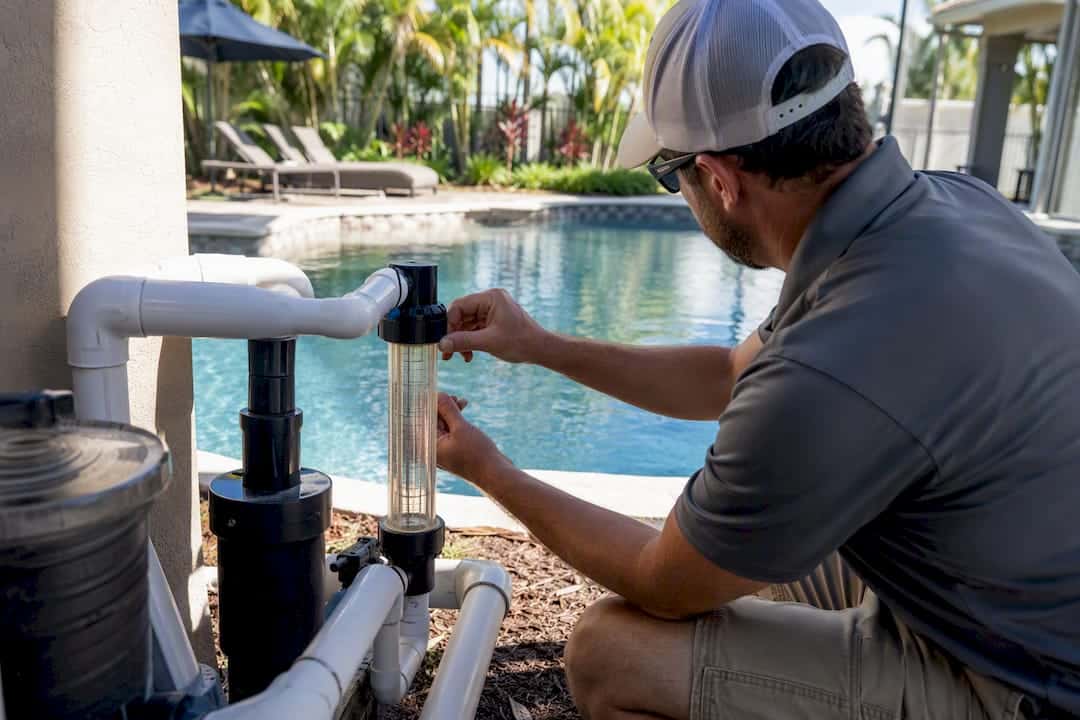
Size your pool pump by required flow, not horsepower. Divide pool gallons by turnover time in minutes to get your target GPM, then check three things before you buy anything: plumbing diameter, filter’s maximum design flow, and an estimate of total dynamic head (TDH). Get those four numbers right and the rest of this guide, including a calculator, worked examples, and a way to verify your results, fills in the details.
TL;DR:
- Correct pump sizing depends on matching required GPM, plumbing diameter, filter flow limits, and estimated total dynamic head, not horsepower ratings alone.
- For most residential pools, an 8-hour turnover is standard, but choosing a shorter or longer turnover impacts flow rates, energy use, and pump size.
- Accurate pool volume measurement requires fresh depth readings and proper shape formulas, especially for irregular or multi-depth pools, to avoid significant errors.
- Total dynamic head varies with plumbing, fittings, and added features; it is crucial to estimate and recheck head every time a new component is added to prevent flow loss.
- Verifying system flow using a flow meter, timed bucket test, or pump curve matching ensures the calculated pump size delivers real-world performance and avoids common sizing mistakes.
Table of Contents
- Pool Pump Sizing Calculator and Cheat Sheet
- How Do You Measure Pool Volume Accurately?
- What Turnover Rate Should You Target?
- What Is Total Dynamic Head and How Do You Estimate It?
- How Do You Match Pump Output to Your System’s Limits?
- Which Pump Type Actually Saves You Money?
- Common Pool Pump Sizing Mistakes and Quick Fixes
- Step-by-Step Pool Pump Sizing Checklist
- How Do You Verify Your Pump Sizing Calculation?
- A Field Perspective on Pump Sizing Mistakes
- How R&R Swimming Pools Handles Pump Sizing for You
- Sources
Pool Pump Sizing Calculator and Cheat Sheet
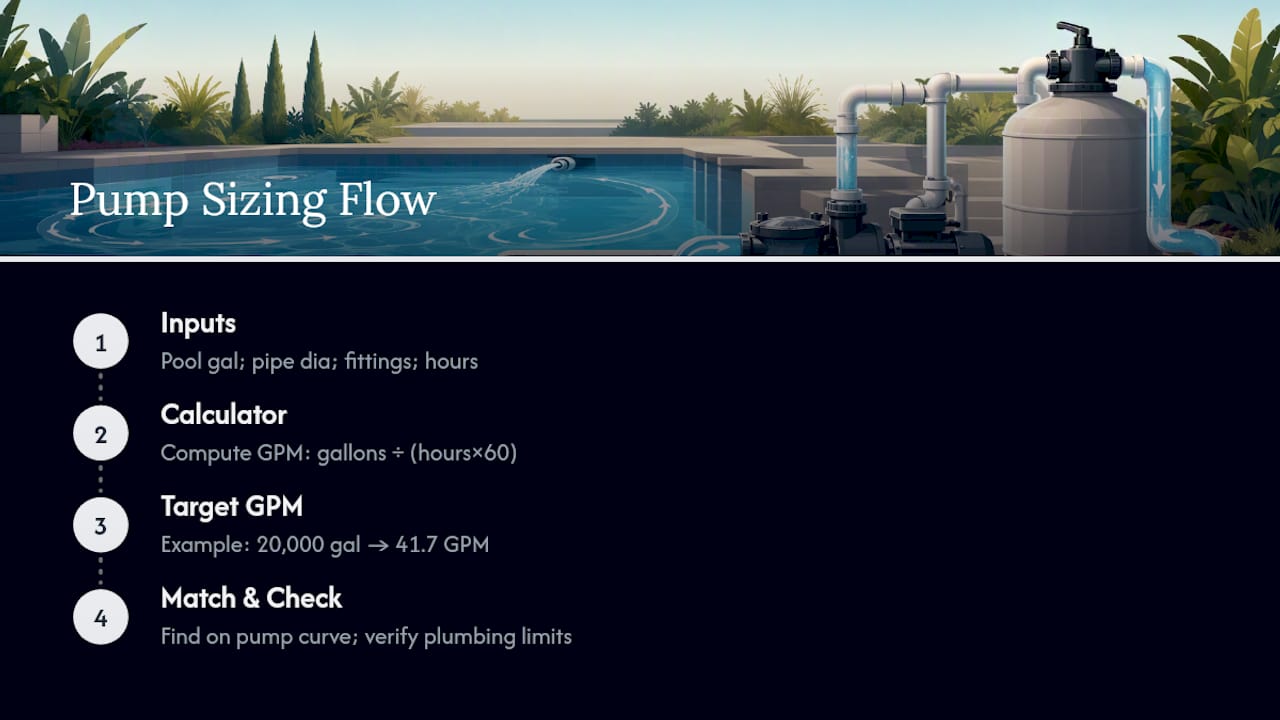
The math behind pool pump sizing is simpler than most equipment catalogs make it look. Start with this formula:
Required GPM = Pool Gallons ÷ (Turnover Hours × 60)
Say you have a 20,000 gallon pool and want the standard 8 hour turnover. That’s 20,000 ÷ 480 minutes, which comes out to 41.7 GPM. That single number, 41.7 GPM, is what you should be handing to a pump curve chart, not a horsepower rating.
A turnover time of about eight hours is the typical default used for most residential pools. Some homeowners opt for a shorter turnover time to handle heavy bather loads or algae, which requires a larger pump working harder and increases energy use.
Here’s how three common pool sizes translate into target flow rates and a rough pump class, assuming typical plumbing and moderate TDH:
Treat that HP column as a ballpark, not a spec. To use a calculator properly, you need four inputs: pool gallons, existing pipe diameter, the count of elbows and valves in your plumbing run, and your desired turnover window. The output GPM tells you where on a pump curve you need to land. If your plumbing or filter can’t support that flow, the calculator result is a target you’ll need to compromise on, not ignore.
How Do You Measure Pool Volume Accurately?
Every calculation downstream depends on getting your gallons right, so this step matters more than people give it credit for.
- Rectangular pools: Length × Width × Average Depth × 7.5
- Round pools: Diameter × Diameter × Average Depth × 5.9
- Oval pools: Length × Width × Average Depth × 6.7
Average depth is where most homeowners get it wrong. For a pool with a shallow end and a deep end, add the shallow depth and deep depth together and divide by two. A pool that’s 3 feet at the shallow end and 8 feet at the deep end has an average depth of 5.5 feet, not 8 and not 3.
For freeform or irregularly shaped pools, split the shape into two or three simple rectangles or triangles, calculate each section separately, and add the volumes together. If the shape resists that, take depth readings every few feet along the pool’s length and average them.
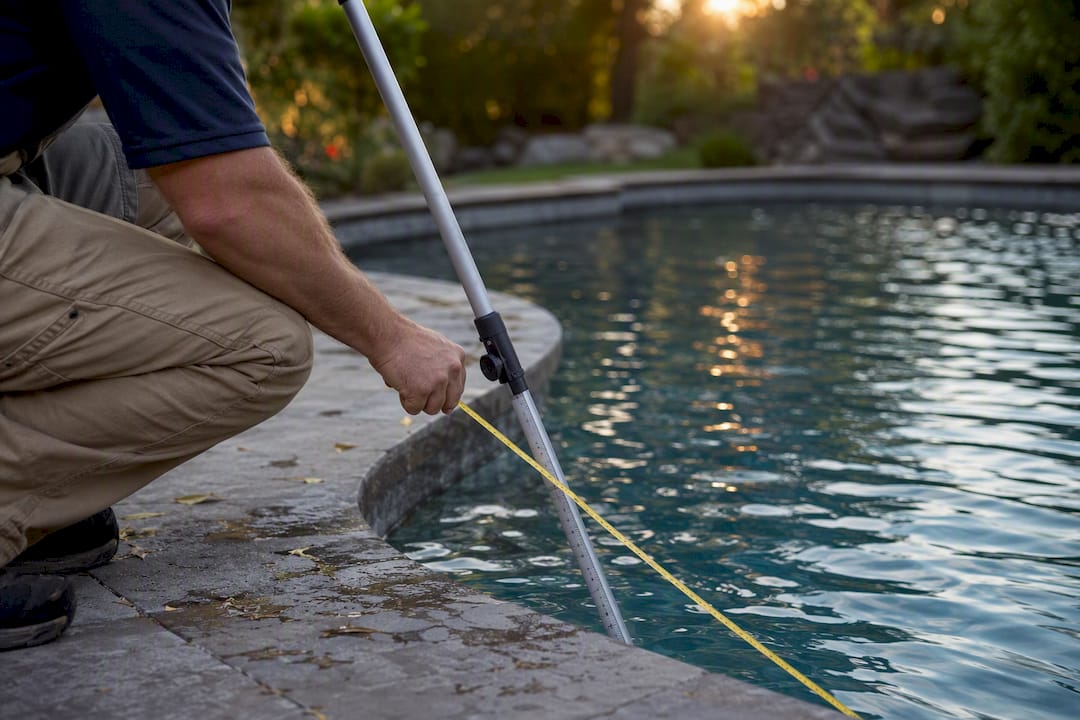
The most common measurement mistake is guessing depth from memory instead of measuring it fresh. Pools settle, and liner replacements or resurfacing can shift depth by an inch or two, enough to throw off your gallon count by hundreds of gallons on a larger pool. Measure with a pole or weighted tape, not a guess.
What Turnover Rate Should You Target?
Turnover rate is how long it takes your pump to cycle the entire pool volume through the filter once. It’s the backbone of the whole sizing exercise.
The formula again: GPM = Pool Gallons ÷ (Turnover Hours × 60)
For a 15,000 gallon pool on an 8 hour turnover: 15,000 ÷ 480 = 31.25 GPM.
- 6 hour turnover: Aggressive. Common for pools with heavy use, spas, or chronic algae problems. Demands more flow and more pump energy.
- 8 hour turnover: The industry standard default for residential pools, and the number most sizing guides and code targets build around.
- 10 hour turnover: Acceptable for lightly used pools but slower to respond to a bather load spike or a storm blowing debris in.
Your turnover choice directly sets your pump’s runtime and your electric bill. A pump sized correctly for 8 hour turnover run 8 hours a day does the job. Push that same pump to hit a 6 hour turnover and you’re either buying a bigger pump or running the one you have harder, both of which cost more in energy and wear.
What Is Total Dynamic Head and How Do You Estimate It?
Total dynamic head, or TDH, is the total resistance your pump has to push water against to deliver its rated flow. It’s the number that turns a nameplate GPM figure into the flow you’ll actually get in your specific system.
TDH adds up from several sources:
- Suction side resistance (skimmer lines, main drain)
- Pipe length and diameter along the entire run
- Fittings, elbows, and valves (each one adds resistance)
- The filter itself
- A heater, if installed
- A chlorinator or salt cell
- Return lines and any water features like waterfalls or spillover spas
For a typical residential setup with moderate plumbing runs and a standard filter, Total dynamic head for most residential pools falls in a range typically between 40 and 60 feet of head, though additional equipment like heaters or waterfalls can increase this value.
Pro Tip: Don’t estimate TDH once and forget it. Every accessory you add later, a heater, an automatic cleaner line, a water feature, raises head and lowers your actual delivered flow, even though the pump itself never changed.
This is exactly why a bare horsepower number tells you almost nothing. The same pump delivers dramatically different GPM depending on the TDH it’s fighting, which is why matching flow to a pump curve at your actual TDH is the only way to know what you’re really getting.
How Do You Match Pump Output to Your System’s Limits?
Once you know your required GPM and your estimated TDH, you find your operating point on a pump curve, the chart manufacturers publish showing flow output at different head values. Where your TDH line crosses the curve is the flow that pump will actually deliver in your pool, not the number stamped on the box.
Two hard ceilings limit that flow no matter what pump you buy:
- Filter design flow. Every cartridge, sand, or DE filter has a maximum rated GPM. Pushing more flow through it than it’s rated for shortens contact time for filtration and can damage the filter internals. Check the filter’s data plate before you shop for a pump, not after.
- Plumbing diameter. 1.5 inch pipe typically limits a system to around 1.5 HP worth of flow before you risk cavitation. 2 inch plumbing supports meaningfully higher flow without that risk. Cavitation happens when a pump tries to pull more water than the suction plumbing can supply, and it sounds like gravel running through the pump housing. It also chews through impellers and seals over time.
Before you contact a pump seller or a contractor, collect these numbers: pool gallons, current pipe diameter on suction and return, filter model and its rated max GPM, count of major fittings and valves, and any planned additions like a heater or water feature. Handing over that list gets you a real recommendation instead of a guess based on your old pump’s horsepower.
Which Pump Type Actually Saves You Money?
Horsepower is a poor sizing metric because it says nothing about efficiency or how the pump behaves at partial loads. The type of pump matters more than its rated HP.
- Single-speed pumps run at one speed, full power, whenever they’re on. Cheapest to buy, most expensive to run.
- Dual-speed pumps offer a low setting for daily filtration and a high setting for vacuuming or spa jets. A step up, still limited.
- Variable-speed pumps run at whatever speed matches the job, often turning much lower during normal filtration hours. ENERGY STAR points to Weighted Energy Factor (WEF) as the metric to compare pump efficiency rather than horsepower, and oversized motors tend to waste energy relative to the flow they actually need to deliver.
Here’s the practical trade-off: a single-speed pump might run 4 hours a day at full draw to hit your turnover target. A variable-speed pump can hit the same daily turnover running 10 hours at a fraction of the speed, and because pump energy use drops steeply as speed drops, that longer, slower run typically uses less total electricity, not more.
Common Pool Pump Sizing Mistakes and Quick Fixes
Most flow problems trace back to one of a small set of mistakes, and most of them are fixable without replacing hardware.
The big three: sizing by horsepower instead of GPM, ignoring the filter’s rated flow limit, and installing a high-output pump on plumbing that’s too narrow to feed it.
Watch for these symptoms:
- Cavitation noise, a rattling or gravel sound from the pump housing, points to plumbing starving the pump of water.
- Rising filter pressure faster than normal suggests flow exceeding the filter’s design rating.
- Leaking fittings or unions under pressure often mean the system is pushing more flow than the plumbing was built for.
- Cloudy water despite a strong-looking return jet can mean the pump is oversized for the filter, moving water fast but not cleaning it well.
Before assuming you need a new pump, run this checklist: check the filter pressure gauge against baseline, inspect suction-side fittings for air leaks, confirm skimmer and main drain valves are fully open, and clean the filter media. Most flow complaints resolve at that level, not at the pump.
Step-by-Step Pool Pump Sizing Checklist
Run through these six steps in order, and you’ll have everything you need to size correctly or hand off to a contractor with confidence:
- Measure pool volume using the correct shape formula and a fresh depth reading.
- Choose your turnover target, 8 hours by default.
- Calculate required GPM using gallons ÷ (turnover hours × 60).
- Estimate TDH from your plumbing, fittings, filter, and any heater or water feature.
- Check your filter’s max design flow and your plumbing diameter as hard limits.
- Find your operating point on a pump curve at your estimated TDH, then verify with a real flow test.
Three worked examples, all assuming 8 hour turnover and moderate residential plumbing:
Pro Tip: If your calculated GPM lands right between two pump models, size toward the smaller one with a variable-speed motor. You can always run it faster during peak bather load. You can’t safely run an oversized single-speed pump slower.
Those TDH figures are assumptions for planning purposes. Your actual number depends on your specific plumbing run, and that’s exactly what the next step is for.
How Do You Verify Your Pump Sizing Calculation?
Math on paper is a starting point, not proof. Three ways to confirm what your system actually delivers:
- Flow meter test. Install an inline flow meter on the return line and read GPM directly under normal operating conditions.
- Timed bucket test. Time how long it takes to fill a 5 gallon bucket from a return jet, then do the math to extrapolate total system flow. Rough, but useful for a sanity check.
- Pump curve intersection. Plot your estimated TDH against the manufacturer’s published curve for your pump model to see the flow it should be delivering at that head.
Call in a contractor for a hydraulic evaluation if you’re seeing persistently low flow despite a properly sized pump, planning to add a heater or water feature that will raise TDH significantly, or suspect your plumbing itself is undersized for your pool’s volume. A professional evaluation typically includes an actual TDH measurement, pump curve matching against your real numbers, and a specific equipment recommendation rather than a generic one.
A Field Perspective on Pump Sizing Mistakes
Decades of residential installs across Central Florida turn up the same retrofit error again and again: a homeowner replaces a failed pump with a bigger one, assuming more horsepower fixes weak flow, when the real bottleneck was 1.5 inch suction plumbing the whole time. The new pump just cavitates harder.
The fix that actually works almost every time is checking plumbing and filter rating before touching the pump specification. Variable-speed upgrades pay for themselves through lower runtime costs, and they forgive a slightly imperfect sizing calculation better than a single-speed pump ever will.
— Results
How R&R Swimming Pools Handles Pump Sizing for You
Randrswimmingpools is the alternative to guessing your way through pump specs and hoping the math holds up. When you bring us in for a custom installation, we measure your actual TDH on site, match it against real pump curves for your pool’s volume, and confirm your filter and plumbing can handle the flow before anything gets installed.

That means no cavitation surprises six months in, no filter damaged by mismatched flow, and equipment backed by a warranty instead of a spec sheet guess. For homeowners planning a new pool or replacing aging equipment across Central Florida, our inground pool installation process builds the hydraulic evaluation into the job from day one. Schedule a free quote and we’ll walk your specific system before recommending a single pump model.
Sources
The formulas, standards, and examples in this guide draw on the Pool Pump Sizing Guide from PoolFounder, ENERGY STAR’s pump efficiency guidance, DOE’s dedicated-purpose pool pump motor resources, federal efficiency rulemaking, and turnover rate standards from Florida’s Best Pools.
- Pool Pump Sizing Guide — PoolFounder
- Pool turnover rate: formula & code targets — Florida’s Best Pools
