TL;DR:
- Proper pool filtration involves circulating water through media to remove debris and contaminants, ensuring water clarity and safety. Regular maintenance, including monitoring pressure and replacing media, supports optimal performance and reduces chemical costs in Central Florida’s demanding climate. Filtration works with sanitizers but cannot eliminate pathogens, making consistent chemical residuals essential for overall pool safety.
Pool filtration is defined as the mechanical process of circulating water through filter media to remove debris, oils, hair, algae particles, and contaminants that make pool water unsafe and cloudy. For Central Florida homeowners, where pools run year-round and subtropical heat accelerates algae growth and bather load, understanding the importance of pool filtration is not optional. It is the foundation of every safe, clear, and cost-effective pool. Without a properly sized and operated filtration system, sanitizers cannot do their job, water turns hazardous, and repair bills climb fast.
How does pool filtration work to maintain water clarity?
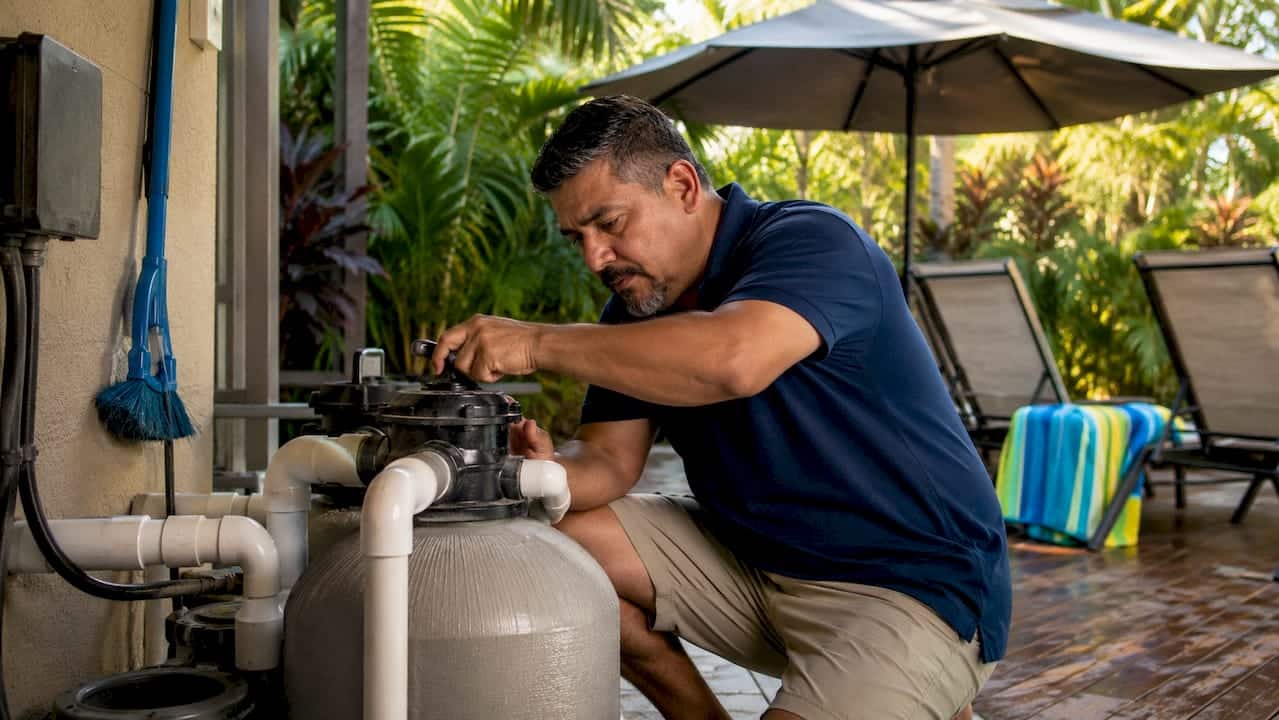
Pool filtration is best understood as a complete system involving a pump, filter media, and controlled water flow working together to remove particles and prevent stagnation. The pump draws water from the pool through skimmers and main drains, forces it through the filter media, and returns clean water through return jets. The filter media physically traps particles as water passes through, progressively clearing the water of visible and microscopic debris.

The three most common residential filter types each operate at different performance levels. Sand filters capture particles in the 20 to 40 micron range, making them the most affordable but least precise option. Cartridge filters trap particles down to roughly 10 microns and require no backwashing, only periodic rinsing. Diatomaceous earth (DE) filters are the most effective, capturing particles as small as 2 to 5 microns, which makes them the preferred choice for pools with heavy bather loads or fine debris.
| Filter Type | Particle Size Captured | Maintenance Required |
|---|---|---|
| Sand filter | 20 to 40 microns | Backwash every 4 to 6 weeks |
| Cartridge filter | 10 to 15 microns | Rinse every 4 to 6 weeks |
| DE filter | 2 to 5 microns | Backwash and recharge DE powder |
| Multi-media filter | Variable, often finer than sand | Backwash periodically |
Turnover rate is the measure of how often the full pool volume passes through the filter. Most residential pools require complete turnover at least once every 8 to 12 hours. In Central Florida’s heat, running your filter 10 to 12 hours daily during summer is standard practice, not excessive. Filtration also works alongside circulation, which distributes sanitizer chemicals evenly. The two processes are distinct but inseparable for water quality improvement.
Pro Tip: Set your filter timer to run during off-peak electricity hours, typically late evening through early morning, to cut energy costs without sacrificing turnover frequency.
Why is regular filter maintenance essential?
Filter maintenance is the single most overlooked factor in pool water quality problems. As the filter captures debris, resistance builds inside the media, and water flow slows. A pressure rise of 8 to 10 psi above your clean baseline reading is the standard signal to clean or backwash immediately. Ignoring that signal forces your pump to work harder, reduces filtration effectiveness, and can cause the filter to push trapped debris back into the pool.
A practical maintenance schedule for Central Florida pools looks like this:
- Weekly: Check filter pressure gauge and note any upward trend.
- Every 4 to 6 weeks: Clean cartridge filters or backwash sand and DE filters.
- Every 3 to 5 years: Replace sand media or DE grids; inspect cartridge elements for tears.
- After contamination events: Replace or deep-clean media following algae blooms or fecal incidents.
- Annually: Inspect O-rings, valves, and multiport assemblies for wear.
Skipping this schedule has real consequences. A clogged filter mimics chemical failure because poor flow means sanitizer never reaches all areas of the pool. Many homeowners add more chlorine when the actual problem is a dirty filter. That wastes money and exposes swimmers to unnecessarily high chemical concentrations. Monitoring filter pressure diagnostics is the fastest way to separate a chemistry problem from a mechanical one.
Pro Tip: Write your clean baseline pressure on a piece of tape and stick it directly on the filter housing. You will always know exactly when the gauge is telling you to act.
What are the key benefits of effective pool filtration systems?
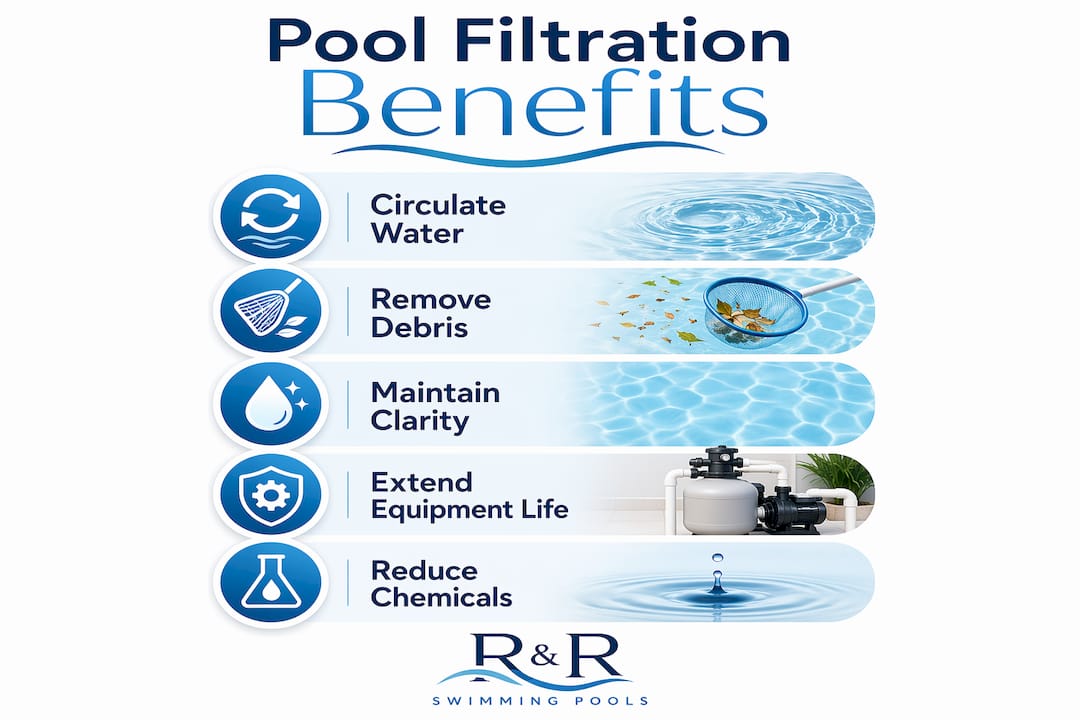
The benefits of pool filtration extend well beyond clear water. Multi-media filtration reduces turbidity by nearly 80% and cuts iron concentration by approximately 80%, producing measurably cleaner water than traditional single-media systems. That level of clarity is not cosmetic. It means lifeguards and parents can see the pool bottom clearly, which is a direct safety benefit.
Effective filtration also reduces your chemical consumption. When the filter removes suspended particles, those particles cannot bind with chlorine and neutralize it. Less chlorine demand means lower chemical costs and reduced skin and eye irritation for swimmers. Over a full Florida pool season, that adds up to meaningful savings on both chemicals and equipment wear.
The broader benefits include:
- Reduced pump strain: A clean filter allows water to flow freely, extending pump motor life.
- Lower algae risk: Removing organic debris eliminates the food source algae need to establish.
- Improved sanitizer efficiency: Filtration supports sanitizer function by removing particles that consume chlorine before it can kill pathogens.
- Longer surface life: Fewer suspended particles mean less abrasive contact with plaster, tile, and vinyl liners.
- Healthier swimming environment: Removing oils, sunscreen residue, and fine debris directly reduces swimmer exposure to irritants.
For Central Florida homeowners running pools 10 or more months per year, these benefits compound. A well-maintained pool filtration system pays for its upkeep many times over in avoided repairs and chemical savings.
What filtration cannot do and why sanitizers are still required
Pool filtration removes physical particles, but it does not kill pathogens. Sand filters capture particles in the 20 to 40 micron range, while viruses like norovirus measure 0.02 to 0.1 microns. Even the finest DE filter cannot trap most viruses. This is why filtration and sanitization are a layered system, not interchangeable tools.
Clear water does not equal safe water. Many pathogens are too small to be trapped by any residential filter and require sanitizers to be neutralized. A pool that looks perfect can still carry harmful organisms if sanitizer levels are inadequate.
The practical implication is direct. You cannot reduce chlorine or other sanitizers simply because your filter is running well. Sanitizer residual must be maintained at all times, even when the water looks crystal clear. Filtration reduces the sanitizer demand by removing particles, but it does not replace the chemical kill step.
Special situations require extra attention. During algae blooms, filter media can harbor algae cells that survive backwashing and reinfect the pool. After fecal contamination events, media replacement or soaking is the recommended protocol, not simply extended pump run time. These scenarios are more common in Central Florida’s warm climate, where algae establish quickly and pools see heavy use.
| Contaminant | Typical Size | Sand Filter | Cartridge Filter | DE Filter | Sanitizer Required |
|---|---|---|---|---|---|
| Dirt and debris | 100+ microns | Yes | Yes | Yes | No |
| Algae cells | 2 to 200 microns | Partial | Yes | Yes | Yes |
| Bacteria | 1 to 10 microns | No | Partial | Partial | Yes |
| Viruses | 0.02 to 0.1 microns | No | No | No | Yes |
How to optimize filtration and troubleshoot common problems
Effective filtration operation comes down to consistent habits and knowing what the system is telling you. Follow these steps to keep your Central Florida pool running at its best:
- Check filter pressure weekly. Elevated pressure is the first sign of a problem. Timely cleaning prevents chemical waste and pump strain before they become expensive.
- Run the filter 10 to 12 hours daily in summer. Florida heat increases bather load, debris, and algae risk. Shorter run times create stagnation zones where sanitizer cannot reach.
- Address cloudiness with multiple turnovers. Cloudiness resolves progressively over repeated filtration cycles, not a single pass. Run the filter continuously for 24 to 48 hours when treating cloudy water.
- Diagnose before adding chemicals. When water quality drops, check filter pressure first. A clogged filter causes poor chemical distribution, which looks identical to a chemistry imbalance.
- Replace media on schedule. Sand media degrades over 3 to 5 years, losing its sharp edges and trapping fewer particles. Proactive replacement costs far less than the chemical overuse and pump repairs that follow neglected media.
- Deep clean after contamination events. Algae and fecal incidents require more than backwashing. Soak or replace media and shock the pool to prevent reinfection from the filter itself.
Pro Tip: For Central Florida pools surrounded by oak trees or palm landscaping, check your skimmer baskets daily during spring pollen season. Organic load spikes dramatically and can clog a filter in days rather than weeks.
Reviewing pool maintenance tips specific to Central Florida conditions gives you a practical framework for each season, not just summer.
Key takeaways
Effective pool filtration requires proper filter sizing, consistent turnover rates, and regular maintenance to keep water safe, clear, and cost-efficient year-round.
| Point | Details |
|---|---|
| Filtration removes physical particles | Debris, oils, algae, and fine particles are trapped before they consume sanitizer or cloud water. |
| Turnover rate drives water quality | Running the filter 10 to 12 hours daily ensures full pool volume is processed every 8 to 12 hours. |
| Pressure monitoring prevents failures | Clean or backwash when pressure rises 8 to 10 psi above baseline to maintain flow and effectiveness. |
| Filtration and sanitizers work together | Filters cannot kill viruses or bacteria; sanitizer residual must be maintained regardless of water clarity. |
| Media replacement is non-negotiable | Sand and DE media degrade over 3 to 5 years and must be replaced to sustain filtration performance. |
Why Central Florida pools demand more from their filtration systems
After decades of watching Central Florida homeowners manage their pools, one pattern stands out clearly. Most people treat their filter as a set-it-and-forget-it component until something goes visibly wrong. By then, the damage is already done: the pump has been straining for weeks, chemical costs have spiked, and the water has been suboptimal for every swim in between.
Florida’s climate is genuinely harder on filtration systems than most homeowners realize. The combination of intense UV exposure, warm water temperatures, heavy pollen loads in spring, and near-constant pool use creates a debris and bather load that northern pool guides simply do not account for. A filter maintenance schedule written for a pool in Ohio will leave a Central Florida pool chronically under-serviced.
What I have found works best is treating filter pressure as the pool’s primary health indicator, not water color or chemical test results. Clear water with a clogged filter is a false signal. The filter pressure gauge tells you what is actually happening inside the system. Homeowners who check it weekly and act at the first sign of elevation spend less on chemicals, replace equipment less often, and swim in genuinely safer water.
The other misconception worth addressing directly: more chlorine is not the answer to persistent water quality problems. In most cases I have seen, the root cause is a filtration issue, not a chemistry issue. Fix the filter first. The chemistry almost always follows.
Understanding Central Florida filtration basics from the start saves years of reactive maintenance and unnecessary expense.
— Randrswimmingpools
Build your pool right from the start with Randrswimmingpools
A filtration system that is undersized, poorly positioned, or mismatched to your pool’s volume will underperform no matter how well you maintain it. Getting the system right starts at installation.
R and R Swimming Pools has been designing and installing custom inground pools across Central Florida since 1985. Every pool we build is sized and configured with a filtration system matched to the pool’s volume, bather load, and local conditions. Whether you are planning a new custom pool installation or evaluating your current setup, our team brings four decades of regional experience to every project. We also offer expert guidance on filter selection, turnover optimization, and maintenance scheduling so your pool performs at its best from day one. Contact Randrswimmingpools for a free quote and get the filtration foundation your pool deserves.
FAQ
What is pool filtration and why does it matter?
Pool filtration is the process of circulating water through filter media to physically remove debris, oils, and particles that cloud water and reduce sanitizer effectiveness. Without it, pool water becomes unsafe and unsanitary regardless of chemical treatment.
How many hours a day should I run my pool filter in Florida?
Most Central Florida pools require 10 to 12 hours of daily filter operation during summer to achieve the recommended full-volume turnover every 8 to 12 hours. Shorter run times leave stagnant zones where sanitizer cannot circulate.
What are the signs my pool filter needs cleaning?
The clearest sign is a pressure gauge reading 8 to 10 psi above your clean baseline. Cloudy water, reduced return jet flow, and rising chemical demand are secondary indicators that the filter is restricting flow.
Can a pool filter replace chlorine or other sanitizers?
No. Filters remove physical particles but cannot kill viruses or bacteria, which are too small to be trapped by any residential filter type. Sanitizer residual must be maintained at all times alongside regular filtration.
How often should pool filter media be replaced?
Sand media typically needs replacement every 3 to 5 years, DE grids every 3 to 7 years depending on use, and cartridge elements every 1 to 3 years. After contamination events like algae blooms, earlier replacement is recommended to prevent reinfection.
