
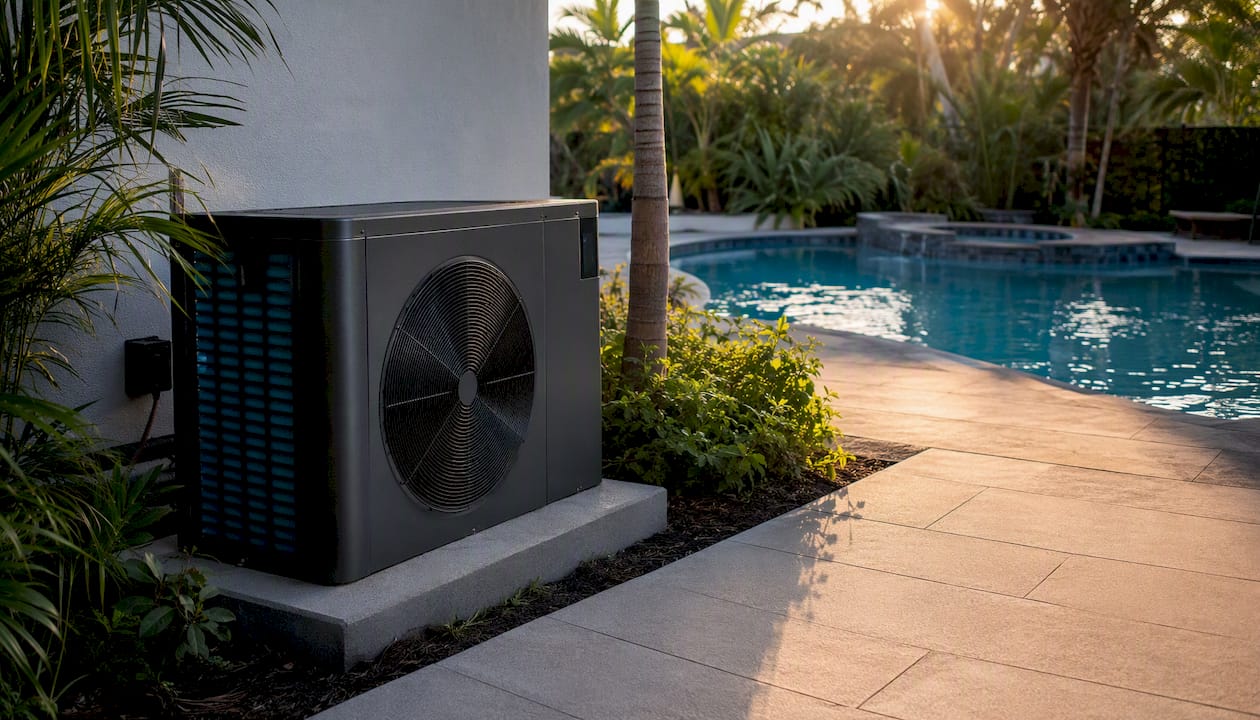
The short answer: multiply your pool’s surface area (sq ft) by the temperature rise you need (°F), then by 12, then by a wind factor between 1.0 and 1.5. That gives you required BTU/hr. Round up to the nearest standard heat-pump size.
Quick rules if you want a number right now:
- Small pools: about 70,000 to 90,000 BTU heat pump
- Mid-size pools: about 110,000 to 125,000 BTU heat pump
- Larger pools: about 125,000 to 140,000 BTU, or consider two units
The worked 15×30 example below shows the full calculation. The lookup chart in Section 5 maps common pool sizes directly to recommended heat-pump ranges so you can cross-check your math in under a minute.
Key Takeaways
Correct pool heat pump sizing comes down to one formula applied honestly: surface area × temperature rise × 12 × wind factor, rounded up to the nearest standard size.
| Point | Details |
|---|---|
| Use the surface-area formula | BTU/hr = surface area × temperature rise × 12 × wind factor; never skip the wind factor. |
| Round up, not down | Modest oversizing causes no harm; an undersized unit that can’t reach setpoint is the most common installer complaint. |
| Covers change the math | Pool covers reduce overnight heat loss by 40–70%, which can let you step down one standard size tier. |
| Check electrical before buying | Units in the 100k–150k BTU range need 240V/30–50A circuits; confirm panel capacity first. |
| Randrswimmingpools offers on-site sizing | Central Florida homeowners can get a free sizing worksheet, unit recommendation, and permit coordination from Randrswimmingpools. |
Table of Contents
- How do you measure your pool’s surface area and volume?
- What is the industry sizing formula for pool heat pumps?
- Worked example: sizing a heat pump for a 15×30 ft pool
- Quick lookup chart: pool size to recommended heat-pump BTU range
- What factors increase or decrease your required heat-pump capacity?
- How do BTU ratings, horsepower, COP, and running costs actually work?
- Should you oversize, right-size, or pair two units?
- When should you call a professional for on-site sizing?
- What most homeowners get wrong about pool heat pump sizing
- Randrswimmingpools can size and install your pool heat pump
- Sources
How do you measure your pool’s surface area and volume?
Surface area is the number that drives your sizing calculation. Pool surface area determines steady-state heat loss far more than volume does — evaporation off the water’s surface is the dominant heat-loss mechanism, not the mass of water itself. Volume matters for estimating how long a cold pool takes to heat up, but it does not set the BTU/hr you need to hold temperature.
Formulas by pool shape:
- Rectangular: length × width (e.g., 15 × 30 = 450 sq ft)
- Oval: length × width × 0.785
- Freeform/kidney: break the shape into rectangles and triangles, calculate each, and add them together
For a homeowner’s guide to pool dimensions and surface area, the segmentation method works well for irregular shapes: sketch the pool on graph paper, divide it into rough rectangles, measure each, and sum the areas.
Converting to gallons:
Gallons = surface area × average depth × 7.48
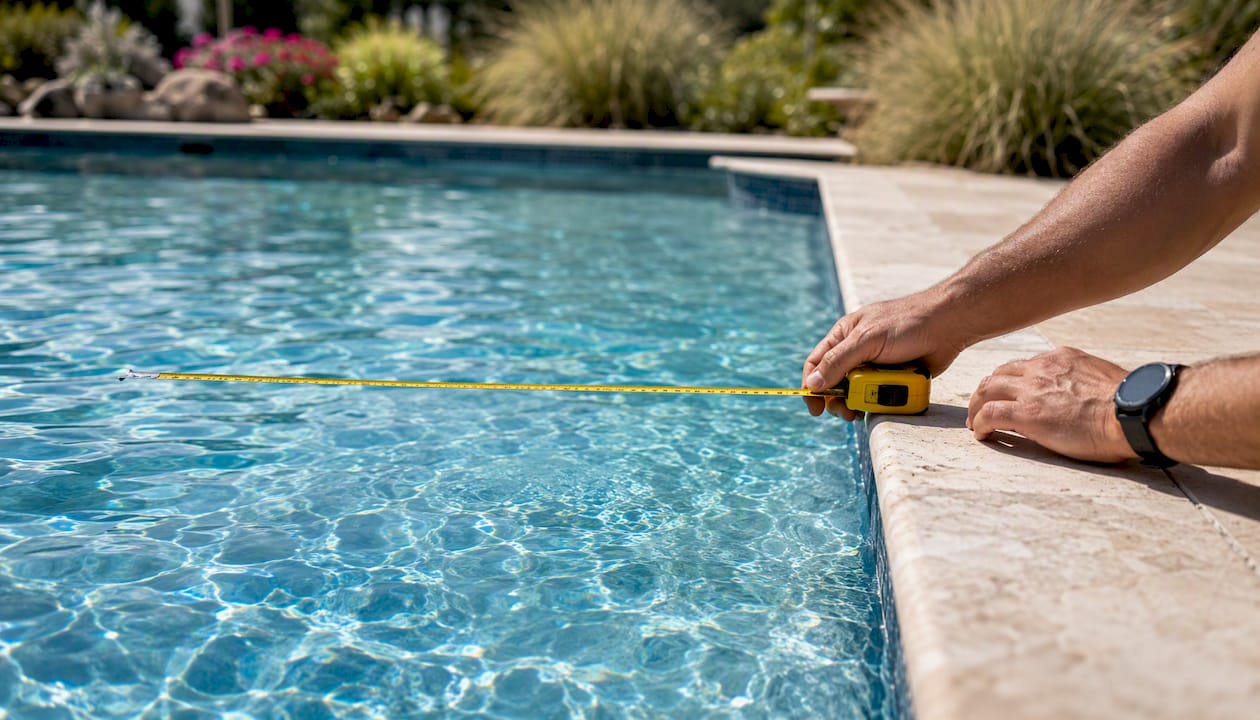
Average depth is the midpoint between the shallow and deep ends. A 15×30 pool with a 3.5 ft shallow end and 6 ft deep end averages 4.75 ft.
450 sq ft × 4.75 ft × 7.48 = ~16,000 gallons
Quick measurement checklist:
- Measure length and width at the waterline (not the deck edge)
- Measure shallow-end depth and deep-end depth; average them
- For freeform pools, photograph from above and sketch to scale before segmenting
- Note any attached spa — spas add surface area and heat loss
What is the industry sizing formula for pool heat pumps?
The standard formula from the U.S. Department of Energy is:
BTU/hr = Pool Surface Area (sq ft) × Temperature Rise (°F) × 12 × Wind Factor
Each term earns its place:
Surface area is your pool’s sq ft at the waterline. Use the measurement from Section 1.
Temperature rise is the difference between your target water temperature and the coldest ambient air temperature during the months you want to swim. If you want 82°F water and your coldest swim-season morning hits 60°F, your temperature rise is 22°F.
The constant 12 is a DOE/industry engineering shortcut. It represents the baseline BTU/hr needed per square foot of pool surface per degree Fahrenheit of temperature difference, assuming a calm 3.5 mph breeze. Think of it as the “still air, mild day” baseline. It is not magic — it is a practical approximation of steady-state evaporative and convective losses under those specific conditions. Change the wind and the formula adjusts through the wind factor.
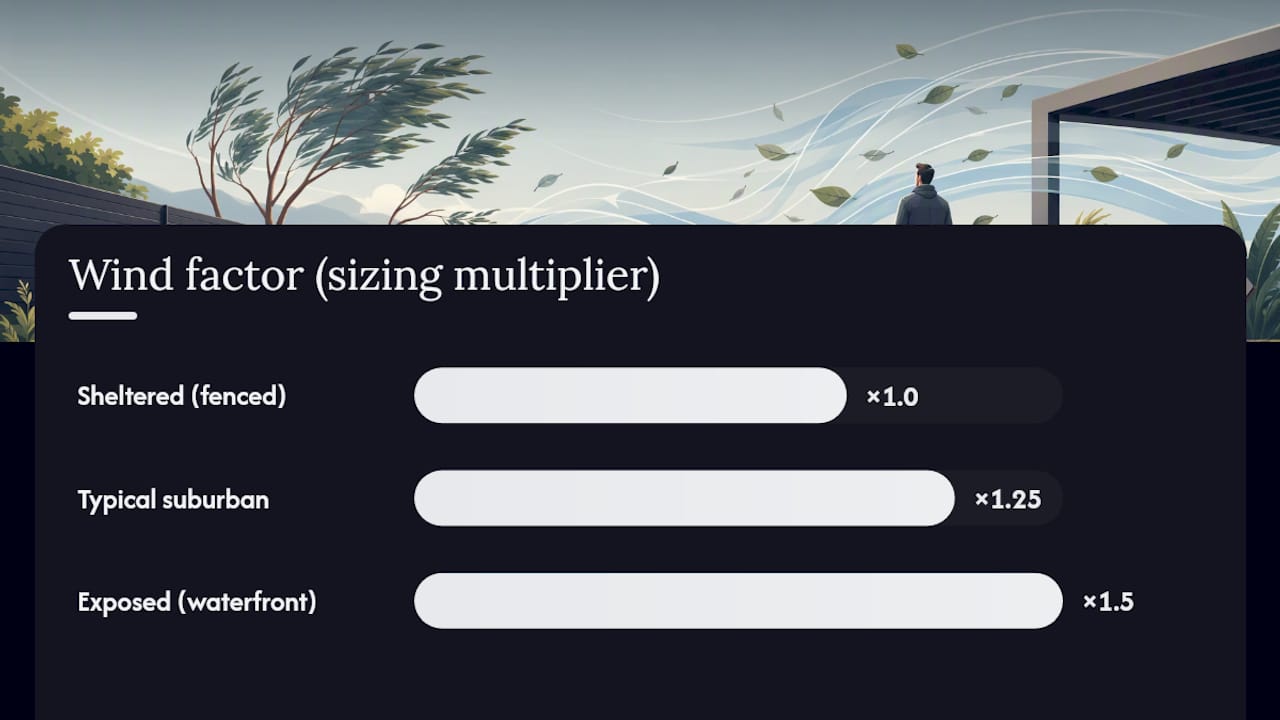
Wind factor scales the formula for your yard’s actual exposure. The standard multipliers are:
| Wind Exposure | Wind Factor | Example Setting |
|---|---|---|
| Sheltered (fenced, walled, tree-screened) | 1.0 | Enclosed backyard, no prevailing wind |
| Typical suburban | 1.25 | Open backyard, light breezes |
| Exposed (hilltop, waterfront, open lot) | 1.5 | Lakefront, elevated property, no windbreak |
Pro Tip: *Use the coldest month you actually plan to swim as your ambient baseline, not the annual average. Central Florida homeowners who want November-through-March use should size to a 55–60°F ambient morning, not the 72°F annual mean.
Worked example: sizing a heat pump for a 15×30 ft pool
A 450 sq ft pool is the most common residential size, so this example travels well.
Scenario 1 — Core-season maintenance (April–October in Central Florida):
- Surface area: 450 sq ft
- Target water temp: 84°F
- Coldest ambient morning: 62°F
- Temperature rise: 22°F
- Wind factor: 1.25 (typical suburban backyard)
450 × 22 × 12 × 1.25 = roughly 150,000 BTU/hr
Per BTU Size’s pool heater calculator, this maps to a standard 150,000 BTU gas heater equivalent, or roughly a 110,000–125,000 BTU heat pump (heat pumps carry a higher real-world output efficiency, so the BTU-to-BTU comparison with gas is not one-for-one).
Scenario 2 — Shoulder-season extension (November–March):
- Same pool, same wind factor
- Coldest ambient morning: 50°F
- Temperature rise: 34°F
450 × 34 × 12 × 1.25 gives a substantially higher BTU/hr requirement, indicating a much larger heat pump or multiple units may be needed
That is a very different number. At this point you are looking at a 125,000–140,000 BTU heat pump running near its limits, or two units staged together.
Rounding rules:
- Always round up to the next standard size, not down
- Standard residential heat-pump sizes run at roughly 50k, 70k, 85k, 110k, 125k, and 140k BTU/hr
- If your calculated BTU lands between two standard sizes, take the larger one
- Add one size tier for exposed lots, pools without covers, or any shoulder-season goal below 55°F ambient
Pro Tip: Modest oversizing hurts almost nothing. An undersized heat pump that runs continuously and still can’t hit setpoint on a cool night is the most common complaint installers hear. Size up when in doubt.
Quick lookup chart: pool size to recommended heat-pump BTU range
This table maps common residential pool sizes to recommended heat-pump ranges, based on representative sizing bands for U.S. residential pools. Figures assume a typical suburban wind factor (1.25) and a 20–25°F temperature rise. Adjust up for exposed lots or shoulder-season goals.
Notes on these model families:
- Pentair UltraTemp is a widely specified residential unit known for titanium heat exchangers and a broad BTU range — a common choice for Central Florida pools.
- Hayward heat-pump lines cover the mid-to-large residential range and are frequently paired with Hayward automation systems already installed on many pools.
- AquaCal SQ series is a Florida-manufactured line designed specifically for humid subtropical climates, with models spanning the full residential BTU range.
These are representative families, not an exhaustive comparison. Your installer will match a specific model to your electrical service, plumbing configuration, and local availability.
Converting your calculated BTU to a manufacturer’s published rating:
Real-world output at 65°F ambient is meaningfully lower. When comparing your calculated BTU/hr to a spec sheet, look for the manufacturer’s performance curve at your actual ambient temperature, not just the headline rating.
What factors increase or decrease your required heat-pump capacity?
The formula gives you a baseline. These modifiers push it up or down.
Factors that increase required BTU:
- Wind exposure: An exposed lot with no windbreak can require 50% more BTU than a sheltered yard. Use the 1.5 wind factor and do not talk yourself down from it.
- Shoulder-season goals: Every 10°F drop in your ambient baseline adds roughly 10°F to your temperature rise, which adds 10 × surface area × 12 × wind factor BTU to your requirement.
- No pool cover: Uncovered pools lose heat overnight at a rate that forces the heat pump to work harder the next morning. Pool covers reduce overnight heat loss by 40–70%, which directly affects how large a unit you need.
- Shade deficit: Pools in full sun gain some solar heat that offsets losses. A heavily shaded pool loses that free input.
- Saltwater pools: Salt systems do not change the BTU calculation, but they require a titanium heat exchanger. Copper exchangers corrode rapidly in salt water.
Factors that decrease required BTU:
- Consistent cover use: A nightly cover habit can let you step down one standard size tier. Regional installers confirm this is one of the most reliable ways to reduce both required capacity and monthly operating cost.
- Indoor pools: No wind, no overnight radiation loss. Indoor pools typically need 50–60% of the BTU an equivalent outdoor pool requires.
- Warmer climate baseline: Central Florida’s mild winters mean a smaller temperature rise than a pool in North Carolina. That is a real advantage for heat-pump sizing.
Pro Tip: If you use a cover every night without fail, factor that into your sizing. If you use it “most nights,” size as if you do not use one at all. Inconsistent cover habits are the reason many homeowners feel their heat pump is undersized — the unit was sized assuming cover use that never happened consistently. For more on energy-efficient pool habits, consistent cover use is the single highest-return behavior change.
How do BTU ratings, horsepower, COP, and running costs actually work?
These terms appear on every spec sheet. Here is what they mean in practice.
| Term | What it means | Practical note |
|---|---|---|
| BTU/hr | Heat output per hour | The primary sizing number; higher = more heating power |
| Horsepower (hp) | Compressor motor size | Rough proxy for BTU; 1 hp ≈ 10,000 BTU/hr depending on design |
| COP | Coefficient of Performance | BTU of heat delivered per BTU of electricity consumed; higher = more efficient |
| AHRI test conditions | 80°F air, 80°F water, 80% RH | The standard test point; real-world COP at 65°F air is lower |
A heat pump with a COP of 5.0 at AHRI conditions delivers $5 of heat for every $1 of electricity. At 60°F ambient, that same unit might deliver a COP of 3.0–3.5. Below about 50°F, COP drops sharply. Below 45°F, most residential heat pumps stop producing meaningful heat. For homeowners who want to understand heater types and ambient limits, this temperature floor is the key reason heat pumps are not a year-round solution in northern states.
Heat-up time and running costs:
A 15×30 pool starting from cold water can take 36–90 hours to reach setpoint depending on unit size, ambient temperature, and whether a cover is used during heat-up. That is 1.5–4 days. Heat pumps are not designed for rapid recovery from cold — they are designed for maintaining temperature once it is reached. Gas heaters heat faster but cost more per hour to run. Heat pumps carry the lowest operating cost of any pool heater type, which is why they dominate new installations in Florida and other warm-climate states.
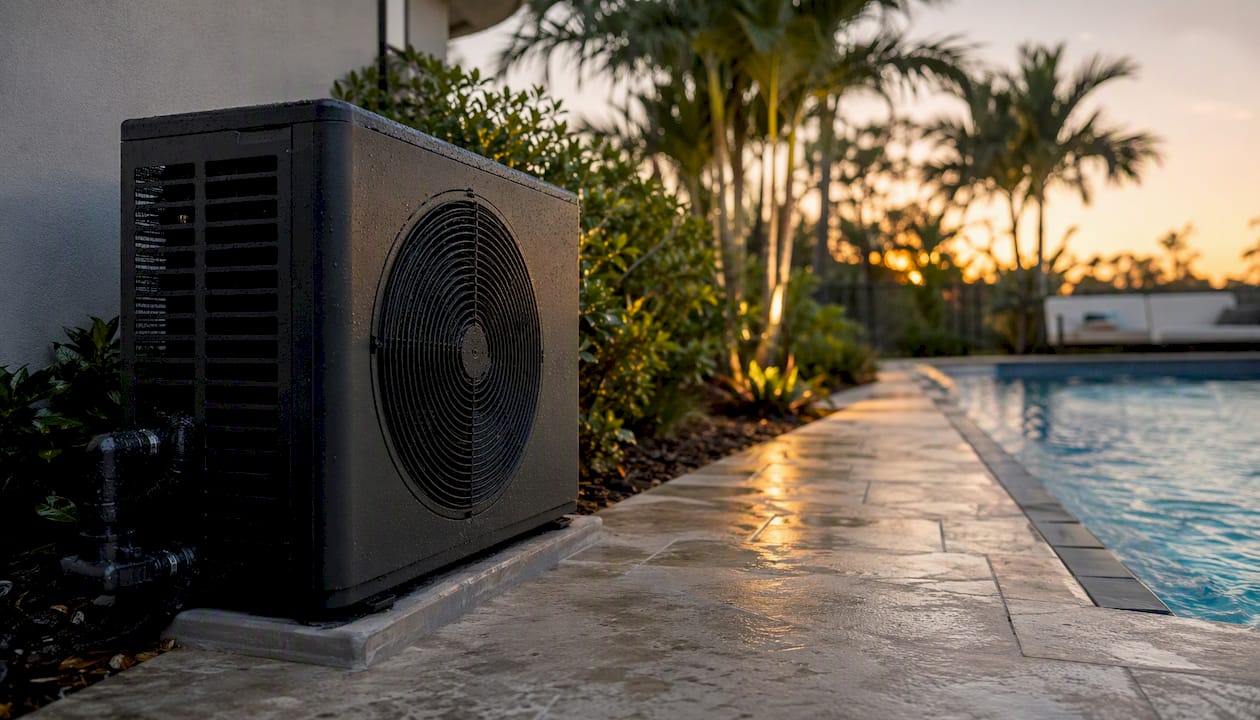
For energy-efficient pool options in Central Florida, a heat pump paired with a good cover is the lowest-cost path to year-round comfortable water temperatures.
Should you oversize, right-size, or pair two units?
There is no universally correct answer, but the tradeoffs are clear.
Oversizing (one unit, larger than calculated):
- Faster heat-up from cold
- Reaches setpoint on the coldest nights your climate produces
- Risk of short-cycling if the pool is small relative to the unit (short run cycles reduce compressor life)
- Generally the right call for exposed lots, shoulder-season goals, or pools without covers
Right-sizing (one unit matched to the formula output):
- Longer, steadier run cycles — better for compressor longevity
- Adequate for core-season use with a cover
- May struggle on the coldest nights or during extended cold snaps
Paired units (two smaller heat pumps):
- Redundancy: one unit can maintain temperature while the other is serviced
- Staged operation: run one unit in mild weather, both in cold weather
- Better for very large pools (600+ sq ft) where a single unit would need to be oversized to the point of short-cycling
- Higher upfront cost, but lower long-term risk
Installation practicalities:
- Heat pumps in the 100,000–150,000 BTU range require 240V single-phase power and 30–50 amp circuits, and installations must meet NEC Article 680 requirements
- Verify your electrical panel has capacity before selecting a unit
- Physical clearance matters: most manufacturers require 24–36 inches of clearance on all sides for airflow
- Noise: heat pumps are quieter than gas heaters but not silent; place them away from bedroom windows
- Salt pools require titanium heat exchangers — copper corrodes within one season in salt water
Pro Tip: Two 85,000 BTU units often outperform one 140,000 BTU unit for pools over 600 sq ft. The staged operation keeps each unit running in its efficient mid-range, and if one unit needs a repair in February, the other keeps the pool warm. For a pool pump guide covering equipment placement and flow rates, proper bypass valves and isolation plumbing are worth specifying from the start.
When should you call a professional for on-site sizing?
The formula gets you close. A professional gets you right. Here is what an on-site sizing check actually covers:
On-site checklist:
- Electrical panel audit: Confirm available circuit capacity for 240V/30–50A service; check for existing pool equipment loads that share the panel
- Microclimate assessment: Measure actual wind exposure, note shade patterns, identify nearby structures that affect airflow to the heat pump
- AHRI/COP performance at local ambient temps: Cross-reference the selected unit’s performance curve against your actual coldest swim-season temperatures, not just the headline AHRI rating
- Pad placement and clearance: Confirm the installation pad location meets manufacturer clearance requirements and local code setbacks
- Plumbing bypass/isolation valves: Verify the plumbing loop includes proper bypass valves so the heat pump can be isolated for service without draining the pool
- Titanium heat exchanger confirmation: For salt pools, confirm the selected unit uses a titanium (not copper) heat exchanger
- Permit and inspection coordination: Most Florida jurisdictions require a permit for heat-pump installation; a licensed contractor pulls the permit and coordinates the electrical inspection
A trained pool professional also evaluates site-specific factors the formula cannot capture: prevailing wind direction, how nearby structures channel or block wind, and local utility rate schedules that affect the real-world cost comparison between heat-pump sizes.
Randrswimmingpools has been building and equipping custom inground pools across Central Florida since 1985. For homeowners who want a formal sizing report and installation estimate, the custom pool planning guide for Central Florida is a good starting point, and the team is available for on-site consultations.
What most homeowners get wrong about pool heat pump sizing
The single most common mistake is undersizing to save money upfront. An undersized heat pump runs continuously, never quite reaches setpoint on a cool night, and wears out faster because it never cycles off. The savings on the purchase price disappear in the first two seasons of frustration and elevated electricity bills.
The second mistake is using the annual average ambient temperature instead of the coldest month you actually plan to swim. In Central Florida, that difference is roughly 20°F between the July average and a January morning. If you want to swim in January, size for January.
From Randrswimmingpools’s experience working with Central Florida homeowners, the pools that generate the most satisfaction are the ones sized conservatively — one step up from the formula minimum, with a titanium heat exchanger for salt systems and a good cover specified from day one. The cover is not optional equipment. It is part of the sizing system. A pool without a cover in a Central Florida winter is a pool that will always feel like the heat pump is not keeping up, regardless of how large the unit is.
Randrswimmingpools can size and install your pool heat pump
Forty years of Central Florida pool installations means Randrswimmingpools has sized heat pumps for every backyard condition the region produces: lakefront lots with constant wind, enclosed suburban yards, salt systems, and pools that need to run comfortably from October through April.
A free on-site sizing consultation with R and R Swimming Pools includes a sizing worksheet with your calculated BTU/hr, a recommended unit or unit pair, electrical coordination for your panel, titanium heat exchanger options for salt pools, and permit filing and inspection coordination. No guesswork, no overselling a unit you do not need.
Ready to get a properly sized heat pump specified and installed? Request your free quote and a Randrswimmingpools specialist will schedule an on-site visit.
Sources
- Pool Heater Size Calculator | BTU & Cost by Pool Size | BTU Size
- Pool Heater Sizing for Orlando Pools | Orlando Pool Heating
