
TL;DR:
- Verifying an active CPC license ensures your pool project complies with Florida’s legal and safety standards.
- Most homeowners overlook the importance of local experience, continuing education, and references, which are crucial for a successful pool build.
Choosing the wrong pool builder doesn’t just slow down your project — it can cost you tens of thousands of dollars in repairs, failed inspections, and legal disputes that drag on for years. Many Central Florida homeowners focus on price and portfolio when evaluating builders, but the credentials behind the company are what truly determine whether your pool gets built legally, safely, and on schedule. One missing license type or one expired renewal can unravel your entire project. This guide walks you through exactly what to verify, how to do it, and why each credential protects your investment.
Table of Contents
- Certified Pool/Spa Contractor (CPC) license: The gold standard
- Experience, state exams, and financial stability: What the CPC demands
- CPC vs. Registered contractor vs. servicing contractor: Who can build, renovate, or repair?
- Renewal, continuing education, and out-of-state experience: Advanced checks
- The credentials most homeowners miss: Lessons from decades of Central Florida pool projects
- Ready to build or renovate? Trust certified expertise for your Central Florida pool
- Frequently asked questions
Key Takeaways
| Point | Details |
|---|---|
| Always check CPC license | A current Certified Pool/Spa Contractor license is essential for any Central Florida pool installation or renovation. |
| Experience matters | Builders need at least four years’ proven experience and must have passed state exams for credibility. |
| Understand license differences | Only CPCs can build new pools; Registered and servicing contractors are limited in scope. |
| Ask for renewal and CE proof | Ensure builders are actively maintaining licenses and continuing education, especially with out-of-state experience. |
| Pro tip: Verify beyond paperwork | Look for local references and ongoing education as signs of high-quality, reliable contractors. |
Certified Pool/Spa Contractor (CPC) license: The gold standard
Every legitimate pool builder operating in Central Florida should hold an active Certified Pool/Spa Contractor license, commonly called a CPC. This is the statewide license issued by Florida’s Department of Business and Professional Regulation, and it is the foundation of every new pool build and major renovation project.
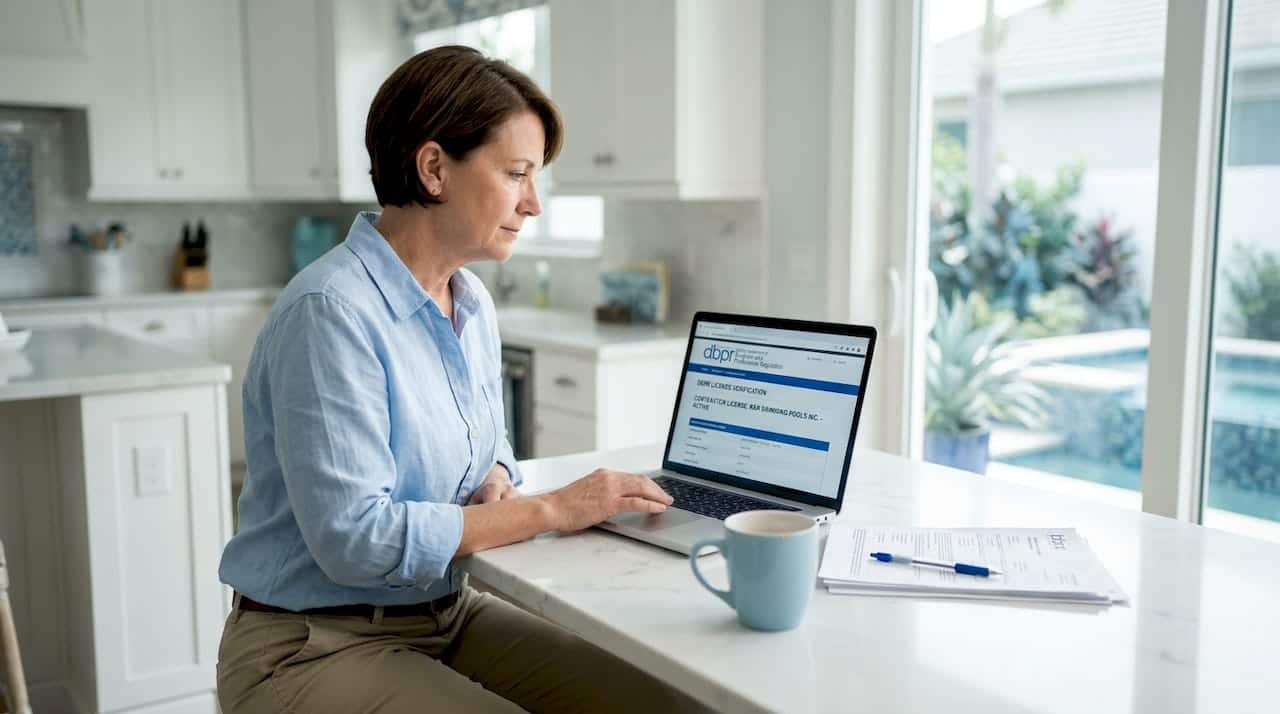
When hiring a pool contractor, the first thing you want to do is confirm their CPC license is active, current, and matched to your project type. The Florida DBPR website lets you verify active CPC license status in real time, so there is no guesswork involved. You type in the contractor’s name or license number and see their status, expiration date, and any disciplinary history.
Here is what to look for when you run that search:
- Active status: A license marked “Current, Active” is valid. Any other status means the builder cannot legally work on your project.
- License type match: Confirm the license category matches your project. A residential CPC is sufficient for most homeowner pools. A commercial CPC is required for larger or public installations.
- No discipline history: Check whether any complaints, fines, or license suspensions appear on the record.
- Name match: The license should belong to the individual or company you are contracting with, not a third party.
One of the most common mistakes homeowners make during pool contractor selection is skipping this step entirely, trusting a contractor’s verbal claim or a printed card. A printed license card can be outdated or even falsified. Always go directly to the DBPR website for real-time confirmation.
Pro Tip: Search the DBPR database using the contractor’s full legal name and company name separately. Sometimes a license is held under a slightly different name than the one on their marketing materials.
Understanding why the CPC matters beyond legality is just as important. Licensed pool builders carry state-mandated liability protections that unlicensed contractors simply do not. If something goes wrong during construction, the licensing board gives you a formal path to file a complaint and seek compensation. Without a licensed contractor, you may have no recourse at all.
Experience, state exams, and financial stability: What the CPC demands
Once you’ve identified a CPC license, dive deeper into what it means and why these behind-the-scenes requirements matter for your project. The CPC is not easy to earn, and that difficulty is exactly what makes it valuable to you as a homeowner.
To earn a CPC license in Florida, a contractor must satisfy the following requirements:
- Documented experience: Applicants must prove four years of relevant experience in pool construction, with specific documentation showing hands-on knowledge of the trade.
- Pass two state exams: One exam tests technical trade knowledge, covering pool systems, construction methods, and safety. A second exam covers business and finance, ensuring the contractor can manage a project without going financially sideways mid-build.
- Financial stability: Applicants must demonstrate a FICO credit score of 660 or higher, or post a qualifying bond. This requirement exists because financially unstable contractors are far more likely to abandon projects or cut corners when cash runs tight.
- Background check: Every applicant submits to a full criminal background check.
- Fingerprinting: A mandatory fingerprint submission is required for state records.
That financial stability requirement deserves extra attention. A contractor who can’t manage their own finances is a real risk on your project. Budget overruns, unpaid subcontractors, and material shortages are common signs of a financially struggling builder. The bonding or credit score requirement is the state’s way of filtering out builders who might leave your backyard half-finished.
“The state exam for business and finance isn’t just a checkbox — it tests whether a contractor can write accurate bids, manage subcontractors, and complete a project within a realistic budget. A contractor who passes that exam has proven they understand the business side of building your pool.”
When selecting a pool contractor for your home, ask the builder directly how long they have been licensed and whether they can share their license number for your own verification. A contractor with nothing to hide will give you that number without hesitation. You can also ask for proof of general liability insurance and workers’ compensation coverage, both of which responsible builders carry alongside their CPC.
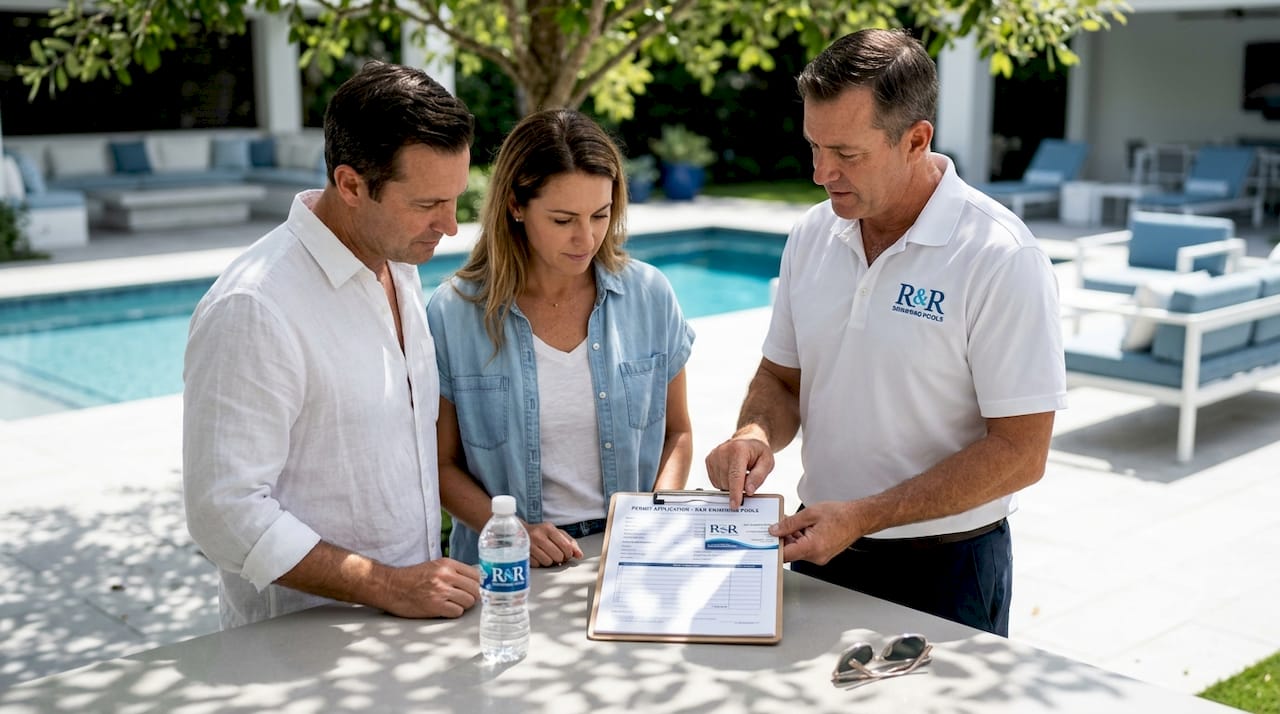
The benefits of hiring a licensed pool builder extend beyond legal protection. Licensed contractors pull permits correctly, coordinate with county inspectors, and build pools that pass final inspection on the first attempt. Unpermitted pools create enormous problems when you try to sell your home or file an insurance claim.
CPC vs. Registered contractor vs. servicing contractor: Who can build, renovate, or repair?
Knowing the requirements isn’t enough. You also need to understand the different license types in Florida, because hiring the wrong one for your project type can halt construction entirely. Florida recognizes three main categories of pool contractor credentials, and each has a distinct scope of authority.
| License type | Geographic scope | Can build new pools? | Can renovate? | Can repair/service? |
|---|---|---|---|---|
| CPC (Certified) | Statewide | Yes | Yes | Yes |
| Registered contractor | County only | Limited | Limited | Yes |
| Servicing contractor | Local | No | No | Yes |
The key distinctions are geographic and functional. A CPC statewide vs. Registered county comparison reveals a critical risk: a Registered contractor can legally perform work within their home county, but cannot take on a new pool build in a different county. If a builder registered in Polk County tries to build your pool in Orange County, they are operating outside their legal authority.
Here is a breakdown of the risks involved with each scenario:
- Hiring a Registered contractor for a new build in a different county: The permit may be denied or revoked, causing major project delays and potential financial loss.
- Hiring a servicing contractor for a renovation: They are authorized only for repairs and routine service. Hiring them for structural renovation work puts you in legal gray territory and may void warranties.
- Assuming CPC and Registered are the same: Many homeowners don’t realize this distinction exists. Both sound professional, but only the CPC carries statewide authority.
Before you sign a contract, ask questions to ask pool builders that go beyond pricing. Specifically, ask whether their license is Certified or Registered, and verify the answer on the DBPR database yourself. Understanding what a pool contractor actually is helps you ask those questions with confidence.
The safest choice for any new pool installation or full renovation in Central Florida is a Certified Pool/Spa Contractor with an active, statewide license. There are no geographic surprises, no scope limitations, and full accountability under Florida state law.
Renewal, continuing education, and out-of-state experience: Advanced checks
As credentials evolve, so do the checks. Once you’ve confirmed the license type and status, the next level of verification involves renewal history and continuing education. These advanced checks separate builders who maintain their expertise from those who earned a license years ago and stopped investing in their craft.
Florida requires biennial license renewal with 14 CE hours of continuing education every two years. Those hours must cover specific topics related to pool safety, construction techniques, and Florida building codes. A builder who has not completed their CE requirements cannot legally renew their license, which means their active status on the DBPR site also confirms they are current on education.
Here is how renewal and CE status breaks down across a typical license cycle:
| Renewal cycle | CE hours required | Exam retake needed? | License status if missed |
|---|---|---|---|
| Year 1 to 2 | 14 hours | No | Active (if completed) |
| Renewal missed | 0 (no compliance) | Possibly | Delinquent or Null and Void |
| Reinstated after lapse | Varies | Possibly | Conditional |
Pro Tip: When reviewing a builder’s DBPR record, look at the license issue date and expiration date together. If the license was issued 15 years ago but the expiration is only a few months away, ask directly when they last completed their CE hours and whether renewal is already filed.
Out-of-state experience is a trickier area. Florida does allow out-of-state pool construction experience to count toward the required four years, which is good news for builders who relocated from other states. However, that credit does not exempt anyone from Florida’s state exams or renewal requirements. A builder who spent ten years constructing pools in Georgia still needs to pass the Florida trade exam and the business/finance exam before receiving a CPC. Every licensed CPC in Florida has done exactly that, regardless of their background.
When preparing for your pool build, ask any builder you’re considering whether their license was earned through Florida residency or through out-of-state credit. That conversation often reveals how well they know Florida’s specific building codes, local permit requirements, and climate-related construction considerations. A builder who worked primarily in a northern climate may have passed the exams but lack practical experience with the specific demands of Central Florida soil types, drainage challenges, and heat-related material performance.
One reason to prioritize local pool builder advantages is exactly this kind of hands-on regional knowledge. Licensing proves baseline competency. Local experience proves proven performance in your specific environment.
The credentials most homeowners miss: Lessons from decades of Central Florida pool projects
Here is the perspective that years of building pools across Central Florida has shaped, and it might surprise you. Most homeowners who get burned by a bad contractor did check the license. They saw “active” on the DBPR site and stopped there. That is the mistake.
What separates a great pool builder from a merely licensed one is the depth of local experience, the quality of their subcontractor relationships, and the honesty of their past customers. A custom pool contractor’s real value shows up in how they handle the unexpected, because every pool project has at least one unexpected moment. Soil conditions in Central Florida vary dramatically from lot to lot. A builder who has worked in Clermont, Orlando, and Winter Garden for decades has seen those variations and knows how to respond without blowing your budget.
There is also the continuing education angle that almost no homeowner checks. Those 14 CE hours every two years aren’t just a bureaucratic hurdle. The best builders use those hours to stay current on energy-efficient pool systems, updated Florida pool safety codes, and new construction materials. Ask your prospective builder what CE courses they completed in their last renewal cycle. A builder who can answer that question in detail is one who takes the professional development seriously.
One more thing: references are credentials too. Ask for three recent homeowner references in your county, not across Florida, not from ten years ago. Credential verification tells you a builder can build your pool. Local references tell you whether they will deliver on their promises in your neighborhood, on your timeline, and with the care your project deserves.
The combination of an active CPC, clean DBPR history, current CE compliance, and strong local references is the full checklist. Most homeowners complete half of it. The ones who complete all of it almost always report a smooth, successful project.
Ready to build or renovate? Trust certified expertise for your Central Florida pool
Credential verification gives you confidence. The next step is putting that confidence behind a builder who has already earned it.
At R&R Swimming Pools, we have been building custom inground pools across Central Florida since 1985 with an active CPC license, a verified DBPR record, and decades of local project experience behind every estimate. Whether you’re planning a new installation or a major renovation, our Central Florida pool installation guide walks you through the full process from permitting to final inspection. Considering a renovation? Our luxurious pool remodeling guide covers what to expect at every stage. We also serve homeowners in Lake County pool construction and surrounding communities with the same certified standards. Contact us today for a free consultation and let your credential checklist lead you to the right team.
Frequently asked questions
How do I verify a pool builder’s CPC license in Florida?
Visit Florida’s DBPR website and search by the contractor’s name or license number to confirm active license status, ensuring the license type matches your project scope and location.
What’s the difference between CPC and Registered pool contractors?
A CPC operates statewide and can build new pools anywhere in Florida, while a Registered contractor is limited to their home county and cannot legally perform new installations beyond that geographic boundary.
Can an out-of-state pool builder’s experience count in Florida?
Yes, out-of-state experience credits may count toward the four-year requirement, but the builder must still pass Florida’s state trade and business exams and comply with all renewal and continuing education rules.
How often do pool builder licenses renew and what is required?
Florida CPC licenses renew biennially every two years, and each renewal requires the contractor to complete 14 hours of continuing education covering pool safety, construction codes, and related topics.
What happens if I hire a contractor with only a servicing license?
Servicing contractors cannot legally build new pools or perform major structural renovations, so hiring one for a full installation will likely result in failed permits, project stoppage, and potential legal liability for both you and the contractor.
