
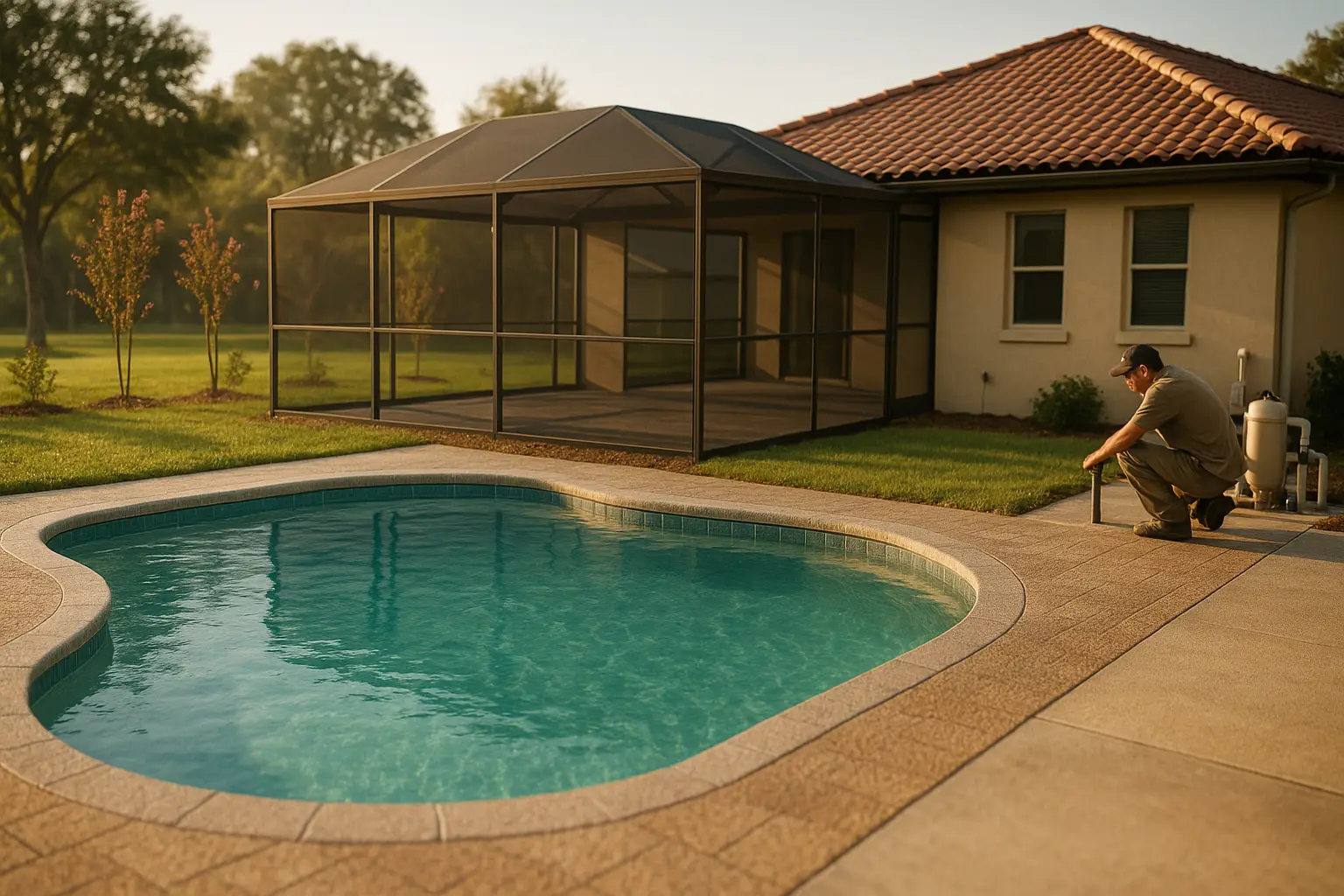
TL;DR: An inground pool usually adds resale value to a Florida home, but it rarely pays back its full cost. National data shows similar homes with pools list for about 8% more, and Realtors estimate owners get back about 56% of the cost when they sell. In Central Florida, where more than half of Orlando-metro listings have a pool, condition and fit with the neighborhood decide how much value a pool really adds.
What does the data say about pool resale value in Florida?
An inground pool usually does add resale value to a Florida home, but it almost never adds as much as it cost to build. Similar homes with pools list for about 8% more, and Realtors estimate sellers get back about 56% of a pool’s cost. In warm markets like Central Florida, the gain tends to be bigger.
That’s the short answer on pool resale value in Florida. Here is where those numbers come from and how they apply to homes in Lake County, Ocala, and nearby towns.
- About 8% higher list price. A Realtor.com analysis compared homes with the same number of bedrooms in the same ZIP code. Pool homes listed about 8% higher. Fort Myers led the country with a 20.4% premium.
- 56% cost recovery. The National Association of Realtors 2023 Remodeling Impact Report priced an 18-by-36-foot gunite pool at $90,000 nationally. Realtors estimated sellers get back 56% of that cost when they sell.
- Top Joy Score. In the same report, homeowners rated an inground pool addition 10 out of 10, the highest score possible.
What about the 54% pool premium headline?
You may have seen a headline saying pool homes are worth 54% more. That number comes from Realtor.com listing data reported by Florida Realtors for April 2025. It compares a typical pool home listed at $599,000 to a typical home without a pool at $389,000. But the pool homes were also about 600 square feet bigger. Most of that gap comes from the house, not the pool. Price per square foot is a fairer measure: $247 with a pool versus $204 without.
Why do pools matter more to buyers in Central Florida?
Pools matter more here because so many homes have them, so buyers expect one. In 2025, 55.3% of home listings in the Orlando metro included a pool, the third-highest share in the country. Tampa was close behind at 47.6%.
Lake County is part of the Orlando metro, so those listings are what local buyers compare your home to. In a neighborhood where most houses have pools, a home without one can have a harder time competing. In an area where few homes have pools, the gain is usually smaller.
Our long swim season helps too. Up north, pools sit closed for months. Here, a pool gets used most of the year, so buyers see it as living space, not a summer extra. Your home might be in a Lake County subdivision or on a bigger lot near Summerfield. Either way, the best guide is what similar homes with and without pools sold for nearby. A local real estate agent can pull those sales for you.
Safety features matter to family buyers
Buyers with young kids look closely at pool safety. Under Florida’s Residential Swimming Pool Safety Act, a new home pool needs at least one approved safety feature to pass final inspection. The options are a barrier that meets the law, an approved safety cover, exit alarms on doors and windows that open to the pool, self-closing and self-latching doors with the release at least 54 inches above the floor, or an in-pool alarm.
What makes one pool add more value than another?
Condition, fit with the neighborhood, and how much yard is left matter most. Appraisers compare your home to recent nearby sales, so a pool that matches what local buyers expect usually holds its value best.
| Factor | Tends to help resale | Tends to hurt resale |
|---|---|---|
| Pool type | Permanent inground pool | Above-ground pool, which appraisers usually treat as personal property |
| Condition | Clear water, working equipment, clean surface | Green water, cracks, worn-out pump or filter |
| Size and yard | Pool sized to the lot, with room left for grass or play | Pool and deck that fill the whole yard |
| Neighborhood | Most nearby homes have pools | Few nearby pools, or a pool far fancier than the homes around it |
| Paperwork | Permits closed, final inspection passed, warranty papers on hand | Missing permits or no records |
Among inground pools, focus on condition and fit. Fiberglass and concrete pools are both permanent, and in Central Florida they cost about the same. Pick the one that suits your yard and the way your family swims. Our Central Florida inground pool cost guide explains what drives the budget.
What are the pros and cons of a pool for resale?
The main pro is keeping up with nearby homes. The main con is that you won’t get the full cost back. Here is the full list.
Pros
- It helps your home compete in neighborhoods where most listings have a pool.
- Pool homes list at a higher price per square foot in national data.
- An inground pool counts as a permanent improvement when your home is appraised.
- You get years of use before you sell.
Cons
- You will likely get back only part of the cost, about 56% in NAR’s estimate.
- Some buyers just don’t want a pool to take care of.
- A neglected pool with green water or old equipment can hurt a sale instead of helping it.
- Cleaning, chemicals, and electricity add up the whole time you own it.
Should you build a pool right before you sell?
Usually not. In NAR’s report, only 1% of Realtors recommended adding an inground pool before listing a home. Many more recommended lawn care and landscaping.
Time is another reason. At R & R Swimming Pools, fiberglass projects typically take 2 to 4 months and concrete projects 4 to 6 months. A pool built for a quick sale may barely be finished when the sign goes up, and you would miss the years of use that make it worth the money.
The better plan is to build a pool because your family will use it, and count any resale value as a bonus. If you’re still deciding, our guide on whether a pool is worth it in Florida covers upkeep and lifestyle trade-offs.
Why work with R & R Swimming Pools?
- We are family-owned and have built pools in Lake County and Central Florida since 1985.
- Our team has built over 1,000 pools.
- We are an authorized Latham Pool dealer for fiberglass pools.
- Our in-house gunite crew builds custom concrete pools with shells 6 to 12 inches thick.
- Both pool types carry a limited lifetime warranty.
- We handle design, engineering, permitting, excavation, plumbing, electrical, and the final walkthrough in-house.
- You can learn how pool permits work in Lake County before you start.
- Financing is available through Lyon Financial and Viking Capital.
To talk through a pool that fits your yard and your neighborhood, call (352) 432-8843 or request a free estimate.
Frequently Asked Questions
Does a fiberglass or concrete pool add more resale value?
Both are permanent inground pools that appraisers can count toward your home’s value. How well the pool is kept up and how well it fits the neighborhood usually matter more than the type. In Central Florida, the two cost about the same.
Do above-ground pools add resale value in Florida?
Usually not. Most appraisers treat above-ground pools as personal property, like furniture, so they rarely add to a home’s appraised value.
How can I protect my pool’s value before I sell?
Keep the water clear, fix any equipment problems, and repair cracks or worn surfaces before you list. Have your permit records, final inspection papers, and warranty documents ready for buyers and their agents.
Is there pool resale data just for Ocala or Marion County?
The big national studies report by metro area, and the published figures used here cover Orlando, Tampa, and Fort Myers. For Ocala, Belleview, or Silver Springs, ask a local real estate agent to compare recent sales of similar homes with and without pools.
Recommended Reads
- Fiberglass vs. Concrete Pool Cost in Florida: A Side-by-Side Breakdown
- How Much Does an Inground Pool Cost in Central Florida? (2025 Pricing Guide)
- How to Finance a Pool in Florida: Loan Options, Lenders, and What to Expect
