
TL;DR:
- Choosing durable, high-quality finishes like pebble or exposed aggregate significantly extends pool service life in Central Florida’s aggressive climate.
- Proper selection and installation of coping and decking materials are crucial for protection, safety, and long-term performance.
Florida’s sun, heavy summer rains, and constant humidity are not forgiving to a pool built with the wrong materials. Homeowners across Central Florida discover this the hard way when their beautiful new pool starts showing cracks, staining, or rough surfaces just a few years after installation. The good news is that choosing the right materials from the start is not complicated once you understand what each option actually delivers under real Florida conditions. This guide walks you through every critical decision, from interior finishes to coping and decking, so you can invest confidently and avoid the repair bills that come with uninformed choices.
Table of Contents
- Understand common pool materials and what they mean for your pool
- Step-by-step: How to evaluate interior finishes for Central Florida pools
- Don’t overlook coping and decking: Frame, protect, and enjoy your pool
- What to watch out for: Common mistakes homeowners make with pool materials
- What most homeowners miss about pool materials in Central Florida
- Move forward: Central Florida pool building done right
- Frequently asked questions
Key Takeaways
| Point | Details |
|---|---|
| Durability matters most | Choosing upgraded finishes and quality coping extends pool life and reduces repairs in Central Florida. |
| Interior finish drives maintenance | Your finish type largely determines how often you’ll need to resurface or clean your pool. |
| Coping is a functional necessity | Coping isn’t just decorative; it protects your pool’s structure and safety. |
| Ask about local benchmarks | Use Florida-specific service life data for each material rather than relying on averages from other climates. |
| Expert help pays off | Professional advice and guides reduce the risk of costly mistakes and maximize satisfaction. |
Understand common pool materials and what they mean for your pool
With the stakes laid out, let’s look at the main pool material options and how they stack up under Florida’s climate.
There are three primary types of inground pool construction: concrete (gunite or shotcrete), fiberglass, and vinyl liner. Each has its own strengths, cost profile, and tolerance for Florida’s specific weather patterns. The right choice depends on your budget, your design goals, and how much ongoing maintenance you are willing to manage.
Concrete pools are the most customizable option and the most common choice for homeowners who want a truly unique shape, depth, or feature set. However, they require an interior finish applied over the structure, and that finish is what determines how your pool looks and holds up over time. As Central Florida resurfacing options point out, Florida conditions can accelerate wear of standard plaster significantly, making your finish choice one of the most important decisions you will make for a concrete pool.
Fiberglass pools come as prefabricated shells and are known for their smooth, non-porous surface that resists algae growth and does not require the same chemical balancing demands as concrete. You can explore the fiberglass pool advantages in detail to understand whether this option fits your project.
Vinyl liner pools offer a lower upfront cost but require liner replacement roughly every 7 to 12 years, which adds to the long-term expense. They are less popular in Central Florida because of the region’s intense UV exposure and ground movement.
Here is a quick comparison of the most common concrete interior finishes by service life and maintenance demand:
| Finish type | Expected service life | Maintenance level | Texture |
|---|---|---|---|
| White plaster (marcite) | 7 to 12 years | High | Smooth |
| Quartz blend | 12 to 20 years | Medium | Slightly textured |
| Pebble/exposed aggregate | 20 to 25 years | Low to medium | Textured |
Factors that accelerate wear in Central Florida pools include:
- Intense UV radiation that breaks down surface materials faster than in northern climates
- Heavy rainfall that dilutes pool chemistry and creates chemical swings
- High bather load during the long swim season
- Ground movement caused by Florida’s sandy, shifting soils
- Frequent temperature fluctuations during cooler months that stress surface bonds
If you want to understand the full picture of best pool finishes for this region, it pays to look closely at how each material responds to these stressors specifically, not just general national data.
Step-by-step: How to evaluate interior finishes for Central Florida pools
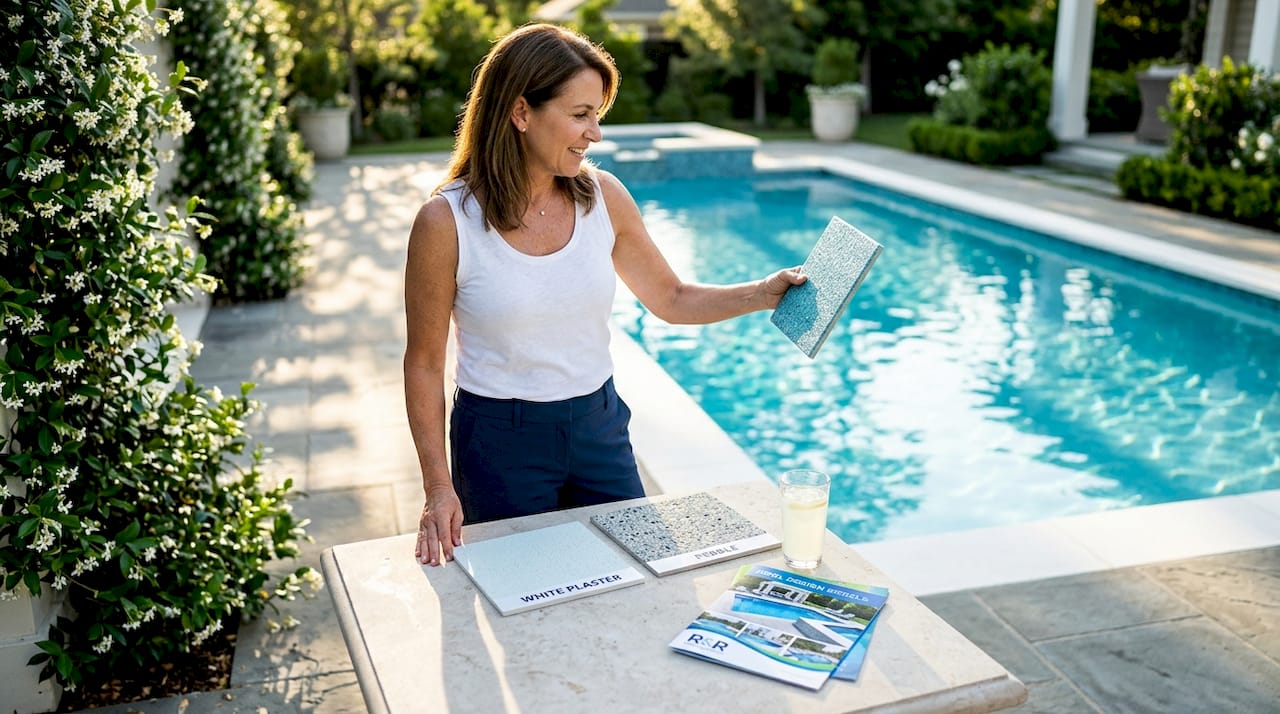
Now that you understand the major materials, the next move is choosing the best finish for your goals and Florida’s realities.
Step 1: Assess your priorities. Start by deciding what matters most to you. Is it the lowest upfront cost? The longest possible service life? A specific look or color? Being honest about your priorities prevents you from making a decision you will regret in five years.
Step 2: Match finish type to your lifestyle. If you have kids, pets, or host large gatherings frequently, a high-traffic finish like pebble or quartz will hold up far better than white plaster. If you prefer a more traditional, crisp-white look, quartz blends now come in white and off-white tones that mimic plaster while lasting twice as long.
Step 3: Budget for a finish upgrade. Many homeowners get a pool quote based on white plaster because it is the default cheapest option. But upgrading to quartz or pebble typically adds a few thousand dollars while doubling or tripling the years before you need to resurface. That math usually works strongly in favor of the upgrade.
Step 4: Ask about local performance data. A contractor working in Central Florida for decades will have firsthand knowledge of how each finish holds up in your specific county’s water chemistry and weather pattern. This local insight is worth more than a product brochure.
Step 5: Review your pool interior finish guide for design options. Once you know the performance category you want, you can look at color and design options within that category to match your backyard aesthetic.
Here is a side-by-side breakdown of the three main finish options:
| Feature | White plaster | Quartz blend | Pebble/aggregate |
|---|---|---|---|
| Service life | 7 to 12 years | 12 to 20 years | 20 to 25 years |
| Stain resistance | Low | Medium to high | High |
| Etching risk | High | Low | Very low |
| Upfront cost | Lowest | Moderate | Highest |
| Texture feel | Smooth | Slightly textured | Textured |
| Best use case | Budget builds | Balanced investment | Long-term value |
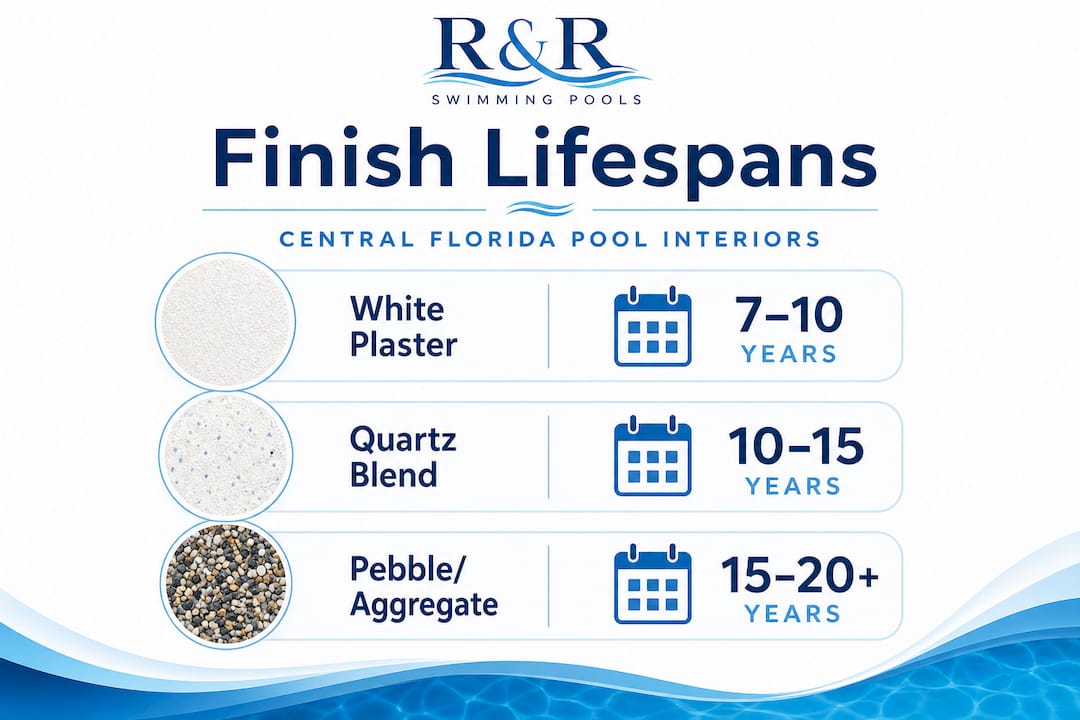
The Central Florida resurfacing options guidance is clear: upgrading from white plaster to quartz or pebble is the most direct way to improve service life and reduce issues like etching and staining when chemistry or rainfall effects are hard to keep perfectly stable. In a climate where summer downpours are a daily reality, “perfectly stable” chemistry is not always realistic.
Pro Tip: If your budget is tight, prioritize the finish upgrade over decorative water features. A longer-lasting finish saves you more money over ten years than almost any other single decision in the pool building process.
Don’t overlook coping and decking: Frame, protect, and enjoy your pool
Selecting a pool’s inner materials is key, but don’t miss the edges, which are the coping and decking, as they protect your investment and improve safety.
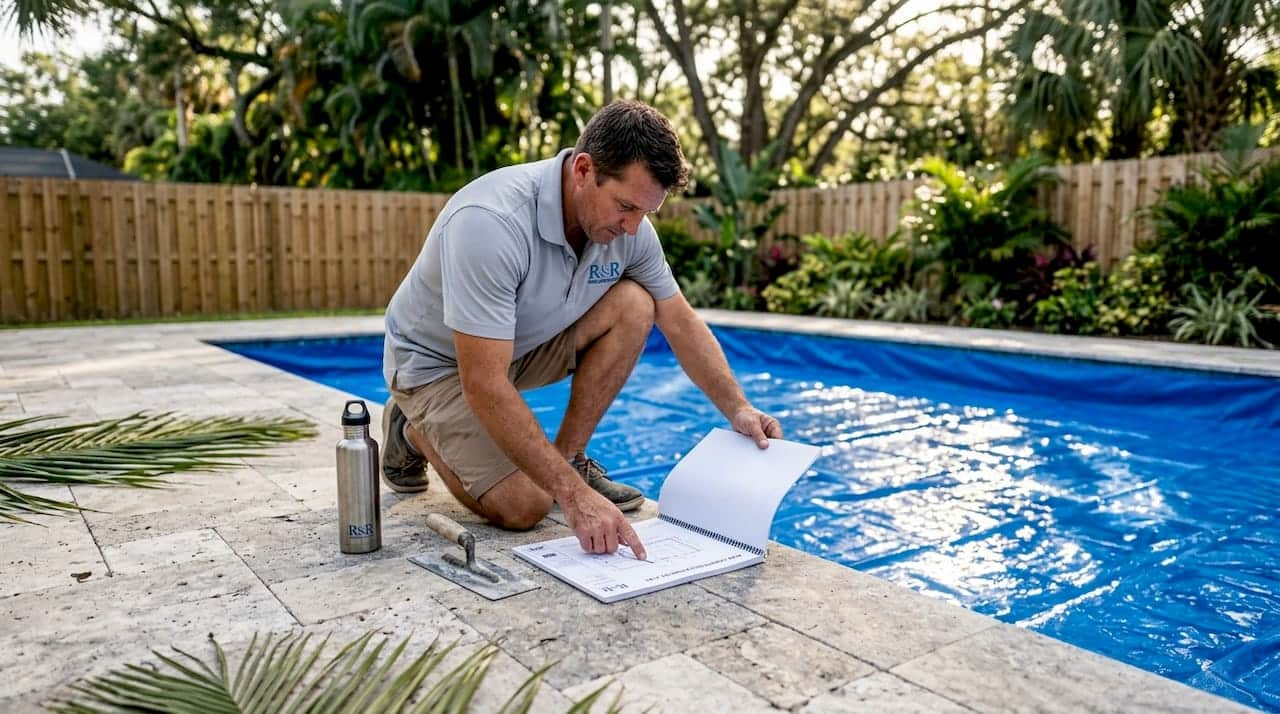
Coping is the material that caps the edge of the pool where the shell meets the surrounding deck. It is not decorative in the way most people think. Pool coping protects the structure and manages safety and drainage at the waterline, meaning the material you choose and how it is installed directly affect how long your pool performs without cracking or water intrusion.
In Central Florida, the most popular coping and decking materials include:
- Pavers (travertine, brick, concrete): Extremely popular because they allow for water drainage between joints and can be individually replaced if cracked or shifted. Travertine stays cool underfoot even in direct sun, which is a significant comfort advantage in Florida summers.
- Poured concrete decking: Durable and cost-effective, though it retains heat and can develop surface cracks over time without proper expansion joints.
- Natural stone: Premium look, long service life, but requires sealing and can be slippery when wet if the wrong texture is chosen.
- Cantilever coping: A poured concrete option where the deck overhangs the pool edge slightly, creating a clean, seamless look without visible coping material.
When installing any deck material around a Florida pool, these best practices protect your investment:
- Always slope the deck away from the pool at a minimum of 1.5 percent grade to direct rain and splash water away from the pool structure and surrounding landscaping.
- Install proper expansion joints every 8 to 10 feet in concrete decking to allow for ground movement and thermal expansion without cracking.
- Choose textured or slip-resistant surfaces near pool entry points, steps, and ledges to reduce slip-and-fall risk during wet conditions.
- Use frost-resistant or non-absorptive materials even in Florida’s mild winters, because occasional cold snaps can cause surface cracking in porous materials that absorb water.
- Seal natural stone and pavers annually to prevent algae growth, surface staining, and water penetration into the material.
Critical installation note: If coping is installed incorrectly or with the wrong bond to the pool shell, water can migrate behind the coping and into the pool structure. Over time, this causes tile cracking, plaster separation near the waterline, and even structural damage that costs far more to fix than the original coping installation. Always insist on a contractor who understands Florida-specific expansion and drainage requirements.
Reviewing your options for pool deck materials early in the design phase helps you budget realistically and avoid late-stage upgrades that disrupt your project timeline.
What to watch out for: Common mistakes homeowners make with pool materials
To lock in the full value of your choices, be sure to avoid these common missteps and check your plan before contracts or purchases.
- Defaulting to the cheapest finish without understanding the cost of ownership. White plaster’s 7 to 12 year service life, compared to quartz at 12 to 20 years and pebble at 20 to 25 years, means resurfacing costs that can reach thousands of dollars arrive far sooner than most homeowners expect.
- Ignoring coping and decking until the last minute. These materials are often treated as aesthetic afterthoughts, but they are structural and safety decisions first. Rushing the choice at the end of a project often leads to mismatched performance characteristics.
- Choosing deck materials that absorb heat. Many homeowners fall in love with dark-toned materials without considering that Florida’s summer sun will make them painful to walk on barefoot. Light-colored, reflective materials like travertine or light gray pavers stay significantly cooler.
- Misunderstanding what pool maintenance actually requires. Each finish type has specific chemical balance requirements. Plaster is particularly sensitive to low pH, which causes etching. Choosing a more forgiving surface like pebble makes pool chemistry errors far less damaging to the finish.
- Skipping the slip-resistance check. Florida’s frequent rain means your pool deck is wet more often than a pool in Arizona or Colorado. A surface that looks beautiful in a showroom may become dangerous when wet.
- Not asking about local experience. A contractor who has only built pools in dry climates may not account for Central Florida’s ground movement, water table issues, or the chemical effects of daily afternoon storms. Local expertise is not optional here.
Pro Tip: Always verify that your chosen deck material has an adequate slip resistance rating and that your finish is chemically compatible with your pool water source. Central Florida’s hard water in some areas and soft water in others means one approach does not fit every project. Review pool maintenance tips specific to this region before finalizing your material selections.
What most homeowners miss about pool materials in Central Florida
After building and renovating pools across Central Florida since 1985, we have watched the same pattern repeat itself. A homeowner makes material choices based on what looks beautiful in the showroom or what fits the tightest possible budget, and then calls us five or seven years later wondering why they are already facing a significant repair bill.
The honest truth is that material selection in Central Florida is not like picking pool materials anywhere else. The climate is aggressive. Every year, this region absorbs intense UV radiation, thousands of gallons of rainwater diluting pool chemistry, and ground movement that tests every bond and joint in the structure. Materials that perform adequately in milder climates simply show their weaknesses here faster.
The lesson we keep sharing is this: upgrading from white plaster to quartz or pebble is usually the most direct way to improve service life and reduce costly issues. We have seen this play out hundreds of times. The homeowner who spent an extra couple of thousand dollars on a pebble finish is still enjoying their original surface fifteen years later. The homeowner who saved that money on plaster has already resurfaced once and is planning a second resurfacing.
That is not a coincidence. It is the predictable result of understanding service life benchmarks rather than chasing the lowest quote or the trendiest look.
The other thing that gets overlooked is how early decisions compound. A properly planned pool with the right pool project budgeting from the start almost always costs less over a ten to twenty year horizon than a pool that was value-engineered at every decision point. Cheap coping fails. Plaster etches. Unsealed pavers stain. Each of those failures costs time, money, and the enjoyment of your pool during repair periods.
Buy smart from day one. It is almost always the least expensive choice in the long run.
Move forward: Central Florida pool building done right
Ready to explore practical steps? Here’s where you can get expert planning and hands-on support.
At R&R Swimming Pools, we have been helping Central Florida homeowners navigate exactly these decisions since 1985. Whether you are starting fresh with a new custom concrete pool building project or renovating an existing pool, the materials you choose will define your experience for decades.
Our team brings local expertise to every conversation, from finish selection to coping installation and deck design. We can walk you through our full step-by-step pool installation guide so you understand exactly what to expect at each stage. If you are still comparing options, our breakdown of the best inground pool types is a great place to see how concrete, fiberglass, and other builds compare side by side. Reach out today for a free quote and let’s build something that lasts.
Frequently asked questions
What material lasts the longest for pool interiors in Central Florida?
Pebble or exposed aggregate finishes offer the longest service life, typically 20 to 25 years under Central Florida conditions, making them the strongest long-term investment for interior surfaces.
Is quartz finish worth the upgrade over standard plaster?
Yes. Quartz finishes last 12 to 20 years with significantly better stain resistance than standard plaster, giving you a durable middle-ground option between basic plaster and pebble aggregate.
Does coping material really affect my pool’s durability?
Absolutely. Pool coping protects the pool structure while managing drainage and waterline safety, and poor coping installation can lead to water intrusion and structural damage over time.
How do rain and pool chemicals affect material choice in Florida?
Frequent rain constantly dilutes pool chemistry, causing pH swings that etch and stain white plaster far faster than in drier climates. Upgrading to quartz or pebble dramatically reduces the damage from these unavoidable chemical fluctuations.
What’s the best way to avoid costly pool material mistakes?
Compare total cost of ownership across the full service life of each material, ask your contractor about local performance data, and confirm that your deck and coping choices meet slip-resistance and drainage requirements before signing any contract.
