
TL;DR:
- Choosing the correct pool tile is essential for long-term durability and safety in Central Florida’s challenging climate. Porcelain tiles excel due to their low water absorption, chemical resistance, and impact strength, making them ideal for submerged areas. Proper installation and maintenance are critical to ensure tile longevity, with expert advice helping homeowners avoid costly repairs.
Pool tile is one of the most consequential decisions you’ll make when building or renovating a pool, yet most homeowners spend more time picking their pool shape than their tile material. That’s a costly mistake. The wrong tile can crack under Florida’s sun, become dangerously slippery underfoot, absorb chemicals, or fail entirely within a few years, turning a beautiful investment into an expensive repair project. In Central Florida’s unique climate, with intense heat, high humidity, fluctuating water chemistry, and year-round use, tile choices genuinely make or break your pool’s long-term performance and appearance.
Table of Contents
- Why pool tile choices matter in Central Florida
- Comparing porcelain, glass, and ceramic tiles: Pros and cons
- Design and function: How tile shapes and placement impact your pool
- Installation best practices and maintenance tips for lasting results
- A fresh perspective: What most guides miss about pool tile choices
- Ready to create your ideal pool? Take the next step
- Frequently asked questions
Key Takeaways
| Point | Details |
|---|---|
| Material impacts longevity | Porcelain tiles are best for Central Florida pools, while glass and ceramic play supporting roles. |
| Safety requires smart placement | Porcelain is essential for steps and floors; glass works best as an accent or waterline feature. |
| Installation quality matters | A skilled installer and proper materials are crucial to avoid costly repairs or early failure. |
| Regular maintenance | Expansion joints, cleaning, and water chemistry all help protect your pool tile investment. |
Why pool tile choices matter in Central Florida
Before focusing on specific tile types, it’s important to understand why Central Florida’s climate and pool usage patterns require careful consideration. This isn’t just about looks. The environment directly determines which materials hold up and which ones fail prematurely.
Florida’s sun is relentless. UV exposure, paired with high ambient temperatures, accelerates the degradation of certain tile glazes and adhesives. Humidity causes moisture to work into any porous material, and when that moisture freezes during rare cold snaps or simply expands and contracts through daily temperature cycling, tiles crack. Pool chemicals add another layer of stress. Chlorine and saltwater are chemically aggressive, and tiles that aren’t rated for full submersion will absorb water and slowly deteriorate from the inside out.
Here’s what most homeowners don’t realize: not all pool tiles are designed for the same job. The benefits of pool tile types vary significantly by material. For example, ceramic tiles are less durable than porcelain in harsh Florida conditions, suitable only for low-stress areas because of their higher porosity (above 0.5% water absorption). That porosity is a real problem in a pool environment where surfaces are constantly wet.
Saltwater pools and homes with hard water face additional risks. Saltwater splashes require non-porous glazes, and hard water mineral deposits can cause scale delamination. If more than 20% of a tile surface is affected, full replacement becomes necessary rather than spot repair. Expansion joints also need attention: reseal them every five years to prevent water infiltration at tile seams.
Key factors every Central Florida homeowner should evaluate before selecting tile:
- Water absorption rate: Look for tiles with less than 0.5% absorption (vitreous or impervious rating) for submerged areas.
- Chemical resistance: Confirm tiles can withstand chlorine and salt without glaze erosion.
- UV stability: Outdoor and above-waterline tiles need UV-resistant glaze to prevent fading.
- Surface texture: Wet pool surfaces demand adequate grip. A coefficient of friction below 0.60 creates a slip hazard.
- Thermal expansion: Tiles must accommodate temperature-related movement without cracking.
Pro Tip: Look for tiles with a COF (coefficient of friction) of at least 0.60 for any walking surface in or around your pool, including steps, ledges, and shallow entry areas. This is a safety standard, not just a recommendation. Checking pool tile material options can help you compare specifications before committing to a product.
Good pool maintenance tips in Florida also start with the right tile, because some materials require far less upkeep than others over time.
Comparing porcelain, glass, and ceramic tiles: Pros and cons
Now that you know why material properties matter, let’s compare the three most popular pool tile options side by side. Each has a genuine role to play, but none is the right answer for every situation.
Porcelain is the workhorse of pool tile. It’s fired at extremely high temperatures, which creates an almost non-porous surface that resists water, chemicals, and UV degradation. Porcelain tiles offer superior durability, slip resistance (COF 0.60 and above for floors and steps), impact absorption, and cost-effectiveness compared to glass. For high-traffic areas like pool floors, steps, and entry ledges, porcelain is consistently the best performer. It also comes in a wide range of finishes, from matte to textured, making it versatile for both modern and traditional pool designs.
Glass tiles are the luxury choice. They catch light in a way no other material can, creating that shimmering, jewel-like effect you see in high-end resort pools. Glass mosaic tiles are ideal for decorative accents, spas, spillways, and waterlines in luxury pools, providing shimmer and chemical resistance. However, glass is not appropriate for walking surfaces. It chips at the edges under impact, and its surface can become slippery when wet. Glass also requires specialized epoxy thinset installation to avoid voids beneath the tile, which cause failure over time.
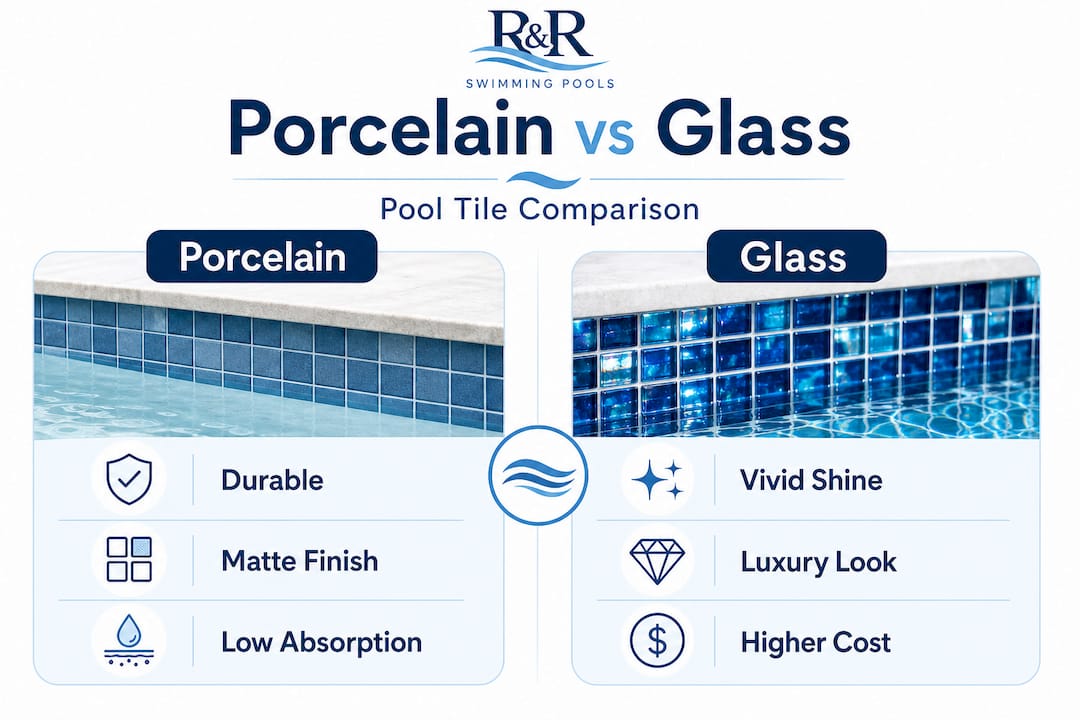
Ceramic tiles fall somewhere in the middle on cost, but near the bottom on durability for Florida pools. They’re fine for above-waterline decorative applications or covered outdoor areas, but their higher porosity makes them a poor long-term choice for submerged or high-stress locations.
| Tile type | Water absorption | Best locations | Slip resistance | Cost range | Durability |
|---|---|---|---|---|---|
| Porcelain | Below 0.5% | Floors, steps, waterline | High (COF 0.60+) | Mid to high | Excellent |
| Glass | Near 0% (non-porous) | Waterline, walls, spas | Low (not for walking) | High | Good with expert install |
| Ceramic | Above 0.5% | Above-waterline accents | Moderate | Low to mid | Fair |
One key statistic worth keeping in mind: porcelain holds its glaze and structural integrity significantly longer in submerged environments, especially in saltwater pools, which are increasingly popular in Central Florida. Glass, while chemically resistant, depends almost entirely on expert installation quality for its longevity.
Pro Tip: The smartest approach is to combine porcelain and glass in the same pool. Use porcelain on every surface where someone might walk or push off (floors, steps, benches), and use glass for your waterline band, spa walls, or feature accents. You get both the safety of porcelain and the luxury of glass without compromising either. This strategy is central to designing a custom backyard pool that truly impresses.
Design and function: How tile shapes and placement impact your pool
Understanding materials is just part of the story. How you use and place those tiles makes a big difference, too.
Tile shape directly affects both the visual character of your pool and its functional performance. Small mosaic tiles, typically one inch to two inches square, create intricate patterns and work around curves effortlessly. They’re the go-to choice for spa interiors, curved walls, and feature surfaces. However, more grout lines mean more potential areas for algae growth and chemical infiltration if the grout isn’t epoxy-rated.
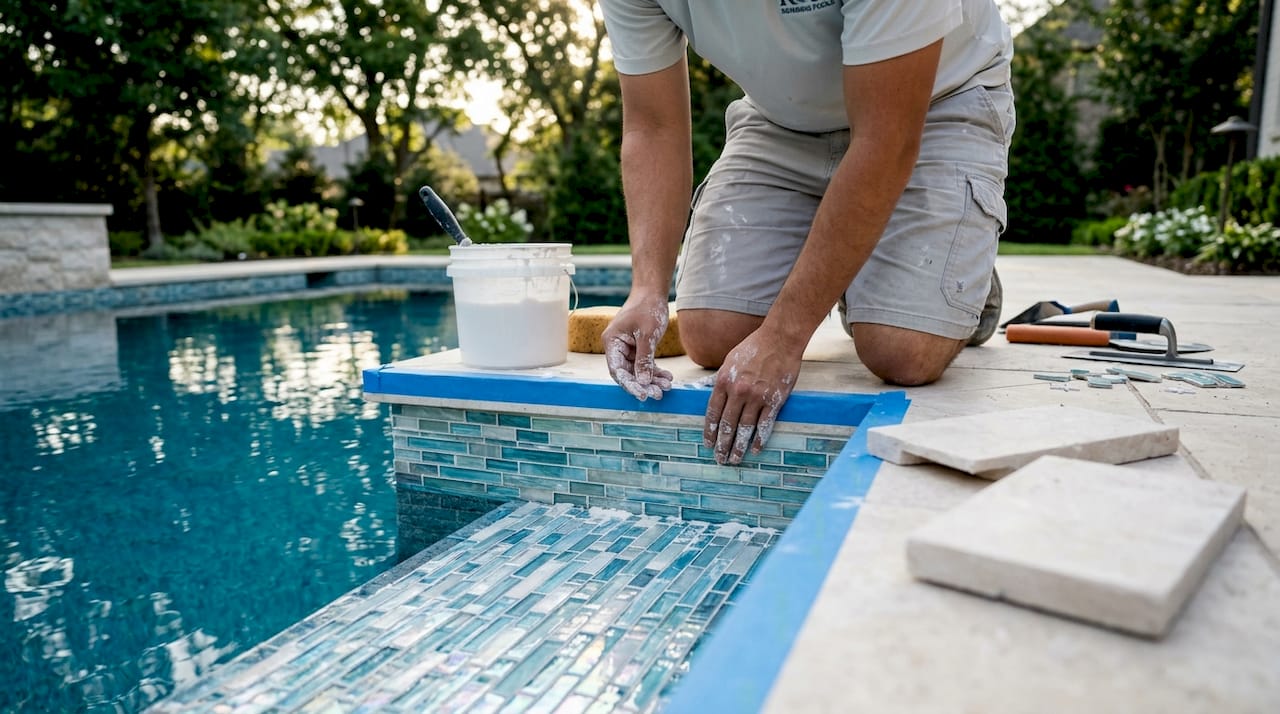
Larger format tiles, those in the four-inch to twelve-inch range, create a sleeker, more contemporary look. They’re easier to clean because fewer grout lines exist, but they require a perfectly level substrate to install correctly. Any deviation in the pool shell surface gets magnified under a large tile, resulting in hollow spots that eventually cause cracking or lifting.
Combining materials is the expert approach: porcelain for floors and steps where safety matters most, glass for accents where luxury is the priority. Professional installation is critical because voids beneath tiles, caused by insufficient adhesive coverage, are the number one reason tiles fail prematurely.
Here’s how different pool areas call for different tile strategies:
- Pool floor: Textured porcelain in a matte or satin finish for maximum grip and durability.
- Steps and entry areas: Anti-slip porcelain tiles with a COF well above 0.60, ideally with a raised profile or grip strip.
- Waterline band: Glass mosaic tiles create a beautiful accent while resisting waterline scale. Pair with a non-porous glaze for salt resistance.
- Spa interior: Glass or smooth porcelain, since spas see less foot traffic and benefit from the reflective quality of glass.
- Spillways and water features: Glass mosaic works beautifully here, catching light as water moves across the surface.
- Pool walls: Either large-format porcelain for a clean contemporary look or glass mosaic for a resort-inspired finish.
“Function must guide form. A pool that looks stunning in photos but has slippery steps or tiles that pop off after two seasons is a failure, not a success. Great pool design means the right material in the right place, every time.”
Proper placement also protects your investment in ways that aren’t immediately obvious. Tiles installed too close to the coping without expansion joints will crack as the pool shell moves slightly with soil shifts. This is especially relevant in Florida, where soil composition and moisture levels fluctuate. Choosing features for your Florida pool requires thinking about these structural details alongside aesthetics.
Installation best practices and maintenance tips for lasting results
Beautiful, safe, and long-lasting pool tile depends as much on installation and care as on initial product choices. Even the best tile on the market will fail if installed incorrectly or neglected.
The installation sequence matters more than most people realize. On gunite pools, tiles should be installed before coping to ensure a level waterline. Pool-rated thinset with 95% coverage, epoxy grout for submerged areas, and laser leveling are all part of proper professional practice. ANSI A137.1 standards govern pool tile installation, and any contractor who can’t reference these standards should raise a red flag.
Here are the critical steps in a professional pool tile installation:
- Prepare the substrate: The pool shell surface must be clean, structurally sound, and free of dust or grease before any tile work begins.
- Apply pool-rated thinset: Use a polymer-modified thinset rated for continuous water submersion. Coverage must reach 95% of the tile back to eliminate voids.
- Set tiles with precision: Use laser leveling tools to maintain consistent alignment, especially at the waterline where any deviation is visible from outside the pool.
- Allow full cure time: Don’t rush this step. Thinset needs adequate time to bond completely before the pool is filled with water.
- Apply epoxy grout: Epoxy grout is mandatory for submerged areas. Unlike standard grout, it resists water penetration, chemical degradation, and staining.
- Install and seal expansion joints: These flexible joints at tile field intersections and along coping allow for natural movement of the pool shell. They must be filled with a flexible, waterproof sealant.
- Inspect before filling: Walk the entire tiled area and check for hollow-sounding tiles, uneven grout lines, and expansion joint gaps before the pool is filled.
For ongoing maintenance, keep these priorities in mind:
- Reseal expansion joints every five years, or sooner if you notice cracking or separation.
- Brush the waterline weekly to prevent mineral scale buildup, which can lift tile glazes over time.
- Balance pool chemistry consistently. High pH accelerates scale; low pH etches grout and glazes.
- Inspect tiles annually for chips, cracks, or loose spots, especially after harsh weather.
Pro Tip: Always hire certified installers who follow ANSI standards and use warranty-backed materials. Ask your contractor specifically about their thinset coverage rate and grout type. The difference between an amateur and a professional installation often isn’t visible on day one, but it becomes very clear within two to three years. Learn more about what goes into the pool tile installation process before signing any contract.
A fresh perspective: What most guides miss about pool tile choices
Most tile guides stop at material comparisons and leave you with a chart. Here’s what 40 years of building pools in Central Florida actually teaches you.
The biggest mistake homeowners make is choosing tile based on showroom samples under controlled lighting. A tile that looks stunning indoors can look completely different submerged under water, lit by LED pool lights, or viewed from outside the pool at a low angle. Always request large wet samples and view them in natural light and under simulated pool lighting before committing.
The second mistake is treating installation as a cost to minimize. We’ve seen it repeatedly: a homeowner invests in premium glass tile and then tries to save money by using a general tile contractor instead of a pool-specific installer. The result is almost always voided warranties, popped tiles within a season or two, and a repair bill that exceeds what they would have spent on professional installation in the first place. Premium tile is only as good as the system it’s installed in, including the substrate prep, adhesive, grout, and expansion joint design.
There’s also a pattern we notice in homeowners who focus entirely on the waterline tile, which is the most visible band, and underinvest in the pool floor material. The floor covers far more surface area, receives the most foot traffic, and is the first place that shows wear. Spending a little more on a quality textured porcelain for the floor pays dividends in safety and appearance for decades.
One more thing most guides won’t tell you: the tile you choose sends a signal about the entire pool. A well-considered tile palette, mixing the right materials in the right places, elevates every other design element around it. A rushed or generic tile selection can make even a well-constructed pool look ordinary. Review the best tile choices for Florida pools and invest the time to get this decision right. Your pool will thank you for it for the next 20 years.
Ready to create your ideal pool? Take the next step
Tile knowledge is powerful, but turning that knowledge into a pool you’ll love for decades takes experienced hands.
At R&R Swimming Pools, we’ve been designing and building custom inground pools across Central Florida since 1985. Whether you’re starting from scratch or upgrading an existing pool, our team guides you through every tile decision, from material selection and safety ratings to installation quality and long-term care. Explore our luxurious pool renovation guide to see what a properly executed tile transformation looks like, or review our custom pool installation guide for everything involved in building your ideal backyard pool. We also offer flexible pool financing options to make your vision achievable. Contact us for a free quote and let’s build something exceptional together.
Frequently asked questions
Which pool tile material lasts longest in Florida’s climate?
Porcelain tiles typically outlast glass and ceramic thanks to their low water absorption and high durability, making them the top choice for submerged and high-traffic pool surfaces in Florida’s demanding environment.
Can you use glass tiles on pool steps or floors?
No, glass tiles should not be used on pool steps or floors because they can be slippery and are prone to chipping at the edges. Glass is unsuitable for walking surfaces and should be reserved for decorative and accent applications only.
How often should pool tile joints be resealed?
Expansion joints should be resealed approximately every five years to prevent water infiltration, tile damage, and costly structural repairs, especially in Florida’s chemically aggressive pool environments.
What causes pool tile to crack or fall off?
Improper installation is the most common cause, particularly failing to achieve 95% thinset coverage beneath each tile, which creates voids that allow water to undermine the bond and eventually pop tiles loose.
