
TL;DR:
- Upgrading to variable-speed pool pumps can reduce energy costs by up to 80%.
- Modern pumps improve water clarity, reduce maintenance, and extend equipment lifespan.
- Energy-efficient pumps offer significant environmental benefits and quick return on investment.
Most Central Florida pool owners are quietly overpaying on their electric bills every single month, and the culprit is something they rarely think about: the pool pump. That outdated single-speed motor running in your backyard can consume more electricity than your refrigerator, washer, and dryer combined. The good news is that upgrading your pool pump is one of the highest-return home improvements you can make, cutting energy use by up to 80%, improving water clarity, and reducing the time you spend on maintenance. This guide walks you through exactly why and how to make that upgrade count.
Table of Contents
- How pool pumps impact energy use and costs
- Performance and reliability: Cleaner water with less maintenance
- Environmental impact: Lower your carbon footprint
- Return on investment: How pool pumps pay you back
- The overlooked opportunity most homeowners miss
- Ready to upgrade your pool? Next steps for Central Florida homeowners
- Frequently asked questions
Key Takeaways
| Point | Details |
|---|---|
| Massive energy savings | Upgrading to a variable-speed pool pump can cut electricity costs by up to 80%. |
| Cleaner, easier pools | Better circulation with modern pumps means lower maintenance and healthier water. |
| Environmental benefit | Using less energy reduces your pool’s carbon footprint and utility demand. |
| Great ROI | Most upgrades pay for themselves within two to three years, then keep saving you money. |
How pool pumps impact energy use and costs
Your pool pump is almost certainly the biggest energy hog in your backyard, and possibly in your entire home. Most older Central Florida pools still run single-speed pumps that operate at full power regardless of what the pool actually needs at that moment. Whether the pool needs light circulation or a heavy-duty cleaning cycle, the pump runs flat out. That constant maximum effort adds up fast on your utility bill.
Variable-speed pumps (VSPs) change everything. Instead of running at one fixed speed, they adjust output based on what your pool actually needs at different times of day. The reason the savings are so dramatic comes down to physics. According to the affinity laws, power consumption scales with the cube of the pump speed. Cut the speed in half, and you use only one-eighth of the power. That’s why upgrading to variable-speed pool pumps reduces energy consumption by 50 to 90%, an impact that shows up immediately on your monthly bill.
Florida studies consistently show that homeowners switching from single-speed to variable-speed pumps see 70 to 80% average savings on pool-related energy costs. For many households, that translates to $500 to $1,200 per year in reduced electricity costs, depending on pool size and how long you run the pump.
Pro Tip: Pull out your last three electric bills and estimate how much of that usage is pool-related. For many Central Florida homes, the pool pump accounts for more than half of summer electricity consumption.
Here’s a quick comparison to put the numbers in perspective:
| Pump type | Average watts used | Estimated annual kWh | Estimated annual cost |
|---|---|---|---|
| Single-speed | 1,500 W | 2,190 kWh | $285 to $350 |
| Two-speed | 900 W (avg) | 1,314 kWh | $170 to $215 |
| Variable-speed | 300 to 600 W | 440 to 875 kWh | $55 to $115 |
Estimates based on 6 hours daily operation and Florida average electricity rates.
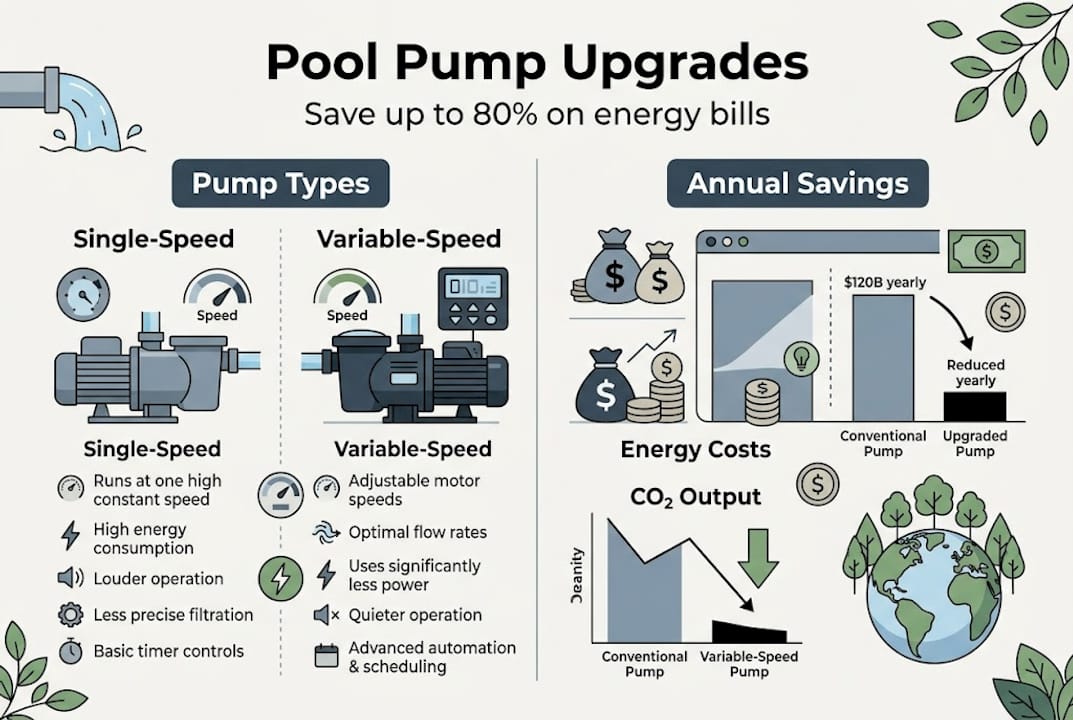
For homeowners exploring energy-efficient pool upgrades beyond just the pump, there are other meaningful changes you can layer on top for even greater savings.
Performance and reliability: Cleaner water with less maintenance
Cutting your energy bill is great, but the performance benefits of a modern pump are just as compelling for everyday pool ownership. Newer variable-speed pumps don’t just save power. They actually clean your water better, and that means less time skimming, less money on chemicals, and fewer frustrating green water episodes.
Here’s why: single-speed pumps blast water through your filter in short, intense cycles. This creates uneven flow, leaving pockets in the pool where water barely moves. Algae and debris love those quiet corners. A VSP running at a lower speed for a longer period pushes water through your filter more steadily and evenly, reaching every part of the pool.
“Reduced speed on VSPs can maintain filtration while lowering energy use” — and in practice, that smoother flow means your filter media captures more particles per cycle, not fewer.
Four ways a better pump reduces your maintenance headaches:
- Fewer algae blooms. Consistent circulation prevents the stagnant zones where algae takes hold.
- More stable chemical balance. Even water movement distributes chlorine and pH adjusters more uniformly.
- Longer equipment life. Lower operating speeds reduce wear on seals, bearings, and impellers.
- Less debris buildup. Steadier suction keeps leaves and fine particles moving toward the filter instead of settling.
Pro Tip: Program your VSP to run at a low speed (around 1,500 to 1,750 RPM) for eight to ten hours daily instead of blasting at full speed for a few hours. You’ll use far less power and wake up to noticeably clearer water.
For a deeper look at matching the right equipment to your specific setup, the pool pump guide for Central Florida breaks down which models work best by pool size and usage. And if you want to understand how your pump and filter work as a system, the pool filters explained resource is worth your time before making any changes.
Environmental impact: Lower your carbon footprint
Beyond your home, there are big-picture reasons to consider an upgrade. Most electricity in Central Florida is still generated using fossil fuels, which means every kilowatt-hour you consume contributes to greenhouse gas emissions. When your pool pump runs inefficiently, it’s not just costing you money. It’s also adding unnecessary carbon output to the grid.
Switching to a variable-speed pump is the environmental equivalent of taking a car off the road for an entire year in terms of annual electricity reduction for the average Florida household. Pool pumps use significant household energy, so efficient models cut electricity use by up to 90%, which makes the pump upgrade one of the most impactful individual choices a homeowner can make.
Three ways efficient pool pumps benefit the environment:
- Reduced grid demand. Lower per-home energy use means fewer peak-load power plants need to fire up.
- Fewer emissions per pool. Cutting 1,500 to 1,800 kWh annually per household directly reduces carbon output.
- Longer equipment lifespan. Less replacement manufacturing and fewer discarded motors in landfills.
Here’s how the carbon numbers look across pump types:
| Pump type | Annual kWh | Estimated CO2 output (lbs) |
|---|---|---|
| Single-speed | 2,190 kWh | ~1,970 lbs |
| Two-speed | 1,314 kWh | ~1,180 lbs |
| Variable-speed | 440 to 875 kWh | ~395 to 785 lbs |
CO2 estimates based on Florida’s average grid emission factor of approximately 0.9 lbs CO2 per kWh.
VSPs can cut pool-related electricity use by up to 90%, which is a meaningful contribution every Central Florida homeowner can make without sacrificing pool enjoyment. Explore more energy efficient pool options to see how other upgrades stack up alongside a pump replacement.
Return on investment: How pool pumps pay you back
So, how do these upgrades actually affect your wallet over time? Variable-speed pumps typically cost more up front than single-speed models. You’re looking at $800 to $1,500 for the pump itself, plus installation, compared to $300 to $600 for a basic single-speed unit. That initial price difference is the sticking point for most homeowners, but the math strongly favors the upgrade.
Most homeowners see full payback from energy savings within two to three years. After that point, the energy savings from VSPs offset the initial investment, and every year becomes pure savings in your pocket.
| Pump type | Upfront cost | Annual energy cost | 5-year total cost |
|---|---|---|---|
| Single-speed | $350 to $600 | $285 to $350 | $1,775 to $2,350 |
| Two-speed | $500 to $800 | $170 to $215 | $1,350 to $1,875 |
| Variable-speed | $800 to $1,500 | $55 to $115 | $1,075 to $2,075 |
How to calculate your expected ROI:
- Find your current annual energy cost for the pump (check your electric bill during summer months).
- Multiply that cost by 0.75 to estimate your projected savings with a VSP.
- Add up the VSP purchase price plus professional installation.
- Divide the total upfront cost by your annual savings to get your payback period in years.
- Multiply your annual savings by 10 years to see your total decade-long benefit.
Beyond direct savings, a pump upgrade can also boost your home’s resale appeal. Buyers in Central Florida actively look for energy-efficient features, and a modern variable-speed pump checks that box. Learn how pool feature upgrades boost value in your specific market, and see what other improvements pair well by reviewing our guide on upgrading an old pool.
Pro Tip: Before purchasing, check with your Florida utility provider. Duke Energy and Florida Power and Light both offer rebates on qualifying variable-speed pool pumps. These rebates sometimes cut your payback period by six months or more.
The overlooked opportunity most homeowners miss
After nearly four decades of building and upgrading pools across Central Florida, we’ve noticed a consistent pattern: homeowners will enthusiastically invest in new tile, a spa, or LED lighting, but balk at spending money on a pool pump they’ll never see. It’s completely understandable. You want to enjoy your backyard, not admire the equipment room.
But here’s the honest truth: no cosmetic upgrade delivers the combination of comfort, savings, and long-term value that a quality pump upgrade provides. We had a customer in Orlando who spent two years debating the upgrade before finally pulling the trigger. Within three months, she told us her pool had never been clearer, her electric bill dropped by over $90 a month, and she was spending half the time on maintenance. She said she wished she’d done it years earlier.
The pool remodeling benefits for homeowners are real across the board, but the pump is the one upgrade that pays you back and improves your daily experience from the very first week. Don’t overlook what’s working hardest behind the scenes.
Ready to upgrade your pool? Next steps for Central Florida homeowners
Convinced it’s time to make a change? Here’s how to get started with expert help. Upgrading your pool pump is straightforward with the right guidance, and our team at R&R Swimming Pools has been helping Central Florida homeowners do exactly this since 1985.

Start with our Pool School resource to understand your options before committing to anything. If you want to see what real upgrades look like in practice, browse our backyard pool upgrade examples for inspiration. And if you’re considering a broader renovation or new installation, our inground pool installation guide walks you through every step of the process. Now is the best time to start saving energy and enjoying your pool more.
Frequently asked questions
How much money can I really save by upgrading my pool pump?
Upgrading to a variable-speed pool pump typically cuts pool energy costs by 70 to 80%, translating to several hundred dollars saved each year, based on energy reductions of 50 to 90% documented for VSPs in Florida households.
How long does it take to pay off the cost of a new pool pump?
Most pool owners see full payback in 2 to 3 years from energy savings alone, as VSP savings offset the initial investment relatively quickly compared to other home upgrades.
Are there rebates or incentives for upgrading pool pumps in Florida?
Yes, many Florida utilities including Duke Energy and Florida Power and Light offer rebates for energy-efficient pool pump upgrades; contact your local provider to check current availability and amounts.
Will a new pool pump help with algae and water quality?
Absolutely. Modern variable-speed pumps improve circulation and filtration by running longer at lower speeds, and sustained filtration at reduced speed prevents the stagnant zones where algae thrives.
