
TL;DR:
- Most homeowners underestimate the full cost of pool projects because shell quotes often exclude essential components like permits, fencing, electrical work, and landscaping. A comprehensive budget should include all major expense categories with detailed quotes, contingency funds, and careful cost tracking during construction to prevent overspending. Proper planning, itemized bidding, and understanding ongoing maintenance costs are crucial for avoiding financial surprises and ensuring project success.
Most homeowners discover too late that the pool quote they received covers only the shell, not the project. By the time excavation, decking, fencing, permits, electrical, and landscaping are added, the final number looks nothing like what they planned for. That gap is where financial stress begins. This step by step pool budgeting guide exists to close that gap. Whether you are planning a brand-new custom inground pool or a full-scale renovation of an existing one, the steps here will walk you through every cost layer so you can build a realistic budget, explore financing with confidence, and actually enjoy the process instead of dreading the invoices.
Table of Contents
- Understanding all costs involved in inground pool projects
- Preparing your detailed pool budget and financing plan
- Executing the pool installation or renovation with cost control
- Verifying budgets and managing ongoing pool ownership costs
- Why many homeowners underestimate pool budgets and how to avoid it
- Explore expert resources and financing options for your Central Florida pool project
- Frequently asked questions
Key Takeaways
| Point | Details |
|---|---|
| Include all project costs | Accurately budget for your pool by including installation, equipment, permits, decking, fencing, and landscaping, not just the pool shell price. |
| Get multiple detailed quotes | Request itemized quotes from several contractors to compare costs and avoid unexpected expenses during construction. |
| Plan financing on total project | Finance the full scope of your pool project, including add-ons and permits, to get realistic monthly payment estimates. |
| Prepare for ongoing costs | Budget for annual maintenance and utilities to avoid surprises after installation. |
| Factor local variables | Consider site conditions, seasonal timing, and Florida permit requirements for a smoother project and better budget control. |
Understanding all costs involved in inground pool projects
Step by step pool budgeting starts with one uncomfortable truth: the shell price is just the beginning. Complete project costs regularly run 50 to 80 percent higher than the base quote. That means a $50,000 shell quote could easily become an $80,000 to $90,000 total project. Once you accept that reality, you can build a budget that actually holds.
The key cost factors for pools break down into several major categories, and every single one needs a line in your budget:
- Pool shell or structure: Fiberglass shells typically cost $20,000 to $45,000. Concrete or gunite pools start higher, often $30,000 to $60,000, and offer more customization.
- Excavation and site prep: Soil type, slope, and access to your yard affect this number heavily. Rocky or clay-heavy soil in parts of Central Florida costs more to excavate.
- Plumbing and electrical: Electrical work for pumps, lighting, and heaters often runs $3,000 to $8,000 alone, and it is required by code.
- Permits and inspections: Florida counties require permits for pool construction. Budget $500 to $2,500 depending on your municipality.
- Decking: A basic concrete deck starts around $5,000. Pavers, travertine, or stamped concrete can push this to $15,000 or more.
- Fencing: Pool barrier fencing is legally required in Florida. Aluminum or vinyl fencing typically costs $2,500 to $7,000.
- Landscaping: Grading, sod repair, and plantings after construction average $2,000 to $6,000.
- Equipment: Pool pump, filter, heater, and automation systems range from $3,000 to $10,000 depending on quality.
- Water features and extras: Waterfalls, spa additions, LED lighting packages, and tanning ledges add $2,000 to $20,000 depending on complexity.
| Cost category | Budget range |
|---|---|
| Pool shell (fiberglass) | $20,000 to $45,000 |
| Pool shell (concrete) | $30,000 to $60,000 |
| Excavation and site prep | $3,000 to $8,000 |
| Electrical and plumbing | $3,000 to $8,000 |
| Permits and inspections | $500 to $2,500 |
| Decking | $5,000 to $15,000+ |
| Fencing (required by law) | $2,500 to $7,000 |
| Landscaping | $2,000 to $6,000 |
| Equipment (pump, filter, heater) | $3,000 to $10,000 |
| Water features and upgrades | $2,000 to $20,000 |
Pro Tip: Before your first contractor meeting, walk through the pool build preparation steps so you can identify site-specific factors that could affect your costs before anyone gives you a number.
With the cost categories clear, the next step is to prepare your detailed budget considering local factors and financing options.
Preparing your detailed pool budget and financing plan
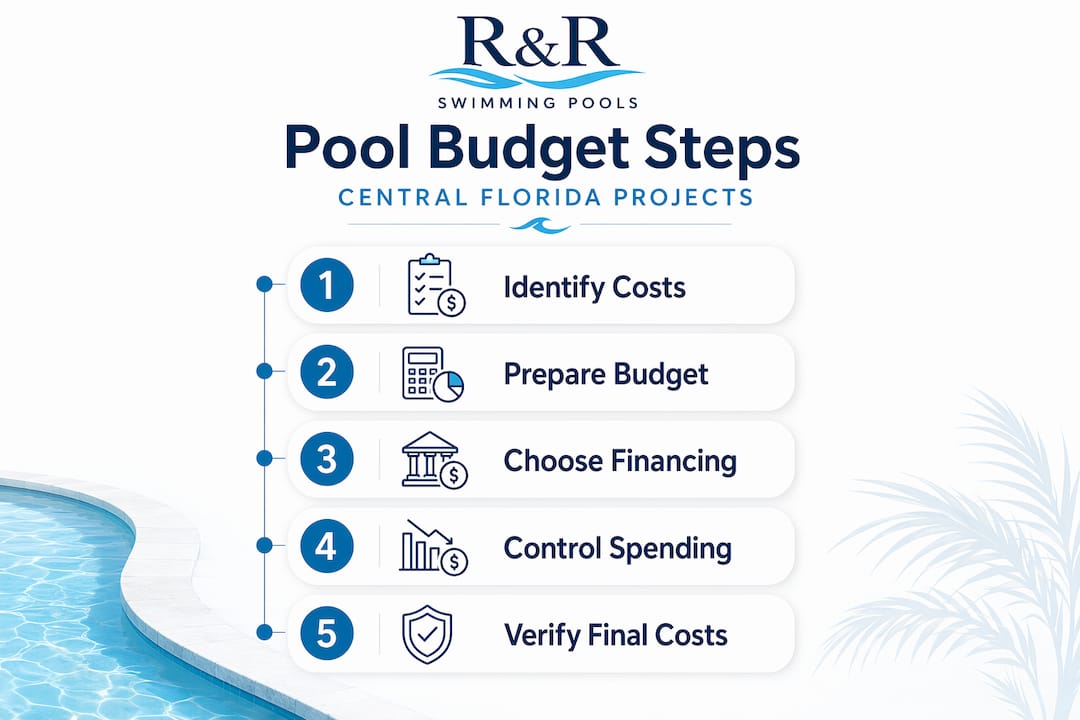
A detailed pool budget is not a single number. It is a line-item document that accounts for every phase of the project. Central Florida pool renovation costs in 2026 range from $8,000 for a basic refresh to over $50,000 for structural overhauls, with engineering plans and permits adding $1,500 to $3,000 when structural or equipment changes are involved.
Here is how to build your budget from scratch:
- List every cost category. Use the table above as your starting checklist. Do not leave anything out because it feels minor.
- Get three or more quotes. For each category, get at least two numbers from different contractors so you have a real range, not just one data point.
- Define your pool scope clearly. Size, material (fiberglass vs. concrete), shape, depth, and features all change the math. Larger pools with more features cost more to build and more to maintain.
- Create three budget scenarios. A base scenario (minimum viable pool), a mid-range scenario (your preferred pool), and a stretch scenario (full wish list). This gives you flexibility when negotiating.
- Add a contingency buffer. Build in 10 to 15 percent above your projected total for unexpected site conditions, material price changes, or scope creep.
- Factor in financing before you finalize. Financing the entire project scope, including permits, landscaping, and add-ons, is how you get accurate monthly payment estimates. Financing only the shell leads to underestimating your loan amount and monthly obligations.
When exploring pool financing options, look for lenders that offer soft credit inquiries during pre-qualification so your credit score is not affected before you are ready to commit. Many home improvement lenders now offer this feature specifically for pool projects.
- Typical loan terms run from 7 to 20 years for pool financing
- Interest rates vary widely, so comparing at least three lenders matters as much as comparing contractors
- Your home’s equity and your credit profile affect the rate you receive
Pro Tip: When planning a custom pool in Central Florida, timing matters. Building in the off-peak season, typically late fall or winter in Florida, can sometimes reduce contractor lead times and may provide negotiating room on price.
Once you have a detailed budget and financing outlook, it is time to execute your pool project with clear cost tracking and management.
Executing the pool installation or renovation with cost control
The difference between a project that stays on budget and one that spirals comes down to two things: the quality of your initial quotes and how closely you track costs during construction. Contractor prices can vary 20 to 40 percent for identical work in the same market. That spread is real, and it means comparing quotes carefully protects your budget.
Follow these steps during execution:
- Require itemized quotes. Every bid should specify the pool shell brand and model, equipment brands and model numbers, decking material and square footage, fence style and linear footage, electrical scope, and permit costs. A single total price tells you nothing useful.
- Compare apples to apples. If one contractor quotes fiberglass and another quotes concrete, adjust for that difference before deciding which is cheaper.
- Clarify what is not included. Ask every contractor directly: “What is not in this quote?” That question surfaces hidden costs before they become change orders.
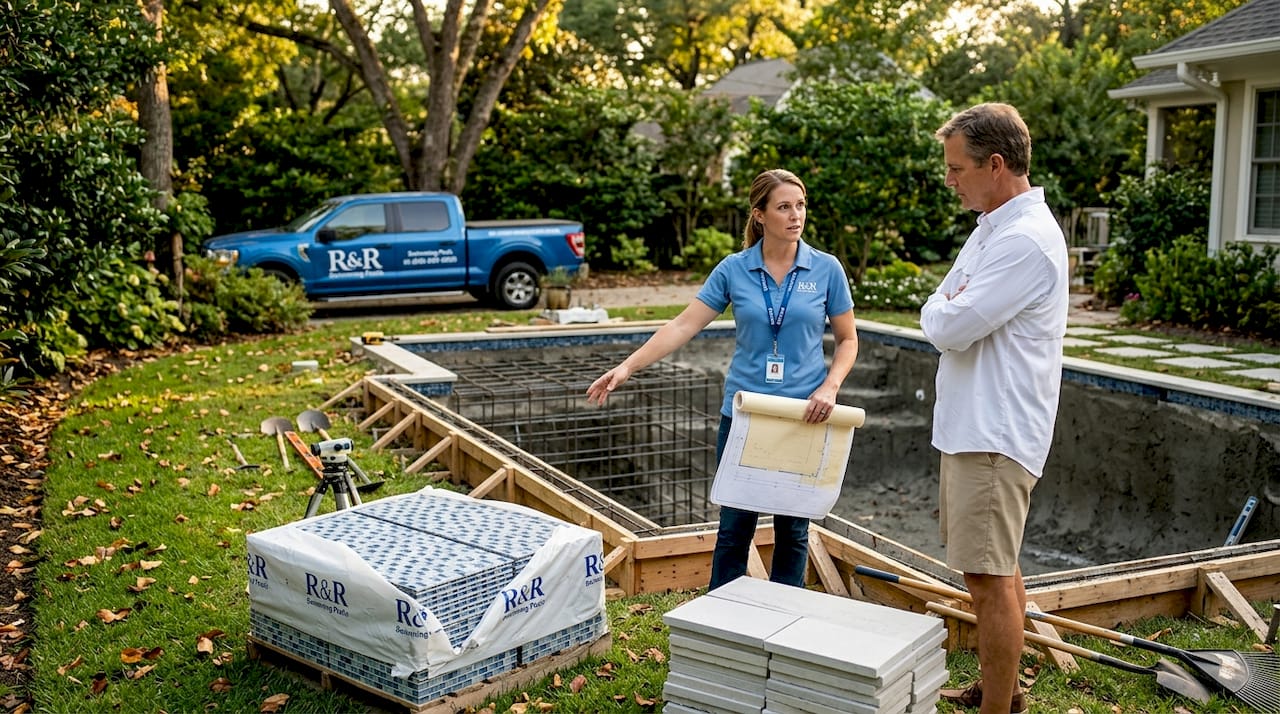
- Schedule a site visit assessment before signing. A good contractor should walk your yard to identify potential excavation challenges, access limitations, and drainage issues. Soil conditions in parts of Central Florida, particularly areas with high water tables, can add significant excavation costs.
- Approve every change order in writing. Verbal agreements during construction lead to billing disputes. Every addition or change should be documented and priced before work begins.
The step-by-step pool building guide outlines exactly what to expect from excavation through final inspection, which helps you know when to ask questions during each phase.
One of the most overlooked cost traps in pool building: adding features after the pool is filled. Retrofitting jets, lighting zones, or automation systems after construction costs 30 to 60 percent more than installing them during the initial build. Decide what you want before the concrete sets.
- Keep a running spreadsheet of every approved invoice and change order
- Photograph each construction phase for documentation
- Confirm the permit is pulled and posted before excavation begins
Pro Tip: When reviewing custom pool planning in Central Florida, ask your contractor which features are easiest to add during construction versus after. The answer will guide your feature prioritization.
After successful execution, checking for common financial and project pitfalls will help verify your budgeting and project outcomes.
Verifying budgets and managing ongoing pool ownership costs
Your pool is finished. Now the real long-term financial picture begins. Annual pool maintenance in Florida typically runs $800 to $3,500 depending on pool type, size, and features. That number does not include energy costs for the pump and heater, which can add $100 to $300 per month to your utility bill.
Build a recurring annual budget that includes:
- Chemical supplies: $600 to $1,200 per year for chlorine, pH adjusters, and shock treatments
- Professional service visits: $1,200 to $2,400 per year for monthly maintenance service
- Equipment repairs: Variable, but budget $300 to $800 annually for unexpected repairs
- Energy costs: Variable speed pumps (a smart upfront investment) can cut electricity use by up to 80 percent compared to single-speed models
- Insurance: Adding a pool typically increases homeowner’s insurance premiums by $50 to $150 per year
- Resurfacing and renovation reserve: Start setting aside $500 to $1,000 annually from day one for future resurfacing, which becomes necessary every 10 to 15 years
| Ongoing expense | Annual estimate |
|---|---|
| Chemical supplies | $600 to $1,200 |
| Professional maintenance service | $1,200 to $2,400 |
| Equipment repairs | $300 to $800 |
| Energy costs (pump, heater) | $1,200 to $3,600 |
| Insurance premium increase | $50 to $150 |
| Resurfacing reserve | $500 to $1,000 |
The homeowners who avoid financial surprises in pool ownership are not the ones who spent the most. They are the ones who planned for the ongoing costs with the same seriousness they applied to the installation budget.
Pro Tip: Reviewing ongoing pool cost factors before your pool is built allows you to choose equipment and materials that minimize long-term operating costs, not just upfront price.
When your pool is complete, compare the final invoice to your original budget line by line. Discrepancies happen, and catching them early matters. Keep all permits, warranties, and equipment manuals organized in a single folder for future service needs.
Why many homeowners underestimate pool budgets and how to avoid it
After decades of working with Central Florida homeowners on pool installations and renovations, there is a pattern worth naming directly: most budget problems start with marketing, not math.
Advertised pool prices almost always reflect the shell only. A “$29,995 pool” in a showroom brochure does not include the hole in the ground, the concrete deck around it, the fence required by Florida law, the electrical work, the equipment, or the landscaping cleanup. Itemizing every scope component before comparing bids is the only way to keep that 50 to 80 percent gap from catching you off guard.
Contractors are not always deliberately misleading. Some genuinely quote what they build and leave the rest to subcontractors or the homeowner to arrange. But the result is the same: a family approves a $55,000 pool and ends up spending $85,000 because they did not know to ask about everything else. The fix is simple. Insist on one contract that covers the entire project scope.
Seasonal timing also affects cost more than most homeowners realize. Building during peak construction season in Central Florida means longer wait times, tighter contractor schedules, and less negotiating leverage. A project that starts in October may move faster and with more contractor attention than one that starts in March.
The homeowners who execute comprehensive pool budgeting in Central Florida successfully share one trait: they treat the process like a business decision. They get multiple quotes, they ask uncomfortable questions about what is excluded, and they plan for the costs that come after the construction crew leaves. The pool itself is the easy part. The budget is where projects succeed or fail.
Explore expert resources and financing options for your Central Florida pool project
Knowing the numbers is one thing. Having the right team and tools behind you makes all the difference when it is time to sign a contract and break ground.
R&R Swimming Pools has been building custom inground pools across Central Florida since 1985, and that experience shows in every quote, every design recommendation, and every project managed from start to finish. The Central Florida pool installation guide walks you through what to expect at every phase, while the pool financing options page helps you find a payment structure that fits your full project budget, not just the shell price. If you are ready to move from planning to building, the custom pool planning guide is where your luxury outdoor space starts to take shape.
Frequently asked questions
What is the typical all-in cost for a new inground pool in Central Florida?
Most complete projects in Central Florida fall between $44,500 and $87,350, with large or high-end pools costing over $135,000 once installation, decking, and fencing are included. Budget well above the base shell quote to avoid surprises.
How much should I budget for pool renovations in Florida?
Typical Florida pool renovations range from $8,000 to over $50,000 depending on scope, and structural or equipment changes can add another $1,500 to $3,000 in engineering and permit fees.
Why is it important to include everything in my financing amount?
Financing the entire project scope rather than just the pool price ensures your monthly payment estimate reflects the true total, including permits, landscaping, and add-ons, so there are no financial gaps during construction.
How can I avoid surprises in pool project costs?
Request detailed, itemized bids from multiple contractors and ask specifically what each quote excludes. Itemized bids allow direct comparisons and expose the hidden costs that turn a $50,000 quote into an $80,000 bill.
What ongoing expenses should I plan for after installing a pool?
Budget for annual maintenance, chemical supplies, equipment repairs, and energy costs, which together typically run $800 to $3,500 per year before factoring in utilities and insurance premium increases.
