
TL;DR:
- Sand is rarely appropriate for above-ground pool pads in Florida, as it often causes more issues than it solves. A compacted mineral soil base with a foam pad or geotextile fabric provides a more reliable, long-term solution for most yards.
Sand alone is rarely the right answer for above-ground pool pad construction in Florida, and in many Central Florida yards it creates more problems than it solves. A compacted mineral soil base with a foam pool pad or geotextile fabric layer is the more reliable long-term choice for most Florida homeowners.
Quick next steps:
- Inspect your site for roots, rocks, and organic material before choosing any base material
- Check whether your pool’s water depth will reach 24 inches or more — that triggers a permit requirement under the Florida Building Code
- Review Chapter 515 of the Residential Swimming Pool Safety Act for barrier requirements that apply before final inspection
- Contact Randrswimmingpools if you need a site evaluation or professional installation in Central Florida
Table of Contents
- Which pool base option works best for Florida yards?
- When is sand actually appropriate in Florida?
- What are the best alternatives to sand for a Florida pool base?
- How do you prepare a Florida yard for pool pad installation?
- What concrete pad thickness and specs work for above-ground pools?
- What permits and setbacks do Florida homeowners need to check?
- What mistakes do Florida homeowners make with pool pads?
- When should you call a pool contractor in Florida?
- Key Takeaways
- What Randrswimmingpools sees in Central Florida yards
- Randrswimmingpools can handle your pool pad and installation
Which pool base option works best for Florida yards?
For long-term durability in Florida’s climate, a compacted native soil base with a purpose-built pool floor pad, geotextile fabric, or concrete outperforms loose sand on almost every measure. Here’s how the main options stack up.
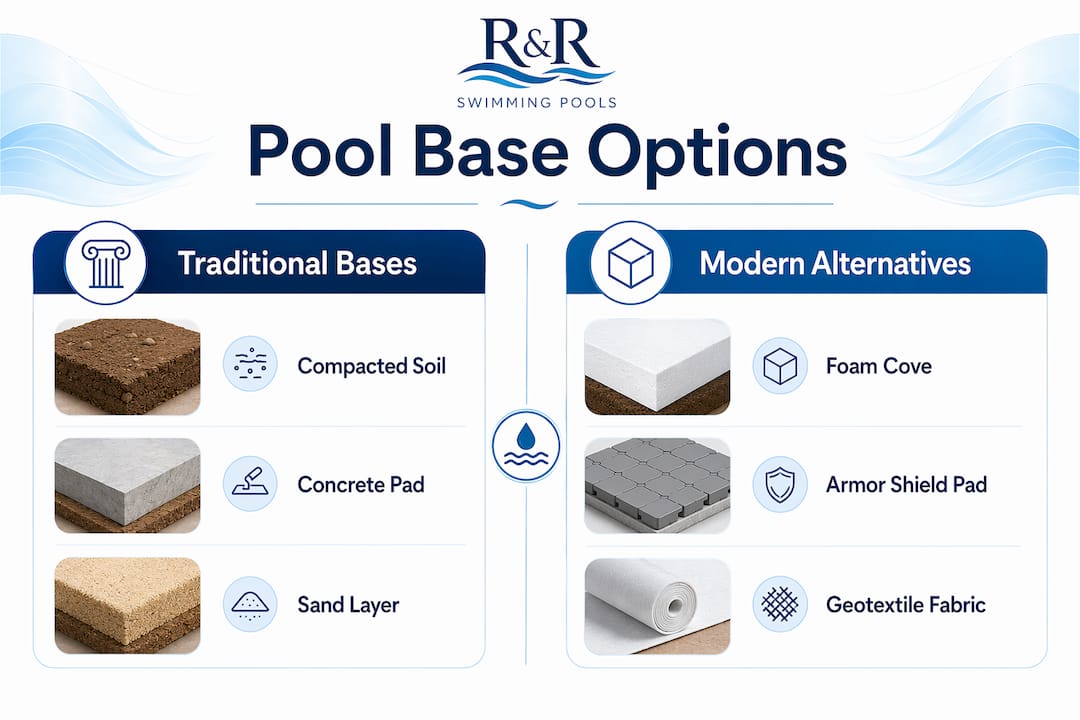
| Base Option | Best For | Puncture Resistance | Typical Cost | Installation Difficulty | Drainage & Maintenance |
|---|---|---|---|---|---|
| Sand (leveling layer) | Short-term DIY on flat, root-free native sand | Low | Low | Easy | Poor — migrates, settles unevenly in rain |
| Foam pool cove / foam pad | DIY liner protection, comfort underfoot | Medium–High | Low–Medium | Easy | Good — no migration, stays in place |
| Armor Shield pool floor pad | Liner protection on rocky or debris-prone sites | High | Medium | Easy–Medium | Good — durable, washable |
| Geotextile fabric + compacted fill | Stable base over soft or variable soils | Medium | Low–Medium | Medium | Good — allows drainage, suppresses weeds |
| Concrete pad / reinforced concrete | Long-term durability, leg-supported pools, permanent installs | Very High | High | Difficult — requires equipment | Excellent — stable, no settling |
Quick picks:
- Fastest DIY setup: foam pool pad over compacted native soil
- Rocky or debris-heavy site: Armor Shield pool floor pad
- Soft or variable soil: geotextile fabric over compacted granular fill
- Permanent or large pool: reinforced concrete pad
When is sand actually appropriate in Florida?
Sand has a specific, limited role: it can serve as a thin leveling layer over an already-stable, compacted mineral soil base. That’s it. It is not a foundation material, and it is not a substitute for proper site preparation.
Sand is acceptable when all of these conditions are true:
- The site is flat, with no visible roots, rocks, or organic debris
- The native soil is already stable, compacted mineral sand (common in parts of Central Florida)
- You are installing a small, lightweight above-ground pool
- A protective layer (foam pad or geotextile) goes on top of the sand
- The site drains well and does not hold standing water after rain
Sand is a bad choice when any of these apply:
- Roots or rocks are present — sharp objects migrate through sand over time and puncture liners
- The soil is organic, filled, or contains decomposing material
- The site holds standing water during Florida’s rainy season (June through September)
- The native soil is already very loose or sandy — over-applying sand on Central Florida’s native sandy soils creates a base that is too soft and causes footprinting under the liner
Site inspection checklist before choosing sand:
- Probe the soil with a rod or screwdriver — it should resist penetration, not sink easily
- Scan the full footprint plus 12 inches beyond the edge for surface roots and buried debris
- Check drainage by observing the area after a heavy rain
- Look for any fill soil, mulch beds, or landscaping that was previously in the area
- Confirm the site is level within 1–2 inches across the full pool diameter
What are the best alternatives to sand for a Florida pool base?
Foam pool cove
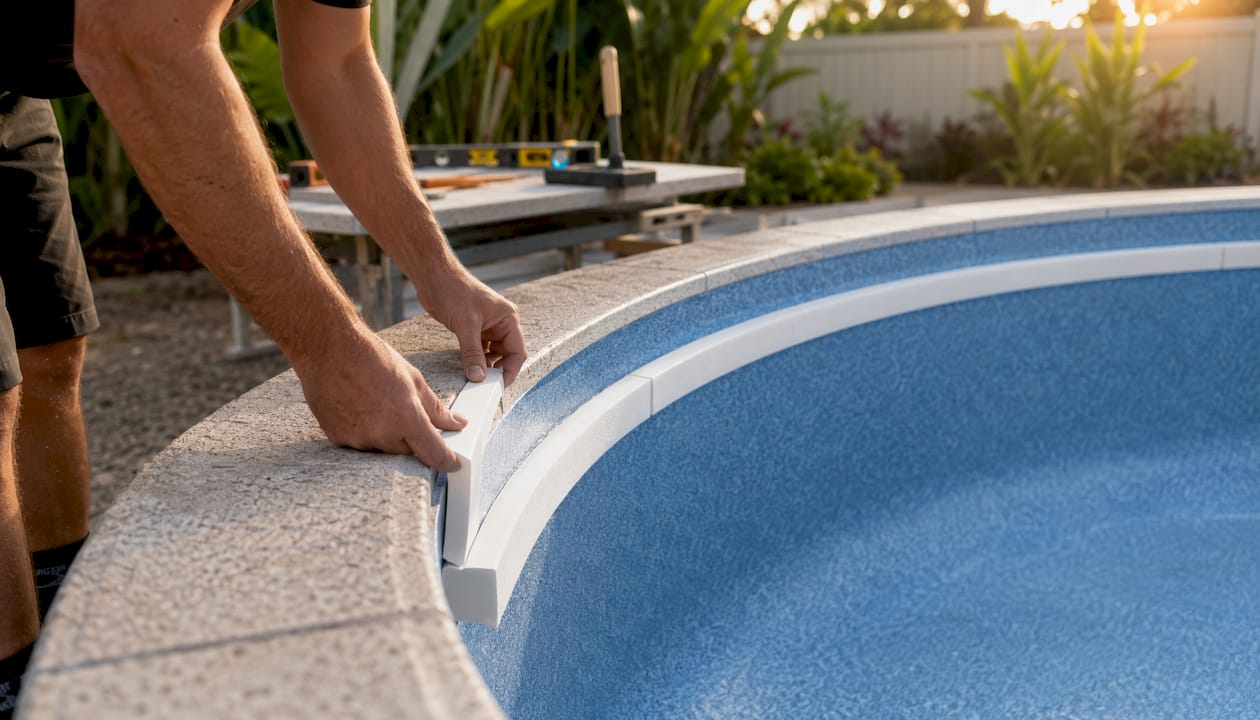
Foam pool cove is a pre-cut foam strip installed around the interior base perimeter of an above-ground pool, replacing the traditional sand cove that many installers used to build by hand. It holds its shape, does not wash away, and gives the liner a smooth, consistent transition from the floor to the wall. For the floor itself, an XPS foam board 1.5–2 inches thick provides better puncture protection and thermal insulation than sand alone. This is a strong DIY option for most Florida homeowners.
Armor Shield pool floor pad
Armor Shield is a geotextile-based pool floor pad designed specifically to protect liners from punctures caused by rocks, roots, and debris. It lays flat over a compacted base, conforms to the pool shape, and can be trimmed to fit. On sites where debris migration is a concern — and in Florida, that includes most yards with tree coverage — Armor Shield adds a meaningful layer of protection that foam alone cannot match against sharp objects.
Geotextile fabric over compacted fill
A nonwoven geotextile fabric (look for a minimum 4-oz-per-square-yard grade for residential use) laid over a compacted granular fill base is one of the most practical solutions for soft or variable Florida soils. The fabric suppresses weed and root growth, allows water to drain through rather than pool beneath the liner, and stabilizes the surface. This approach works especially well when the native soil has soft pockets or when you need to build up a low area.
Concrete pad / reinforced concrete
Concrete is the most durable base option and the right call for permanent installations, large pools, or any site with poor soil. For leg-supported above-ground pools, concrete pavers or pressure-treated 2×6 lumber under each leg prevent sinking caused by Florida’s heavy seasonal rains. A full concrete slab is covered in detail in the section below.
Pro Tip: Never skip the foam cove even when you use Armor Shield or geotextile fabric on the floor. The cove protects the liner at its most vulnerable point — the base-to-wall transition — and foam holds that angle far better than any granular material.
| Alternative | Best For | Durability | Cost (Materials) | DIY Difficulty | Drainage |
|---|---|---|---|---|---|
| Foam pool cove + XPS board | Liner protection, comfort, DIY installs | Medium | Low | Easy | Good |
| Armor Shield pool floor pad | Rocky/debris sites, liner longevity | High | Medium | Easy | Good |
| Geotextile + compacted fill | Soft/variable soils, drainage-sensitive sites | Medium–High | Low–Medium | Medium | Excellent |
| Concrete pad (reinforced) | Permanent installs, large pools, poor soils | Very High | High | Difficult | Excellent (with drainage slope) |
How do you prepare a Florida yard for pool pad installation?
Site preparation is where most DIY installs go wrong. Florida’s climate — heavy summer rains, high humidity, and sandy soils that can hide organic layers — demands more thorough prep than most homeowners expect.
- Mark the pool footprint and setbacks. Use spray paint or stakes to mark the full pool diameter plus a 12-inch border. Confirm setback distances from property lines before you break ground.
- Remove all sod, grass, and surface vegetation. Cut and strip sod across the entire marked area. Do not just kill it with herbicide and leave it in place — decomposing organic matter creates soft spots.
- Excavate roots and organic material. Remove roots and organic material down to bare mineral soil across the full footprint plus the 12-inch border. This step separates a pool that stays level for years from one that develops soft spots after the first rainy season.
- Remove rocks and debris. Screen the soil surface with a landscape rake. Any rock or debris left under the liner is a future puncture waiting to happen.
- Grade for drainage. Slope the base 1–2% away from the pool center toward the edges. Water should never pool beneath or directly under the pool structure.
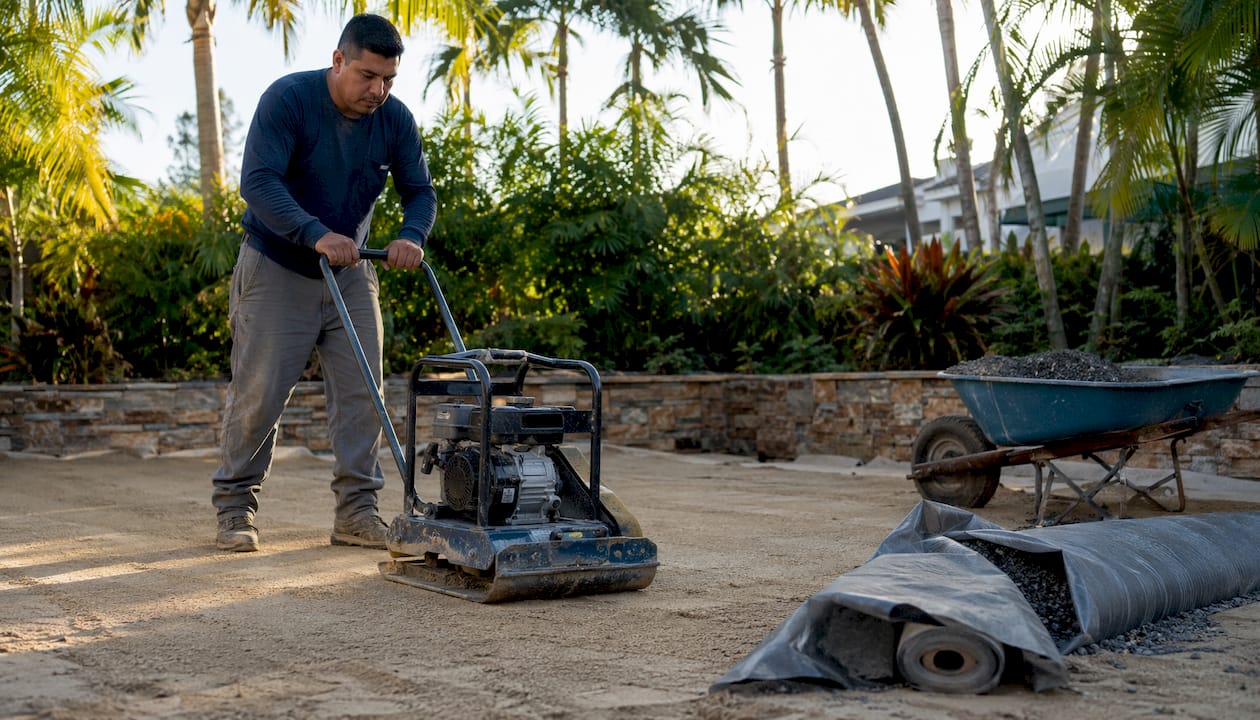
- Compact the base. Rent a plate compactor for any area larger than a small splash pool. A hand tamper works for very small pools but will not achieve adequate compaction on larger footprints.
- Lay your chosen pad material. Install geotextile fabric, foam board, or Armor Shield over the compacted base before pool assembly begins.
Equipment and supplies to have on hand: plate compactor (rental), hand tamper, wheelbarrow, flat-blade spade, landscape rake, spray paint for marking, geotextile fabric or foam pad, and gravel if you need to build up drainage under a low spot.
Pro Tip: Schedule compaction and pad installation during a dry window. Florida’s rainy season runs roughly June through September. Compacting wet soil gives you a false reading — the base feels firm but loses density as it dries. Aim for late winter or spring installation when possible, and check the 10-day forecast before you start.
Avoid working on saturated ground. If you hit a soft sandy pocket that does not compact, excavate it and replace it with compacted granular fill before proceeding. For guidance on preparing your yard for pool installation, Randrswimmingpools has published a detailed walkthrough specific to Central Florida conditions.
What concrete pad thickness and specs work for above-ground pools?
Concrete is the most stable long-term base for above-ground pools in Florida, but only when it is built correctly. Poorly prepared sandy subgrades cause floating slabs to crack, which defeats the purpose.
Thickness and reinforcement:
- Full concrete slabs for above-ground pools typically run 4 inches thick for standard residential installations; some installers use 6 inches where soil conditions are poor or the pool is large
- Spot pads under individual pool legs are commonly poured at 4–6 inches thick with a wider footprint than the leg itself to distribute load
- Wire mesh (6×6 W1.4/W1.4 welded wire reinforcement) is standard for residential slabs; rebar at 12-inch centers on center is used for engineered designs or larger pours
- When a concrete slab is chosen, best practice is to compact the subgrade to a contractor-specified target, use a structural base course where needed, and place reinforcement so tensile cracks will not compromise the pool structure — details normally included in engineered drawings
Florida-specific construction notes:
- Always compact the sandy subgrade before pouring; an uncompacted sandy base is the leading cause of slab cracking in Florida
- Install a 4-inch layer of compacted gravel or crushed stone beneath the slab to improve drainage and reduce moisture wicking
- Slope the slab surface slightly (about 1%) so water does not pond on top
- Chamfer slab edges to reduce chipping and trip hazards
- Avoid pouring during the rainy season — concrete curing in saturated conditions performs poorly
When concrete beats every other option: If you have a large pool, a site with poor or unknown soils, or you plan to keep the pool in place for more than a few seasons, concrete is worth the added cost. It eliminates settling, prevents leg sinking, and gives you a surface that holds up through years of Florida weather. For homeowners considering a permanent concrete pool installation, Randrswimmingpools builds both full concrete pools and engineered pad systems across Central Florida.
Note: Confirm specific thickness and reinforcement requirements with your local building department or a licensed contractor. Local soil conditions and pool size affect the right specification for your site.
What permits and setbacks do Florida homeowners need to check?
Florida’s permitting rules for above-ground pools catch many homeowners off guard. The trigger is simpler than most people expect.
Key permit triggers:
- Any above-ground pool with a water depth of 24 inches or greater requires a permit under the Florida Building Code
- Any permanent decking, electrical connections, or equipment tied to the pool also require permits
- A Notice of Commencement is often required when job value exceeds a certain threshold; for example, Brevard County requires it at job values over a certain amount — confirm your county’s threshold
Setback guidance:
- Brevard County requires a minimum 5-foot setback for pools and pool screen enclosures from property lines
- Plan your pool location with a future screen enclosure in mind — siting the pool too close to a property line now can make adding an enclosure later impossible without relocating the pool
- Setbacks vary by county and zoning district; always confirm with your local planning and building department before finalizing placement
Documents to bring to the permit office:
- Plot plan showing pool location and distances from all property lines
- Manufacturer’s installation instructions and specifications
- Pump, filter, and electrical equipment specs
- Barrier compliance plan (fence, alarm, or safety cover meeting Chapter 515 requirements)
Pro Tip: Call your county building department before you buy the pool. Permit fees, review timelines, and document requirements vary significantly across Florida counties. A five-minute phone call can save you weeks of back-and-forth after the pool arrives.
For a detailed breakdown of Central Florida pool permit requirements, Randrswimmingpools has published a county-level guide covering the most common questions.
What mistakes do Florida homeowners make with pool pads?
Most pool pad failures in Florida come down to a handful of repeatable errors. Here’s what to watch for.
- Using sand to hide poor site conditions. Sand does not neutralize roots or rocks — it buries them temporarily. After one rainy season, sharp material migrates upward and damages the liner.
- Leaving sod and organic matter in place. Grass and roots decompose under the pool, creating soft pockets that cause the pool to shift and the liner to wrinkle or tear.
- Over-applying sand on native sandy soil. Central Florida’s native sand is already a sandy base. Adding more sand on top creates a surface that is too soft, and footprints appear under the liner within weeks.
- Skipping compaction. A surface that looks flat is not necessarily compacted. Without a plate compactor, the base will settle unevenly after the first heavy rain.
- Ignoring drainage. Florida gets intense summer rain. A base that does not slope away from the pool will hold water, accelerate corrosion on metal frames, and cause differential settling under pool legs.
- Leaving pool legs on bare soil without pads. Pool legs concentrate load on a small area. On Florida’s sandy soils, legs sink after heavy rain, throwing the pool out of level and stressing the frame. Place concrete pavers or pressure-treated lumber under each leg.
- Failing to check permits before installation. Installing a pool that requires a permit without one creates problems when you sell the property or need homeowner’s insurance coverage.
When should you call a pool contractor in Florida?
Some pool pad jobs are straightforward DIY work. Others are not, and the consequences of getting it wrong — a cracked slab, a shifted pool, a failed permit inspection — are expensive to fix.
Call a professional when:
- Soil conditions are unknown, soft, or show signs of fill material or organic layers
- The site has a high water table or holds standing water after moderate rain
- You need a concrete slab (full or spot pads) — proper subgrade compaction and reinforcement placement require experience and equipment
- The project involves complex grading or drainage work
- You need permit filing assistance or engineered drawings
- The pool is large enough that differential settlement would be a structural risk
What a reputable Florida pool contractor will do:
- Evaluate soil conditions and identify any drainage or stability issues before recommending a base type
- Review your plot plan and confirm setbacks meet local code
- Recommend an appropriate pad type with specific material specs
- Handle permit filing or guide you through the process
- Compact the subbase to a specified standard and install the chosen pad system
- Place leg pads or pour concrete footings where needed
- Prepare the site for final inspection
Questions to ask when vetting contractors:
- Are you licensed in this county, and can you provide your license number?
- How many above-ground pool pad installations have you done in Florida?
- What base type do you recommend for this specific site, and why?
- Do you carry general liability and workers’ compensation insurance?
- What is your timeline from site prep to pad completion, accounting for Florida weather?
- What warranty do you offer on workmanship?
Pro Tip: Ask specifically about their experience with Florida soils, not just pool installation in general. A contractor who has worked in Central Florida understands the difference between stable native sand and problematic fill soil — and that distinction changes the entire base recommendation.
Local experience matters more than most homeowners realize. A contractor who has installed pools in your specific county knows which soil conditions are common, which inspectors to work with, and which pad specifications local building departments expect to see.
Key Takeaways
A compacted mineral soil base with a foam pad, Armor Shield, or geotextile fabric is the right starting point for most Florida above-ground pool installations — sand alone is not a foundation.
| Point | Details |
|---|---|
| Sand has a limited role | Use sand only as a thin leveling layer over stable, compacted mineral soil — never to cover roots, rocks, or organic material. |
| Remove organic material thoroughly | Strip sod and roots to bare mineral soil across the full footprint plus a 12-inch border to prevent soft spots and settling. |
| Permit trigger is at the water depth threshold for pools requiring a permit under the Florida Building Code; bring a plot plan and manufacturer specs. | |
| Concrete needs proper subgrade prep | A 4-inch reinforced slab over compacted gravel is the most durable base; sandy subgrades must be compacted before pouring or the slab will crack. |
| Randrswimmingpools for professional help | Randrswimmingpools has served Central Florida since 1985 and provides site evaluation, engineered pad options, and permit assistance for pool installations. |
Timeline estimate: From site inspection to completed pad installation, most above-ground pool base projects take 1–3 days of active work in good weather. Factor in permit review time (which varies by county) and schedule work outside Florida’s rainy season for best results. For a full homeowner checklist, see Randrswimmingpools’s step-by-step pool build guide.
What Randrswimmingpools sees in Central Florida yards
After nearly four decades of pool work across Central Florida, the same site problems come up repeatedly: organic soil layers hiding under a thin layer of native sand, pool legs sinking after the first summer storm, and homeowners who bought a pool before checking whether the water depth triggers a permit.
The practical reality is that Florida’s soils are not uniform. A yard in a newer subdivision may sit on compacted fill that performs well. A yard in an older neighborhood may have decades of organic buildup just below the surface. The only way to know is to probe the soil and look, not assume.
What separates a pool that stays level and looks good for ten years from one that develops problems in the first season is almost always site preparation. The pad material matters, but it cannot compensate for a base that was not properly cleared and compacted. Foam pads and Armor Shield are genuine upgrades over sand, but they work because they sit on a solid foundation, not because they create one.
The permit question is also worth taking seriously. Chapter 515 barrier requirements exist because drowning is a real risk, and the inspection process is designed to catch installations that skip safety steps. A pool that passes final inspection is also a pool that is properly documented for insurance and resale purposes.
Randrswimmingpools can handle your pool pad and installation
R and R Swimming Pools has been building pools in Central Florida since 1985, and pool pad construction is one of the first things that gets done right on every project. For homeowners who want professional site evaluation, engineered pad options, concrete pad installation, or help navigating the permit process, Randrswimmingpools covers all of it across Central Florida communities.
The difference between a DIY install that fails after one rainy season and a pool that holds level for years usually comes down to what happens before the pool goes in the ground. Randrswimmingpools evaluates soil conditions, recommends the right base for your specific site, handles permit filing, and builds to Florida Building Code standards from day one. Whether you are starting with a pad for an above-ground pool or planning a full custom inground pool installation, the process starts with a free site consultation. Request your quote today and get a straight answer about what your yard actually needs.
Useful sources and where to check local rules
- Brevard County Residential Pool Permit Application — permit triggers, setback requirements, document checklist, and fee information for Brevard County; use as a model for what your county will likely require
- Chapter 515, Florida Statutes (Residential Swimming Pool Safety Act) — barrier requirements, safety feature options, and penalty provisions that apply statewide
- Florida Building Code, 7th Edition (2020) — minimum plan requirements, inspection milestones, and barrier compliance standards
- Your county’s planning and building department — setbacks, fees, and Notice of Commencement thresholds vary by county; call or visit before purchasing your pool
- Manufacturer’s installation instructions — bring these to the permit office; they are a required document in most Florida jurisdictions and specify the base type the manufacturer recommends
What to bring to a permitting meeting: a plot plan drawn to scale showing pool location and distances from all property lines, the manufacturer’s installation manual, pump and filter specifications, and your proposed barrier compliance method. Confirm county-specific fees and Notice of Commencement rules before you go — some counties require the NOC to be recorded before work begins, and the threshold varies.
